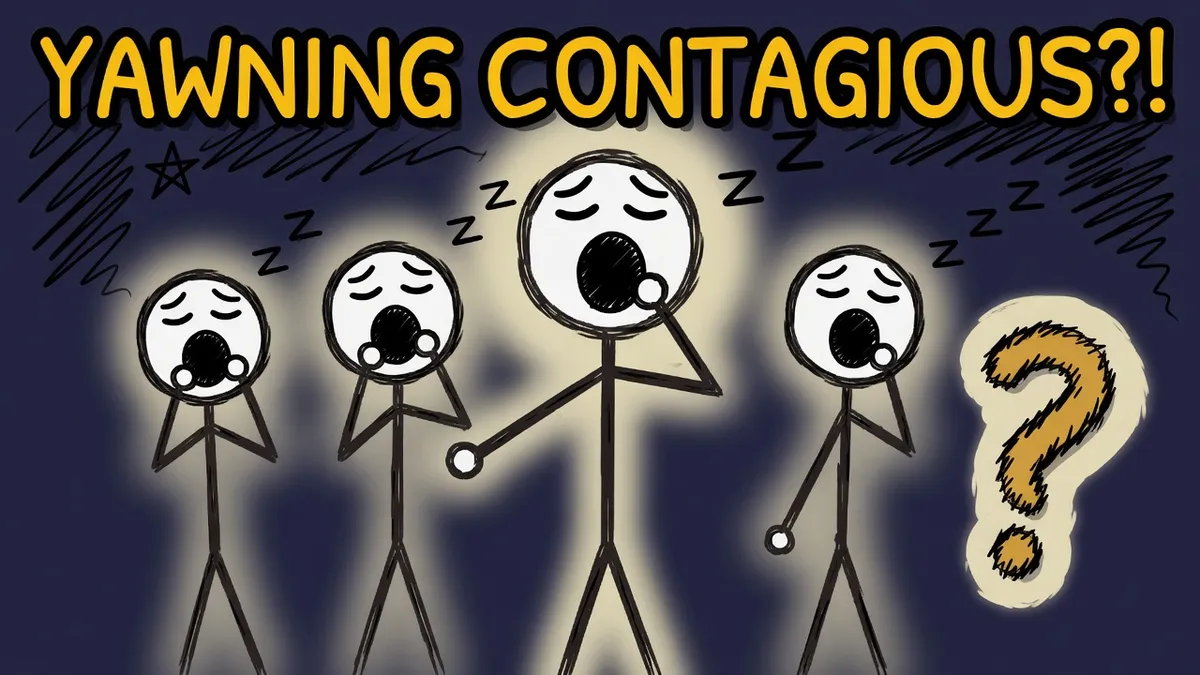
Here is something faintly ridiculous about being human: someone across the room opens their mouth in a wide, involuntary yawn, and within a second or two, without deciding to, without even wanting to, your own jaw cracks open in reply. You could be wide awake. It doesn't matter. And fair warning: by the time you finish reading this, you will almost certainly have done it at least once. Reading the word is often enough. So what exactly is spreading, and why is it so absurdly hard to resist?
01 · The catchIt spreads through sight, sound, and even a single word
Start with how easily it jumps. Seeing a yawn does it. Hearing one does it: people born blind yawn more the moment they simply hear a recording of a yawn. Even the idea of yawning, arriving as a written word on a page, quietly starts working on you. Estimates of how many people are susceptible vary a fair bit by study, but it’s a large slice of us, commonly put somewhere around half to two-thirds of adults. It is one of the most reliably contagious things the human body does. And here’s the first clue that something odd is going on: none of this has much to do with being tired.
02 · The bigger mysteryWhy we yawn at all, and it isn't for oxygen
Before the catching part, the deeper question: why do we yawn in the first place? The old schoolyard answer, that a yawn tops up your oxygen, was actually tested, and it flatly failed. In a classic experiment, breathing pure oxygen, or air loaded with extra carbon dioxide, made no difference to how much people yawned. A yawn simply isn’t a breathing trick.
The leading idea now is stranger and rather elegant: a yawn cools your brain. That huge stretch of the jaw and deep pull of cool air work a bit like a radiator, helping draw heat away from an overheating head. It fits the pattern of when we yawn, drifting toward sleep, bored, stressed, all moments when the brain runs warm and could use a reset. It even survives some pointed tests: cooling your forehead, or just breathing through your nose instead of your mouth, makes contagious yawning almost vanish. It’s the leading theory rather than a closed case, but it’s the one that keeps passing.
03 · The copierYour brain reflexively runs the same action
So why would you catch someone else’s yawn? Because your brain is a relentless copier. Watch another person yawn and a set of mirroring systems in your own head quietly runs the very same action, the same machinery that makes you wince when someone stubs their toe, or smile back at a stranger’s smile. You don’t choose it. Brain scans of contagious yawning light up the regions we use to understand other people, not the ones that deal with being sleepy. That’s the crucial twist: catching a yawn isn’t really about sleep at all. It’s about other minds.
The thing you can't hold back isn't a sign of tiredness: it's your brain automatically syncing itself to the people around you. Which is why the people you're closest to are the ones whose yawns you catch the fastest.
04 · The tellThe closer you are, the more you catch
And here’s the lovely giveaway. The strength of the effect tracks how close you are to the person. You catch yawns from family more than from friends, and from friends more than from total strangers. Children barely catch them at all until around four or five years old, precisely the age they develop theory of mind, the understanding that other people have their own thoughts and feelings. The more tuned in to others you are, the more catchable you tend to be.
Now, one honest caveat. It’s tempting to conclude that catching yawns simply measures how empathetic you are, and there is a real link, but scientists genuinely argue about how tight it is. At least one large study found that individual susceptibility is remarkably stable from person to person yet not well explained by empathy scores or the other usual suspects. So the fair statement is: your yawn is quietly a social signal, wired into how you read other people, even if the exact empathy equation isn’t settled.
05 · The company we keepDogs, chimps, and even budgies do it too
And it isn’t only us. Chimpanzees catch each other’s yawns. So do bonobos, some monkeys, and, remarkably, budgerigars, little parrots, the only bird species so far shown to do it. Dogs manage the trick across the species line: your dog can catch a yawn straight from you, and does it more readily from a familiar person than a stranger, the same closeness effect we see in ourselves. When a reflex turns up this widely across social animals, that’s a strong hint it’s ancient, and that it’s actually for something.
06 · The deep rootsYou were yawning before you were born
Here’s how deep this reflex runs. Long before you could catch a yawn off anyone, you were already doing it solo: fetuses yawn in the womb, distinctly enough that researchers can tell a genuine yawn from an ordinary mouth-opening on a 4D ultrasound scan, months before birth. That early yawning is nobody’s copy: it’s built in. And there’s a tidy clue that the cooling story reaches across the animal kingdom too: yawn length tracks brain size. Measure it across mammals and the bigger the brain, the more there is to cool, the longer the yawn tends to run, with humans, at around six seconds, near the top of the list. A caught yawn is social. But the yawn itself is one of the oldest, most hardwired things a body does.
07 · The payoffSo why is yawning contagious?
Put it together and the answer stops being about sleepiness at all. A yawn, on its own, is most likely your brain shedding a little heat. But a caught yawn is something more social: your brain reflexively copying another mind, using the very circuitry you rely on to understand other people. The best guess for why that copying evolved is synchronisation: a yawn rippling through a group may keep everyone’s alertness roughly in step, no leader required. One drowsy animal yawns, the yawn rolls down the line, and the whole group ticks back toward the same state.
So the yawn you can’t hold back isn’t laziness, and it isn’t really about being tired. It’s a reflex tens of millions of years old, quietly keeping you in sync with the people, and the creatures, around you. Whether you like it or not. And yes: you did, didn’t you.
The animated version
Same answer, told as a little animated story with the strange little stickman acting it out. Dry, quick, and, obviously, correct.
Quick questions
Why is yawning contagious?
Because your brain automatically imitates other people. Seeing, or even just hearing, a yawn activates the same systems you use to understand others, and quietly runs the same action in you. It spreads most easily between people who are emotionally close, which is why it looks more like a social reflex than a sign of tiredness.
Why do we yawn at all if it's not for oxygen?
The oxygen idea was directly tested and failed: breathing extra oxygen or carbon dioxide doesn't change how much people yawn. The leading explanation now is brain cooling: a big yawn pulls in cool air and boosts blood flow, helping shed heat from an overheating head. It fits why we yawn when drowsy, bored or stressed, and why people yawn more in cool conditions than in hot ones.
Why do you yawn when you're not tired?
Because tiredness was never really the trigger. Paratroopers have been seen yawning before their first jump, musicians before walking on stage, athletes before an event, moments of stress and high alert, not sleepiness. The brain-cooling idea fits neatly: stress and anticipation warm the brain up, and a yawn helps cool it back toward its ideal working temperature. So a yawn is less 'I'm sleepy' and more 'my brain is resetting itself.'
Why does yawning feel so good?
A yawn is a big, satisfying stretch of the jaw, and it often arrives bundled with a full-body stretch, a combo called pandiculation. Stretching a stiff, under-used muscle and then releasing it eases built-up tension and appears to re-set the nerves controlling it, and the brain tends to reward useful bodily housekeeping with a pulse of relief. So the good feeling is real, even if the exact mechanism isn't fully pinned down: it's your body doing maintenance it's wired to enjoy.
Why do you stretch when you yawn?
Because they're two halves of one reflex, pandiculation, the involuntary yawn-and-stretch you do most often on waking. It seems to be run by deep, ancient parts of the brain, and its job appears to be re-priming muscles and nerves after a stretch of stillness. Cats, dogs and even fetuses do it. You don't decide to; it just happens as your body shifts gears between rest and action.
Can you stop yourself from catching a yawn?
Somewhat, and the trick isn't willpower: it's temperature. In studies, breathing through your nose instead of your mouth, or pressing something cool to your forehead, sharply cut contagious yawning (one experiment dropped it from around 41% with a warm pack to 9% with a cold one). Both cool the blood heading to your brain, which removes the reason to yawn in the first place. Clamping your jaw shut just delays it; cooling actually calls it off.
Does yawning actually wake you up?
A little, maybe, though it's not the whole story. Your heart rate briefly climbs at the peak of a yawn, and the deep breath and jaw-stretch may give a small nudge of alertness, which suits those pre-event yawns. But we also yawn most as we're drifting off to sleep, so a yawn plainly isn't a pure wake-up button. The honest read is that it's more of a reset toward whatever alertness the moment calls for than a simple shot of energy.
How long does a yawn last, and do babies yawn in the womb?
A typical human yawn runs about four to seven seconds, and, curiously, bigger-brained animals yawn for longer, which fits the brain-cooling idea: more brain to cool, longer the yawn. As for babies, yes, fetuses yawn in the womb, clearly visible on 4D ultrasound well before birth. That early solo yawning has nothing to do with catching one off anyone; the contagious version only switches on around age four or five.
Does catching yawns mean you're more empathetic?
It's linked, but the link is genuinely debated. Contagious yawning uses brain systems tied to understanding others, and it's stronger between close relationships, but at least one large study found individual susceptibility is very stable and not well explained by empathy scores. So: related, not settled.
Can dogs catch yawns from humans?
Yes. Dogs have been shown to catch yawns from people, and they do it more readily from a familiar person than a stranger. Chimpanzees, bonobos, some monkeys, and even budgerigars, little parrots, catch yawns too, which suggests the reflex is ancient and social.
Is excessive yawning a sign of something serious?
Usually not: the common culprits are plain tiredness, poor sleep, or certain medicines (SSRI antidepressants are a known cause). But a sudden, relentless spike in yawning can occasionally be the body reacting to something else, because yawning is tied to the vagus nerve, which also helps regulate the heart. Rarely, heavy unexplained yawning has accompanied heart or neurological problems. The rule of thumb: yawning on its own is harmless; yawning that's new, excessive and paired with chest pain, breathlessness or sudden weakness is worth getting checked promptly.
Why can reading the word 'yawn' make you yawn?
Contagious yawning doesn't need the sight of a yawn: the sound of one works, and even thinking or reading about yawning can set it off. People born blind yawn more after simply hearing a yawn. It's the idea of yawning, routed through your brain's copying machinery, that pulls the trigger.
Take the quiz on this
A quick 4-question check on what you just read. Get them right to earn XP: no points for just scrolling.
Our sources 14 checked
// every claim on this page was checked before it went up