Here is a genuinely strange fact about your own body: three completely unrelated situations, stepping into a cold shower, hearing footsteps behind you in the dark, and the key change in a song you love, all produce the identical physical response. A wave of tiny bumps, every hair on end. Your skin does the same thing whether you're freezing, terrified, or moved to tears. That's a big clue that something old and automatic is running underneath.
01 · The triggerOne reflex, three very different buttons
The common thread is a chemical: adrenaline. All three triggers, cold, fear, and strong emotion, flip your body into its sympathetic state, the “fight, flight, or freeze” setting. That release of adrenaline is what reaches your skin and pulls the trigger. So goosebumps aren’t really about temperature or fear specifically. They’re about arousal, in the old physiological sense: your nervous system going on alert, for whatever reason.
02 · The mechanismThe tiny muscle behind every hair
Attached to the base of each of your roughly five million hairs is a microscopic muscle called the arrector pili. Most of the time it does nothing. But when that adrenaline signal arrives, it contracts, and because of the angle it’s attached at, contracting doesn’t just tense the hair, it levers it from lying flat to standing bolt upright. As it does, it tugs the surrounding skin down into a little pit, pushing a bump up around the follicle. Millions of those at once, and you’ve got a field of gooseflesh. The medical name, pleasingly, is cutis anserina, literally “goose skin.”
03 · The evolutionYou're fluffing up a coat you no longer own
In a furry animal, this is genuinely useful. Raise every hair at once and you trap a thick layer of air against the skin, instant insulation, like fluffing a duvet. That’s why a cold cat looks bigger. And it works as a threat display too: a frightened cat, its fur standing on end, really does double in size to a rival. Bigger looks scarier, and scarier buys you a moment.
Which is the slightly absurd part. Your body is still doing all of this, running the full fluff-up-the-fur routine, on skin that lost its fur somewhere on the order of a million-plus years ago. You get the muscle contraction, the hairs standing up, the works. You just don’t have the coat for any of it to matter. It’s a reflex that outlived its own point: a party trick your ancestors needed and you inherited anyway.
For most of a century we called goosebumps "vestigial", a useless leftover. Then, in 2020, a Harvard lab looked closer, and found the muscle had quietly kept a day job the whole time.
04 · The chillsWhy a song gives you goosebumps
This is the one that feels like magic, because there’s no cold and no danger, just sound. The technical name is frisson, or “aesthetic chills,” and it tends to strike at a very specific kind of moment: when music does something your brain didn’t quite predict. A sudden swell, an unexpected harmony, a voice cracking on the perfect note. Your brain flags it as a big deal and fires the same old adrenaline pathway, and up go the hairs.
But there’s a reward twist. Brain-imaging work has shown that these peak musical moments come with a genuine release of dopamine, the same feel-good chemical tied to food and other pleasures. So the chills aren’t just a physical echo, they’re stapled to a little jolt of joy. Not everyone gets them, mind you. Estimates vary, somewhere between about half and two-thirds of people, depending on the study, and it seems linked to how strongly the emotional and listening parts of your brain are wired together, and to how open to experience you are as a person.
05 · The 2020 twistNot so useless after all
Here’s the redemption arc. In 2020, researchers at Harvard traced exactly what the arrector pili muscle is connected to, and found something nobody expected. That little muscle is the bridge between a sympathetic nerve and the pool of stem cells that regrow your hair. The muscle holds the nerve in place against the follicle; the nerve, in turn, keeps those stem cells primed. In the cold, the nerve doesn’t just fire a quick “stand up” pulse, it ramps up a sustained signal that nudges the stem cells into action, driving new hair growth over the longer term.
So the goosebump muscle turns out to be doing two jobs at once. The flashy one, the instant hair-raise, is the fossil we’ve been laughing at. But the quiet one, keeping the hair-growing machinery alive and ready, is very much still on the payroll. The “useless” muscle was never useless. It just kept its real job off the CV.
06 · The rare fewThe people who raise them at will
Here’s a wrinkle almost nobody expects. Goosebumps are supposed to be pure reflex, automatic, outside your control, the whole point of the word. And yet a small number of people can summon a wave of them on command, no cold and no emotion required. In 2018 a team led by James Heathers studied thirty-two of them: people with voluntary piloerection, who could raise gooseflesh in about a second flat, usually by tensing some hard-to-describe muscle around the head, neck or ears, the way a few people can wiggle theirs. It’s thought to be rare, on the order of one in a thousand-odd. And here’s the tidy part: every single one of them scored unusually high on openness to experience, the very trait that predicts getting the chills from music. Nobody yet knows quite how they do it.
07 · The payoffSo what is a goosebump, really?
It’s a fossil reflex that mostly does nothing you can see, wired to a muscle that quietly does something you can’t. It’s your body reaching for a coat that isn’t there, when you’re cold, when you’re scared, and, strangest of all, when something is simply beautiful. The next time a song lifts every hair on your arms, that’s a survival routine older than our species, misfiring in the loveliest possible way, over four minutes of pop music.
Give yourself the chills
Press it. The arm up top will do its thing, and we'll hand you a frisson fact.
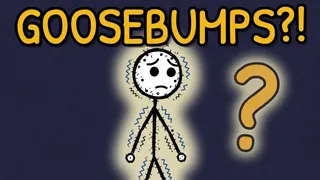
The animated version
Same answer, told as a little animated story with the strange little stickman acting it out. Dry, quick, and, obviously, correct.
Quick questions
Why do I get goosebumps when I'm not cold?
Because goosebumps aren't really triggered by cold, they're triggered by adrenaline. Fear, stress, and strong emotion all flip your body into its fight-or-flight state and release the same chemical, which pulls the same trigger. Temperature is just one of several ways to get there.
Why does music give me goosebumps?
It's a response called frisson. When music does something your brain didn't fully predict, a big swell, a surprising harmony, it flags the moment as significant and fires the adrenaline pathway. Brain scans show these peak moments also release dopamine, so the chills come bundled with a genuine hit of pleasure.
Are goosebumps useless in humans?
The visible part, hairs standing up, does very little now that we've lost our fur. But the muscle that causes it isn't useless: a 2020 Harvard study found it links a nerve to the stem cells that regrow hair, helping keep them active, especially in the cold. So the reflex is a leftover, but the hardware still has a job.
Why do animals puff up when they're scared?
Same reflex, called piloerection. Raising all their fur at once traps warm air and makes them look bigger, a frightened cat can appear to nearly double in size. Bigger reads as more dangerous, which can be enough to make a threat back off.
What's the medical name for goosebumps?
Cutis anserina, literally "goose skin." The reflex itself is called piloerection, and the tiny muscle responsible for each hair is the arrector pili.
Why do I get goosebumps when I pee?
That's the "pee shivers", sometimes called post-micturition convulsion syndrome, and honestly, it's barely been studied, so there's no settled answer. The two leading guesses: a quick drop in temperature as you expose warm skin to cooler air, and a nervous-system hiccup where emptying your bladder sets off a small surge of the same fight-or-flight chemicals that raise goosebumps. Both are plausible, neither is proven. It's harmless and genuinely unexplained.
Can you give yourself goosebumps on purpose?
A few people can. A 2018 study documented 32 people with voluntary piloerection, the knack of raising their goosebumps at will, no cold or emotion needed, usually by tensing something around the head, neck or ears. It's thought to be rare (one rough estimate is around 1 in 1,500), and every person who could do it scored unusually high on openness to experience, the same trait tied to getting the chills from music.
Can goosebumps be a sign of something medically wrong?
Almost always they're harmless. But goosebumps that keep appearing for no clear reason can point to something else, commonly keratosis pilaris (permanently bumpy skin from blocked follicles, harmless but persistent), or anxiety, or substance withdrawal. Very rarely they show up in temporal-lobe epilepsy, or, after a spinal-cord injury, in autonomic dysreflexia, which is a medical emergency. If yours won't go away, or come with other symptoms, get them checked.
Why do fingernails on a chalkboard give you goosebumps?
The unbearable part seems to be the sound itself. A 2006 study found the worst frequencies in that screech sit close to those of a primate distress or warning call, so one idea is that your brain treats it as an ancient alarm and fires the fight-or-flight response, hair and all. It's a plausible explanation rather than a proven one, but a satisfying reason your body recoils at a noise that can't actually hurt you.
Why do some people get goosebumps from music when others never do?
It comes down to brain wiring and personality. Reliable frisson is linked to the trait openness to experience, and to how richly the brain's hearing and emotion regions are connected, a 2016 study found people who get the chills have denser white-matter links between those areas. If music never raises your hair, nothing's wrong with you; your brain just routes the same song differently.
Why do you get goosebumps when you have a fever or the chills?
When you're fighting an infection, your brain nudges up your internal "set point," so your normal body temperature suddenly reads as too cold. Your body reacts exactly as it would to real cold, shivering to make heat and raising goosebumps to trap it, which is that clammy, bristling feeling of the chills. The bumps are your thermostat trying to haul you up to its new, higher target.
What is frisson?
The technical name for those chills and goosebumps from music, film or speech. When something emotional and slightly unexpected hits, the brain's reward and arousal systems fire together, dopamine included, and the same piloerection pathway that cold and fear use kicks in.
Do other animals get goosebumps for the same reasons we do?
They get piloerection for cold and threat, which fluffs fur for warmth and makes the body look bigger. What is less clear is whether non-human animals get music-like frisson; the shared core is the sympathetic hair-raising reflex, not necessarily the aesthetic chills.
Take the quiz on this
A quick 4-question check on what you just read. Get them right to earn XP: no points for just scrolling.
Our sources 12 checked
// every claim on this page was checked before it went up