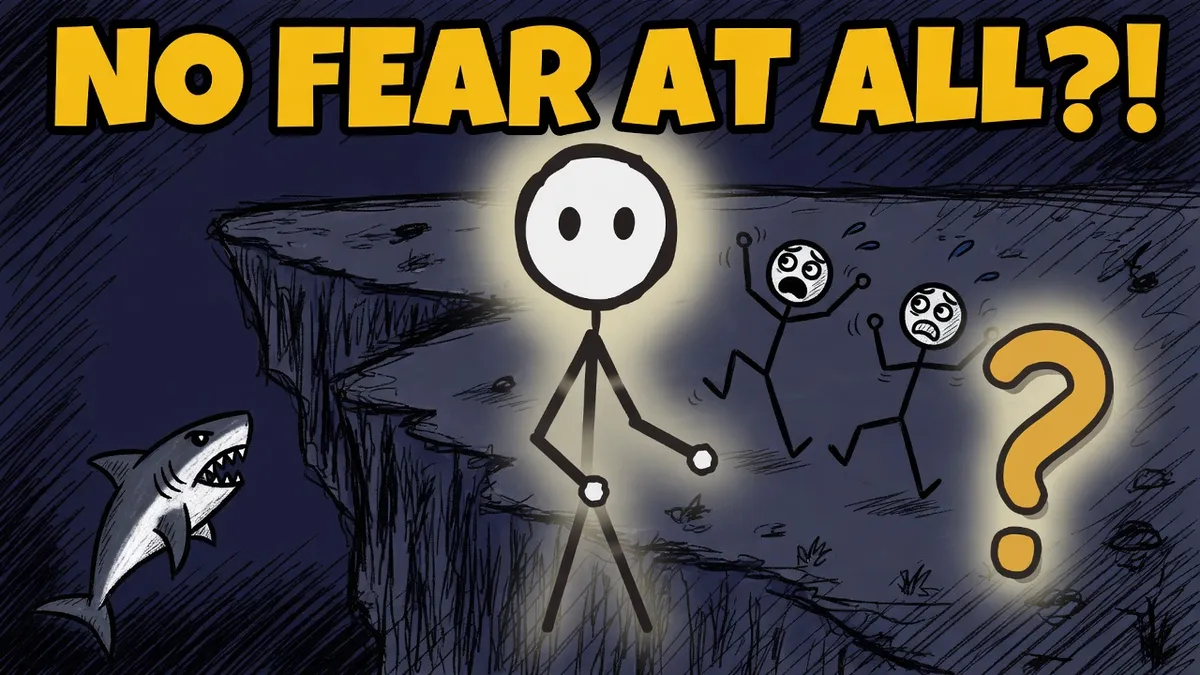
There is a woman, known to science only by her initials, who cannot be frightened. Not by snakes draped over her hands, not by a haunted house full of chainsaws and actors in masks, not by the horror films that make the rest of us flinch. Researchers spent years actively trying to scare her and failed every time. She is one of the most important people in the study of fear, precisely because she seemed to have none. And then, one afternoon, they gave her a single breath of gas, and she panicked harder than most people ever will.
01 · The woman without fearSnakes, spiders, and a haunted house
Her initials are S.M., and a rare disease called Urbach-Wiethe destroyed a specific pair of structures deep in her brain, on both sides, while leaving nearly everything else intact. In 2011, a team including Ralph Adolphs, Antonio Damasio and Daniel Tranel set out to do something unusual: to deliberately frighten her, under controlled conditions, to see if they could.
They took her to an exotic pet store. Faced with snakes and spiders, S.M. didn’t recoil, she asked to hold the most dangerous ones, and had to be stopped. They took her through the Waverly Hills Sanatorium, one of the “most haunted” attractions in America, where actors leap out of the dark. S.M. led the group, unbothered, and at one point startled a monster by poking it out of curiosity. They showed her clips from horror films. Across all of it, she reported excitement and interest, but never more than a trace of fear. In her own life, questionnaires and interviews suggested she simply hadn’t felt real fear in decades.
02 · The almond in your headWhat the amygdala actually does
The structure S.M. is missing is the amygdala, a pair of almond-shaped clusters buried in the temporal lobes on each side (the name is just Greek for “almond”). For years the popular shorthand called it “the fear centre,” as if fear were a light switch wired to one spot. That’s too tidy, and it turns out to be wrong.
The amygdala is better understood as a fast threat detector: it scans the outside world for things that might matter, especially danger, and triggers the body’s alarm before your slower, thinking brain has caught up. It’s involved in learning what to be afraid of, in reading fearful faces, even in how close you let a stranger stand. Fear is one of its jobs, not its entire identity. And that distinction, its job versus the feeling of fear, is the whole story here.
03 · The diseaseHow you lose an amygdala
S.M. didn’t choose this, and it isn’t bravery. Urbach-Wiethe disease (also called lipoid proteinosis) is a very rare inherited condition that lays down waxy deposits through the body. In somewhere between roughly half and three-quarters of diagnosed cases, it also causes symmetrical calcification in the medial temporal lobes, hardening and killing the tissue there. In S.M., that process wiped out the amygdala on both sides while sparing the surrounding brain. That precise, symmetrical, near-total loss is vanishingly rare, and it’s exactly what makes her a once-in-a-generation natural experiment.
04 · The cost of no fearWhy this is not a superpower
It is tempting to read S.M.’s story as enviable, a life without dread. It is the opposite. Fear is a guardrail, and hers is gone. By multiple accounts she has been threatened at knifepoint and held at gunpoint without the surge of panic that would make most people flee, has ended up in dangerous situations and relationships, and has been repeatedly victimised. The alarm that quietly tells the rest of us “leave now, this is wrong” simply doesn’t fire for her.
There are quieter costs too. She stands too close. In a measured experiment, her preferred personal-space distance was about a third of a metre, roughly half of what comparison subjects wanted, and she reported no discomfort even nose to nose. And she struggles to read fear on other faces, which turns out to have a beautifully specific cause: in a 2005 study, researchers found she simply doesn’t look at people’s eyes, and the eyes are where fear shows. When they told her, explicitly, to look at the eyes, her ability to recognise fear snapped back to normal. The information was always there. Her gaze just never went to it.
05 · One breath changes everythingThe experiment that broke the story open
For years the conclusion seemed clean: no amygdala, no fear. Then, in 2013, Justin Feinstein and colleagues tried something different. Instead of a threat in the room, a snake, a monster, a knife, they created a threat inside the body. They had S.M. inhale air containing 35% carbon dioxide, far more than the ordinary trace we breathe. A lungful of that feels, to the brain, like suffocation.
S.M. began gasping, clawed at the mask, and cried out that she couldn’t breathe. She had a full-blown panic attack, the first fear of her adult life. And she wasn’t alone: two other patients with bilateral amygdala damage did the same. None of the three had ever had a panic attack before. The woman who couldn’t be scared by anything in the outside world was, at last, terrified, by something coming from within.
The fearless woman proved that fear does not live in one place. Her destroyed amygdala meant nothing in the outside world could scare her. But an alarm from inside her own body reached terror by a completely different road.
06 · Two roads to terrorOutside threats and inside threats
Here’s the interpretation that makes sense of both results. The amygdala is the brain’s watchtower for the external world: predators, weapons, angry faces, the dark. Destroy it, and those threats stop registering as frightening. That’s S.M. with the snakes.
But suffocation is not an outside threat, it’s an internal one. Your body monitors rising carbon dioxide and falling pH directly, through chemoreceptors, including acid-sensing sensors in the brainstem, and when they scream “you’re not breathing,” that signal can drive fear and panic without ever passing through the amygdala. Two separate alarm systems, watching two different kinds of danger. S.M. lost one and kept the other completely intact. So the honest answer to “where does fear live?” is: not in a single structure. Fear is something the brain can build by more than one route.
07 · What it means for the rest of usPanic, anxiety, and a careful hope
There’s a genuinely surprising wrinkle here, and it’s worth stating carefully. The amygdala-damaged patients didn’t just panic to CO2, they panicked more readily than most healthy people do. That hints, tentatively, that an intact amygdala might normally help hold internal panic in check, rather than cause it. If that holds up, it could reshape how we think about panic disorder, where the body’s suffocation alarm seems to misfire, and about the bodily side of anxiety and PTSD.
But this is where the brand honesty matters most: this is an early finding built on a tiny number of extraordinarily rare patients. It’s a compelling lead, not a treatment and not a settled mechanism. What is solid is the deeper lesson S.M. taught us, almost by accident. For decades we pointed at one almond-shaped spot and called it fear. A woman who lost that spot, and then, one afternoon, felt fear anyway, showed us we were pointing at the wrong thing. Fear was never in the almond. It was in the whole alarmed body, and there is more than one way to set it off.
The animated version
Same answer, told as a little animated story with the strange little stickman acting it out. Dry, quick, and, obviously, correct.
Quick questions
Is it possible to feel no fear at all?
Near enough, yes, but it is caused by brain damage, not willpower. The clearest documented case is patient S.M., a woman whose amygdala on both sides was destroyed by a rare disease. Across years of testing she showed and reported essentially no fear of the external threats that reliably scare other people. Importantly, it made her less safe, not more heroic.
What is the amygdala and what does it actually do?
It's a pair of almond-shaped clusters deep in the temporal lobes (the name comes from the Greek for almond). The old shorthand called it 'the fear centre', but that's too simple. It works more like a rapid threat and salience detector: it flags things in the environment that might matter, especially danger, and kicks off the body's alarm response. Fear is one of its jobs, not its whole identity.
Who is patient S.M.?
S.M. is the initials of a woman studied for decades by neuroscientists including Ralph Adolphs, Antonio Damasio and Daniel Tranel. A rare genetic condition, Urbach-Wiethe disease, calcified and destroyed her amygdala on both sides while leaving the rest of her brain largely intact. That makes her a rare natural experiment in what the amygdala does. Her identity is kept private.
What is Urbach-Wiethe disease?
It's a very rare inherited disorder (also called lipoid proteinosis) that causes waxy deposits in skin and mucous membranes. In roughly half to three-quarters of diagnosed cases it also produces symmetrical calcification in the medial temporal lobes, which can damage the amygdala on both sides. In S.M.'s case that damage was near-complete, which is what makes her so scientifically valuable and so rare.
How did they try to scare her?
In the 2011 study, researchers exposed S.M. to live snakes and spiders in an exotic pet store (she wanted to touch the more dangerous ones), took her through the Waverly Hills Sanatorium haunted attraction, where she led the group and startled the actors rather than the other way round, and showed her clips from horror films. She reported curiosity and excitement, but not fear.
If she feels no fear, isn't that a superpower?
No, and this is the honest part. Fear is protective. S.M. has been threatened at knifepoint and held at gunpoint, has been in dangerous relationships, and by several accounts has been repeatedly victimised, in part because the internal alarm that tells most people 'leave now' doesn't fire. Losing fear doesn't make you brave, it removes a guardrail.
Why can't she recognise fear on other people's faces?
Because of where she looks. Adolphs and colleagues showed in 2005 that S.M. fails to fixate on the eyes when viewing faces, and the eyes are where a fearful expression is most readable. When researchers explicitly instructed her to look at the eyes, her recognition of fear became essentially normal. So the deficit was about where her gaze went, not an inability to process the information.
Does she stand too close to people?
Yes, and it was measured. In a stop-distance experiment, S.M.'s preferred personal-space distance was about 0.34 metres (roughly a foot), around half the roughly 0.64 metres preferred by comparison subjects, and she reported no discomfort even nose-to-nose. The amygdala appears to help set the sense of personal space, so without it that boundary largely disappears.
So what actually made her feel fear?
Carbon dioxide. In a 2013 study, S.M. and two other patients with bilateral amygdala damage inhaled air containing 35% CO2. All three had a full-blown fear response, and panic attacks, something none of them had experienced before. The rising CO2 signals suffocation, an internal bodily threat, and that triggered terror by a route that doesn't need the amygdala.
Why did CO2 work when snakes didn't?
The leading interpretation is that the amygdala's job is detecting threat in the outside world: predators, weapons, scary faces. Suffocation is an inside threat. The body senses rising CO2 and falling pH through chemoreceptors, including acid-sensing pathways in the brainstem, and that internal alarm can drive fear and panic without going through the amygdala at all.
Does this mean the amygdala isn't the 'fear centre' after all?
That's the big takeaway. The 2013 result shows the amygdala is not required for the feeling of fear or panic; it's better described as one crucial system for detecting and reacting to external danger. Fear can be generated by more than one pathway in the brain, so it doesn't live in a single spot.
What does this mean for panic disorder and anxiety?
It's suggestive, and researchers are careful here. Strikingly, the amygdala-damaged patients panicked more readily to CO2 than most healthy people do, which hints that an intact amygdala might normally help inhibit internal-alarm panic rather than cause it. That could matter for understanding conditions like panic disorder, but it is an early finding from very few patients, so treat it as a promising lead, not a settled mechanism.
Could this help people with PTSD?
Possibly, indirectly. S.M.'s case shows the amygdala is central to learning and reacting to external fear, and PTSD involves an overactive threat response to reminders of trauma. Understanding the separate internal-alarm pathway may help explain why some panic and trauma symptoms are so bodily. But no treatment follows directly from these studies yet, so any clinical claim should be hedged.
Are there other people like S.M.?
Extremely few with damage this complete and this selective. The 2013 CO2 study included two additional patients (referred to as A.M. and B.G.) with bilateral amygdala damage, which is partly why the result carried weight. But cases of near-total, isolated bilateral amygdala loss are rare worldwide, which is exactly why S.M. has been studied so intensively.
Take the quiz on this
A quick 4-question check on what you just read. Get them right to earn XP: no points for just scrolling.
Our sources 10 checked
// every claim on this page was checked before it went up