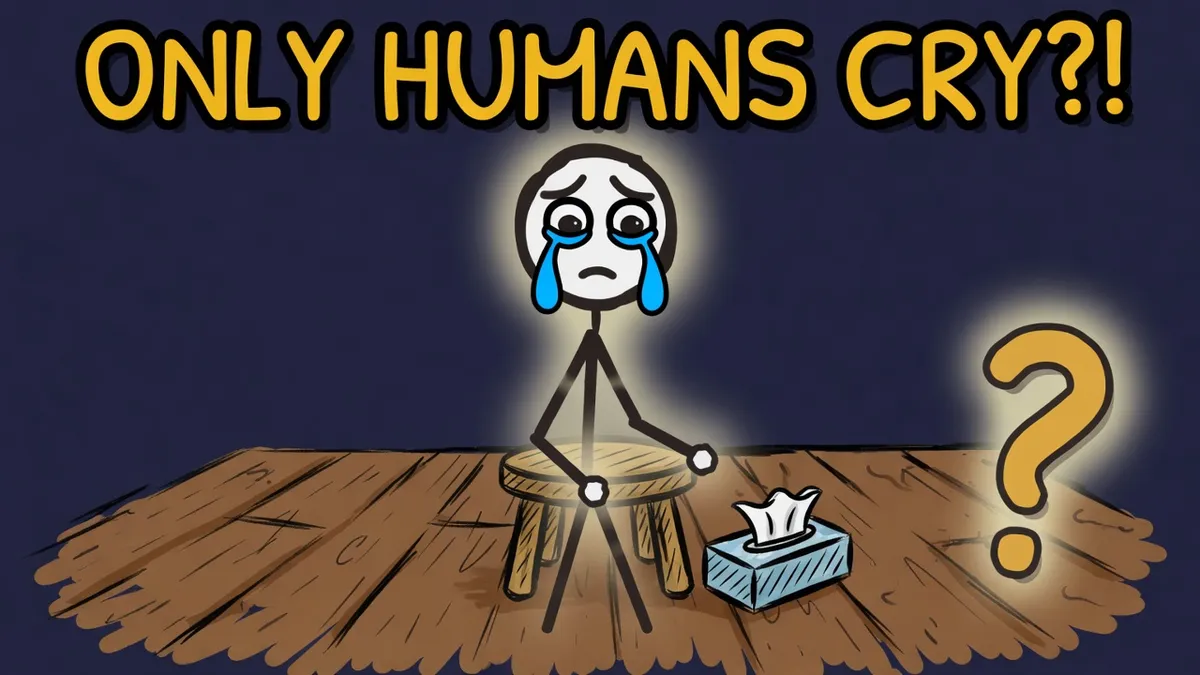
Here is a genuinely strange fact about you: as far as anyone can tell, you are the only animal on Earth that cries because it's sad, and after centuries of looking, nobody can fully explain why. Think about the two ways your eyes water. You stub your toe, and they water. You watch a film about a dog, and they water. It's the same salty little drop both times, for two completely different reasons, and one of those reasons might belong to human beings alone.
01 · The three tearsYou don't make one kind of tear, you make three
Start with the plumbing, because it’s stranger than it looks. You produce three different kinds of tear. There are basal tears, the thin film that’s always there, quietly keeping your eyes alive. There are reflex tears, the ones that come flooding in to flush out onion fumes or grit. And then there are emotional tears, the odd ones out, and the whole reason we’re here.
That constant film is doing far more than keeping things wet. Back in 1922, years before he ever stumbled onto penicillin, Alexander Fleming discovered that tears are laced with an enzyme called lysozyme, something that literally punches holes in bacteria. Which means every time you blink, you are, in a small way, disinfecting your own eyes.
02 · The chemistryAn emotional tear is a different liquid entirely
Reflex tears are basically an emergency wash. Slice an onion and it releases a tiny cloud of irritant gas; the surface of your eye reads it as an attack and hits the sprinklers. There’s no feeling in it at all, it’s pure defence, and it’s mostly just water.
Emotional tears are something else. They aren’t sadness leaking out of your face; they’re chemically a different liquid. In the 1980s, a biochemist named William Frey found that emotional tears carry far more protein than reflex tears, along with stress hormones like ACTH and prolactin, and even leucine-enkephalin, a natural painkiller your own brain makes. A reflex tear is a splash of water. An emotional tear has an actual recipe.
03 · The detox mythA good cry does not flush out the stress
Which brings us to the idea you have definitely heard: that a good cry drains all the stress out of you, like pulling the plug on a bath. It’s a lovely theory. It’s on a thousand inspirational posters. It has just never actually held up.
When researchers show people a sad film in a lab, the ones who cry feel worse straight afterward, not better. Their mood only climbs back above where it started around ninety minutes later, and mostly when someone around them responds with a little comfort. So the relief was never your body draining out toxins. It was other people all along. And that turns out to be the first real clue to what tears are actually for.
04 · The only weeperEmotional crying appears to be ours alone
Because emotional crying really does seem to be uniquely human. Plenty of animals make reflex tears: a crocodile’s eyes water while it eats, which is exactly where the phrase “crocodile tears” comes from. But weeping, actual tears triggered by how you feel, appears to belong to us. (I’ll hedge that “appears”, proving a total absence in every species is hard, but it’s the current consensus.) Which makes the real question almost absurd: why would evolution ever build such a thing?
Look at what a tear actually does to you in the moment: it blurs your vision. For a few seconds you genuinely can't see straight, which means you can't fight, and you can't run. One evolutionary psychologist argues that this isn't a flaw. It's the entire point.
05 · The white flagAn honest signal you can't fake
This is the leading theory, from the evolutionary psychologist Oren Hasson: a tear is an honest signal. You can fake a smile easily enough. But deliberately blurring your own vision, right in front of another person, is very hard to fake: it costs you something, which is exactly what makes it believable. And without a single word, it broadcasts: I’m not a threat. I’m not going to fight you. I need you.
And on the people around you, it works. In economic-game experiments, a crying face makes others rate the crier as warmer and more trustworthy, and measurably more willing to hand over money or help. The most vulnerable thing your body can do turns out to be one of the most persuasive.
It might even run deeper than anything they can see. In a 2011 study, men sniffed women’s emotional tears (completely odorless, they couldn’t detect a thing), and their measurable arousal and testosterone dropped anyway. That result is genuinely contested: one later team failed to reproduce it, while others confirmed effects on testosterone and aggression. So treat it as a tantalizing maybe, not a settled fact, but the maybe is that your tears carry a chemical message you don’t even know you’re sending.
06 · The payoffSo why do we cry?
Crying almost certainly isn’t a malfunction, and it almost certainly isn’t your body flushing out stress. It looks far more like a social tool hiding in plain sight, the single most vulnerable thing you can do, turned into one of the strongest bonds you have. The parts we can be confident about (three tears, distinct chemistry, the debunked detox myth, the trust effect) are solid; the grand why (the honest-signal theory) is still the leading idea rather than proven law.
So the next time an advert about a dog quietly ambushes you on the sofa and your eyes betray you completely, don’t worry, you’re not broken. You’re doing something no other animal appears to do: broadcasting, loudly, that you are the kind of creature that needs the others. And maybe that’s the simplest answer of all. We might be the only animal that weeps because we’re the animal that needs each other the most.

The animated version
Same answer, told as a little animated story with the strange little stickman acting it out. Dry, quick, and, obviously, correct.
Quick questions
Why do we cry when we're sad?
Nobody can fully explain it, but the leading idea is that emotional tears are a signal rather than a release. A tear briefly blurs your vision: you can't fight or run, which is a hard-to-fake way of showing you're not a threat and you need support. Crying reliably makes other people rate you as warmer and more trustworthy, and more likely to actually help.
Is crying good for you? Does it release toxins?
The "detox" idea is a myth. In lab studies, people who cry at a sad film feel worse immediately afterward, not better. Their mood only climbs above where it started around 90 minutes later, and mainly when someone responds with comfort. The relief seems to come from other people, not from your body draining anything out.
Are humans the only animals that cry?
Lots of animals make reflex tears: a crocodile's eyes water as it eats, which is where "crocodile tears" comes from. But emotional weeping, tears triggered by how you feel, appears to be uniquely human. That's the strange part science is still trying to explain.
Why do emotional tears feel different from crying over onions?
Because they're chemically different liquids. In the 1980s, biochemist William Frey found emotional tears carry far more protein than reflex tears, plus stress hormones like ACTH and prolactin and a natural painkiller called leucine-enkephalin. A reflex tear is mostly water; an emotional tear has an actual recipe.
Why do women cry more than men?
On average they do. Frey's counts put women at about five times a month and men at just over once. But boys and girls cry at nearly the same rate until puberty. Then testosterone (which appears to suppress crying) and prolactin (which appears to promote it) pull the averages apart. It's partly hormones, not just how much you feel.
Why do we cry when we're happy?
Tears of joy look like a glitch, a negative-seeming reaction to a wonderful moment, but psychologist Oriana Aragón calls it a dimorphous expression, and the leading idea is that it's your brain steadying itself. Hit by an overwhelming positive emotion (a wedding, a reunion, a very good dog), the body seems to answer with the opposite signal to bring you back down to earth. It's a leading theory rather than settled fact, but people who cry happy tears do appear to recover from emotional highs a little faster.
Why do I cry when I'm angry or frustrated?
Angry tears usually aren't really about the anger. They're about what's underneath it: feeling hurt, powerless, embarrassed or unfairly treated. Intense emotion fires up the brain's limbic stress system, and for a lot of people that overflow comes out as tears rather than shouting. It's a normal way of discharging emotional overload, not a sign you're weak, though the exact wiring is still partly inferred rather than nailed down.
Why can't I cry, even when I want to?
It's more common than you'd think, and it isn't one thing. Physically, dry-eye conditions or a tear-gland disorder can cut tear production. Emotionally, prolonged stress, trauma or depression can bring a kind of numbing that dams them up. And some medications. SSRI antidepressants especially, are known to blunt emotions, crying included. It's often reversible, so if it troubles you it's worth mentioning to a doctor.
Is it normal to cry a lot, and how often do people cry?
Broadly, yes. Frey's classic counts put women at around five cries a month and men at just over one, so a regular weepy moment is squarely normal. The thing worth watching is the pattern, not the number: crying most days, or crying you can't stop, or tears that come with a low mood you can't shift, can be a sign of depression that's worth talking to someone about.
Why does my nose run when I cry?
Your eyes and nose are plumbed together. Tears drain off the eye through tiny holes in the inner corners of your lids, down the nasolacrimal duct, and straight into your nose. Normally that's a trickle you never notice; a proper cry turns it into a flood that mixes with mucus and runs out your nostrils. The runny nose is just your tears taking the back exit.
Why do I get a headache after crying?
A hard cry scrunches the muscles of your face, scalp and neck, floods your sinuses as tears drain through them, and releases stress hormones like cortisol, a combination that can tip into a tension-type or sinus headache. It's harmless and usually eases with water, rest and a little time. If crying reliably triggers a severe, one-sided headache, that can be a migraine and is worth mentioning to a doctor.
Do newborn babies actually cry tears?
Not at first. Babies wail plenty from birth, but the tear glands aren't fully up and running yet, so those early cries are usually dry. Visible tears typically show up somewhere between about two weeks and three months old. If a baby still isn't making tears by around three months, or has constant watering, redness or discharge, that's one to get checked.
Do any animals cry emotional tears?
The honest answer is 'probably not, but watch this space.' The nearest finding is a 2022 study showing dogs' eyes well up with extra tears when they're reunited with their owners, driven by the bonding hormone oxytocin. That's a genuine, measurable tear bump tied to a warm moment, but it's a long way from proving a dog weeps the way we do. Emotional weeping still looks uniquely human; the dog result just makes the story a little less tidy.
Why do onions make you cry if there's no emotion involved?
Pure chemistry. Cutting an onion ruptures its cells, which mix enzymes and sulphur compounds to make a volatile irritant called syn-propanethial-S-oxide. It wafts up, hits the wet surface of your eye, and your cornea reads it as an attack, so it fires off reflex tears to wash it away. No feeling in it at all: it's the same emergency rinse you'd get from grit or smoke.
Take the quiz on this
A quick 4-question check on what you just read. Get them right to earn XP: no points for just scrolling.
Our sources 18 checked
// every claim on this page was checked before it went up