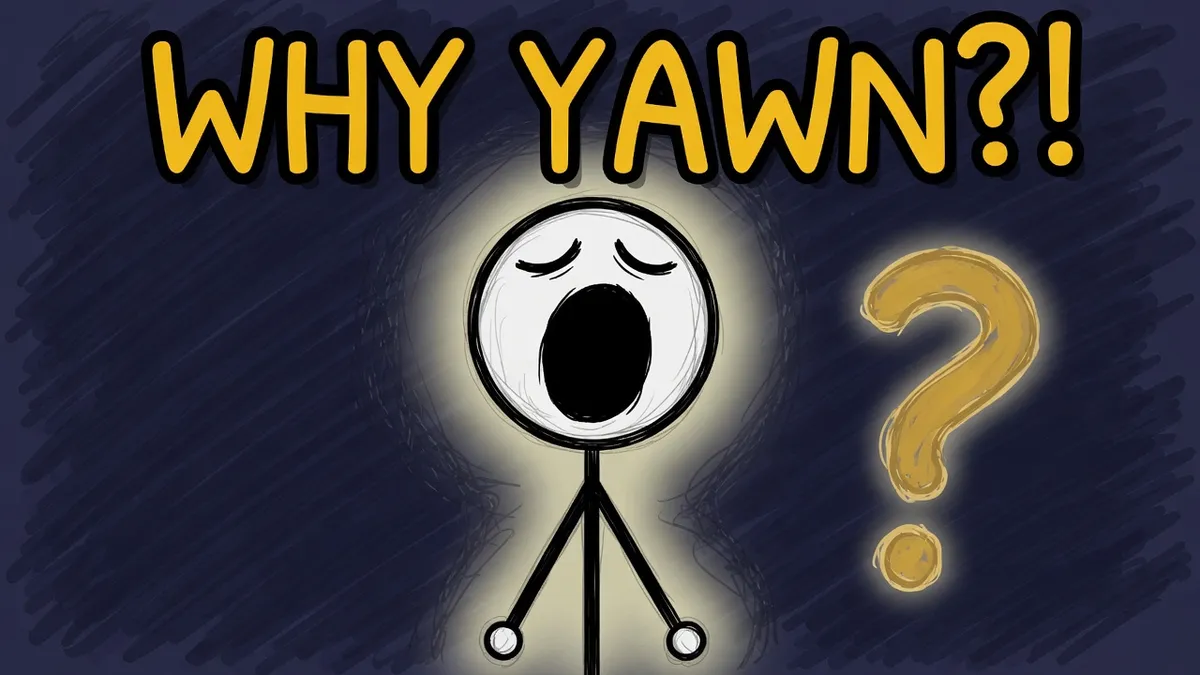
Ask anyone why we yawn and you'll get the same confident answer: we're tired, or we need more oxygen. It's one of those facts everyone just knows. It's also, as far as the science can tell, wrong. When researchers actually put the oxygen idea to the test, it fell apart. What replaced it is far stranger and better: your yawn isn't a gulp of air for your lungs. It's a cooling system for your brain.
01 · The myth, tested to deathIt isn't about oxygen
The oxygen story sounds so reasonable that almost nobody questions it: you’re stuffy and sluggish, you yawn, you feel refreshed, so a yawn must be topping up your air. So a researcher did the obvious experiment. He gave people air enriched with extra oxygen, then air heavy with carbon dioxide, and watched their yawning. If yawns were about gas levels, the rates should have swung. They didn’t move. Breathing pure oxygen didn’t cut yawning; extra CO2 didn’t boost it. The tidy oxygen theory that everyone believes had just failed its own test.
02 · The better ideaA radiator for the brain
So what is a yawn for? The leading answer is temperature. Your brain is a small, intensely busy organ that runs best in a narrow thermal band, and when it drifts too warm it works less well. The brain-cooling theory says a yawn is your body reaching for the thermostat. Look at what a yawn actually does: you drag in a big breath of cooler outside air, and you crank your jaw wide open, which pumps a surge of blood through your head. Cool air in, hot blood flushed out. It’s a radiator, built into your face, that you fire several times a day without knowing what it’s for.
03 · The proof in the ratsYawns chase the heat
The best hard evidence comes from an experiment you’d only run on rats. Researchers slipped tiny thermal probes into rats’ brains and simply watched the temperature while the animals went about their business. The yawns didn’t come at random. They came precisely as brain temperature spiked, and right after each yawn, the temperature dropped back toward normal. The yawn wasn’t a symptom of a warm brain; it looked like the fix. Heat climbs, yawn fires, heat falls. That single, elegant pattern is the backbone of the whole theory.
04 · The weather testWhy you yawn more in the cold
Here’s a prediction the cooling theory makes that the oxygen theory can’t: if yawns cool the brain by bringing in cool air, they should work better, and happen more, when the outside air is cool. When it’s blazing hot, air as warm as your body can’t cool anything, so yawning should taper off. And that’s exactly what studies find. People yawn more in cool conditions and less as the air approaches body temperature. Pressing something cold to the forehead, or breathing through the nose (which chills the blood heading to the brain), also cuts yawning. Every one of these lines up with cooling and none of them makes sense for oxygen.
Compare yawns across the animal kingdom and a pattern jumps out: the bigger the brain, the longer the yawn. Humans out-yawn mice not because we're lazier, but because a larger brain takes a longer yawn to cool. Your yawn length is, in a sense, a readout of your brain size.
05 · The tired connectionWhere sleepiness fits in
If it’s about heat, why do we yawn when we’re tired or bored? Because those states and brain temperature are quietly linked. Your brain and body naturally warm up in the run toward sleep and cool as you wake, and a drowsy or under-stimulated brain tends to drift warm and sluggish. So the yawn that ambushes you in a dull meeting or as your eyes grow heavy isn’t crying out for oxygen; it’s the cooling reflex kicking in to nudge an overheating, under-worked brain back toward its sweet spot. The sleepiness is real. It’s just not the reason, it’s the trigger.
06 · The other yawnWhy they're catching
One thing brain-cooling doesn’t explain is why yawns are so contagious, why just reading this paragraph might set one off. That’s a different mechanism entirely: catching a yawn is a kind of social mirroring, tied to empathy and the brain’s habit of unconsciously copying the people around us. Tellingly, you catch yawns most easily from those you’re closest to, and young children barely catch them at all until the social brain matures. So we have two yawns wearing the same face: a private one that cools your brain, and a social one that binds you to your group.
07 · The payoffSo why do we yawn?
Not for oxygen, whatever everyone tells you. The strongest evidence says a yawn is a cooling reflex: a deep pull of cool air and a jaw-wide flush of blood that carries heat away from an overheating brain, firing hardest when you’re tired, bored or in cool air, and scaling with the size of the brain doing the yawning. It’s still a theory under test, appropriately hedged by the scientists chasing it. But next time a yawn cracks your jaw in a warm, dull room, you can enjoy knowing what it almost certainly is: your brain, quietly running its radiator.
Quick questions
Why do we yawn, simply put?
The best current answer is to cool the brain. When you yawn, you take a deep breath of cooler air and stretch your jaw wide, which increases blood flow to the head. Both help carry heat away from a brain that has warmed up slightly, for example when you're tired or bored. So a yawn is less about being sleepy and more about your brain reaching for its thermostat.
Doesn't yawning give you more oxygen?
No, and this is the big myth. Researchers tested it directly by having people breathe air with extra oxygen or extra carbon dioxide, expecting yawning to change if it were about gas levels. It didn't budge. That result is a large part of why the oxygen explanation, though almost everyone believes it, has been largely abandoned by scientists.
What is the brain-cooling theory of yawning?
It's the idea, also called the thermoregulatory or thermal-window hypothesis, that yawning is triggered when the brain warms slightly above its ideal temperature. A yawn cools it two ways: the deep inhalation brings in cooler outside air that draws heat from blood passing through the head and sinuses, and the powerful stretch of the jaw pumps more blood, and therefore more heat, out of the skull. It's essentially a built-in radiator flush.
What's the evidence that yawning cools the brain?
Several strands. In rats, thermal probes in the brain showed yawns happened right as brain temperature spiked, and temperature fell back afterwards. In people, yawning is more common in cooler conditions and drops off when the surrounding air is as warm as body temperature, because warm air can't cool anything. And pressing something cool to the forehead or breathing through the nose, both of which cool the brain, reduces yawning. It all points the same way.
Why do we yawn when we're tired or bored?
Because both states tend to nudge brain temperature upward or slow the systems that keep it steady. Brain and body temperature naturally rise before sleep and dip on waking, and a drowsy or under-stimulated brain may drift warm. On the cooling theory, yawning kicks in to counter that, which is why yawns bunch up when you're sleepy, bored or just woken, rather than because you literally need air.
Why is yawning so contagious?
That's a separate puzzle from why we yawn in the first place. Catching a yawn from someone else is thought to be a form of social mirroring, linked to empathy and the same brain systems that make us unconsciously copy others. Interestingly, contagious yawning is stronger between people who are emotionally close, and it appears later in child development, which is why it looks tied to social connection rather than to brain temperature.
Do animals yawn, and why?
Yes, widely, from mammals to birds and even fish. In many animals yawning appears to serve similar arousal and possibly cooling roles. A striking finding is that across species, animals with bigger brains and more neurons tend to have longer yawns, which fits the brain-cooling idea neatly: a bigger brain needs a longer yawn to shift more heat. Yawning is clearly ancient and shared, not a quirk of humans.
Why can't you stop yourself yawning once it starts?
Because yawning is a deep reflex, driven by brainstem circuits largely outside conscious control, a bit like a sneeze. Once the sequence is triggered, it tends to run to completion. You can suppress the full open-mouthed version, but it often leaves you with a stifled, unsatisfying half-yawn, and the urge frequently returns until the reflex has run its course.
Is excessive yawning ever a sign of a problem?
Usually yawning is completely normal. But a sudden, marked increase in yawning that isn't explained by tiredness can occasionally be linked to medical issues, since anything affecting brain temperature regulation or certain neurological and heart conditions may alter yawning. It's rarely serious, but a persistent, unexplained spike in yawning is worth mentioning to a doctor.
Why do you yawn when you're not even tired?
Yawning isn't only about sleepiness: it also clusters around shifts in alertness. People often yawn before a stressful or demanding moment, such as athletes before a race or performers before going on stage, which fits the idea that yawning helps prod a warm or under-aroused brain toward its ideal state. So a yawn can mean your brain is gearing up as much as winding down.
Why do you often stretch at the same time as yawning?
The combined yawn-and-stretch has its own name, pandiculation, and it tends to happen around waking or drowsiness. Stretching the muscles and yawning together may both serve to raise alertness and get the body ready to move, boosting circulation and shaking off grogginess. The two reflexes are closely linked in the brain, which is why one so often triggers the other first thing in the morning.
Do babies yawn before they are born?
Yes. Ultrasound studies have shown that fetuses yawn in the womb, well before birth and long before there is any 'tiredness' to speak of. This is one reason researchers think yawning serves a basic developmental or regulatory role rather than simply signalling sleepiness. Exactly what those early yawns do is uncertain, but they show the reflex is wired in very early.
Why do dogs seem to catch yawns from people?
Dogs do appear to catch human yawns, and some studies suggest they do so more readily from their own owners than from strangers. This points to contagious yawning being tied to social bonding and a basic form of empathy, the same theme seen in humans. It fits the picture that the 'catching' side of yawning is about connection between individuals, quite separate from why a yawn happens in the first place.
Our sources 6 checked
// every claim on this page was checked before it went up