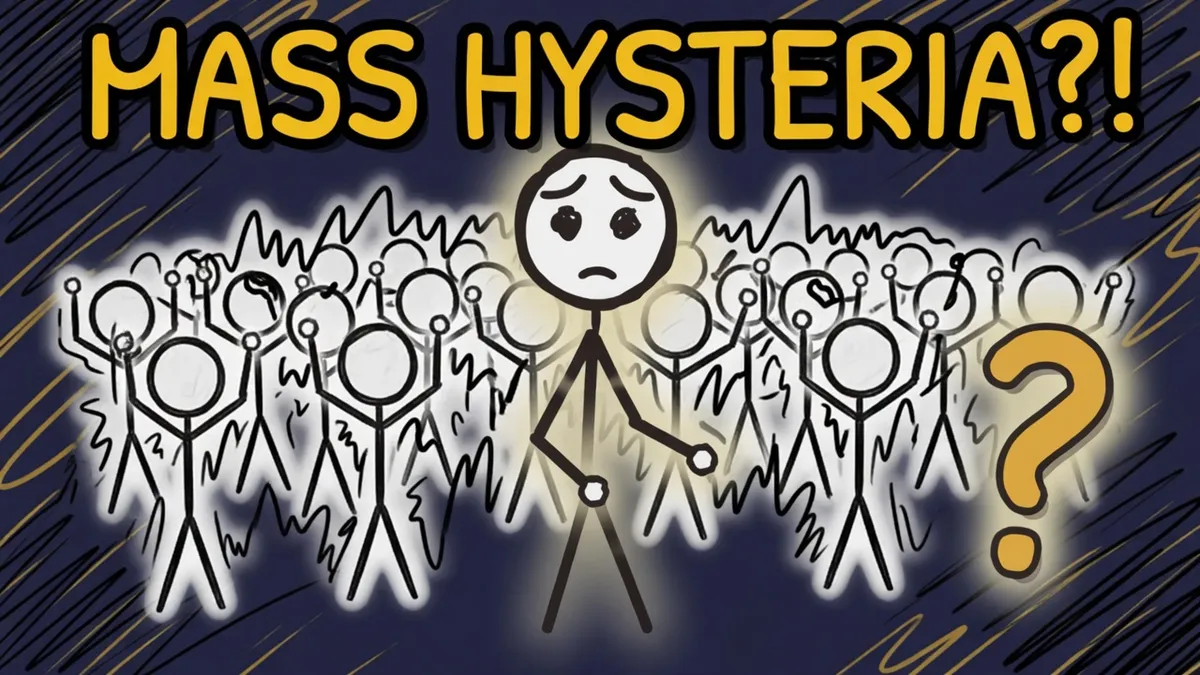
Here is a scene that has played out, in one form or another, hundreds of times across the last century. A student in a packed assembly faints. Then another. Within the hour, a dozen more are dizzy, breathless, their hearts pounding, some collapsing, some vomiting. The school is evacuated. Hazmat teams sweep the building; the water, the air and the cafeteria food are all tested. And every single test comes back clean. Nothing was in the room that could have made anyone ill. And yet the illness was completely real. So what, exactly, moved from one person to the next?
01 · The patternReal symptoms, no physical cause
The phenomenon has an unfortunate old name, mass hysteria, and a growing pile of better ones. Strip away the drama and the pattern is remarkably consistent. A group of people, usually under real stress and often crammed together (a school, a factory floor, a barracks), starts to fall ill with genuine symptoms: fainting, nausea, dizziness, headaches, twitching, trouble breathing or walking. The symptoms are real. The doctors’ inability to find a germ, a gas or a poison is also real. Both things are true at once, and holding them together is the whole key to understanding it.
Crucially, this is not rare, and it is not a relic. Documented outbreaks stretch from possessed medieval convents to modern high schools, and they keep happening. What links them is not a place or an era. It’s a set of conditions.
Nobody in these outbreaks is faking. The fainting, the nausea, the tics are genuinely involuntary, real bodily events the person cannot stop. What spreads is not a toxin. It's a belief, and the body's honest reaction to it.
02 · The laughterTanganyika, 1962
The strangest entry in the file began at a girls’ boarding school in the village of Kashasha, in what was then Tanganyika, in January 1962. Three girls started laughing and could not stop. It spread. Within weeks, most of the school was caught up in fits of uncontrollable laughing and crying, along with restlessness, pain and fainting. The school had to close, and as the pupils went home, it spread to their villages, then to other schools.
By the time it faded, the outbreak had touched around a thousand people and shut 14 schools. The details are worth getting right, because the story is usually inflated: nobody laughed non-stop for months. Individual attacks lasted anywhere from a few hours to about a fortnight, and the epidemic as a whole waxed and waned over roughly eighteen months. Doctors examined the afflicted and found nothing physically wrong. What they were watching was a stressed population, in a newly independent country, passing an involuntary reaction from one person to the next.
03 · The June bugHow suggestion does the work
That same year, on the other side of the world, gave us the textbook case. In June 1962, workers at a textile mill in Spartanburg, South Carolina, began falling ill with nausea, dizziness and numbness. The story going round the floor was that a strange insect, a “June bug”, had arrived in a shipment of English cloth and was biting people. Entomologists were called in. They combed the mill and found no bug capable of doing any such thing.
Sociologists Alan Kerckhoff and Kurt Back studied the outbreak in detail, and their findings are the clue to the whole phenomenon. Of the roughly sixty affected workers, the overwhelming majority were women, most worked the same overloaded shift, and a striking number only reported symptoms after seeing others fall ill or hearing about it. The illness spread along lines of friendship and sight. The bug was a story the anxiety told itself. The stress, the exhaustion and the suggestion were the real bite.
04 · The triggerA smell, a rumour, and the nocebo effect
Often there is a plausible-but-wrong explanation that lights the fuse, and it does not need to be true to work. It only needs to be believed. In the spring of 1983, across the West Bank, roughly 943 people, about seven in ten of them schoolgirls aged 12 to 17, reported fainting and dizziness in wave after wave. In the tense atmosphere, many were convinced they had been poisoned by gas. Investigators, including the American CDC, concluded the outbreak was largely psychogenic, perhaps set off in one school by the faint smell of low levels of hydrogen sulfide, a real but harmless whiff that a frightened population read as an attack.
This is where mass psychogenic illness shakes hands with the nocebo effect, the placebo effect’s dark twin. If expecting a sugar pill to help can genuinely ease your symptoms, expecting a smell to poison you can genuinely make you ill. A rumour of gas, an odd odour, a whispered word of contamination: the belief that you have been exposed is enough for the body to produce the sickness to match. Multiply that across a scared crowd, and you have an epidemic with nothing in the air.
05 · The nameWhy "hysteria" is a bad word for it
The word “hysteria” comes loaded, and every ounce of the load is wrong. It descends from the Greek for womb, and it drags along an old, ugly assumption: that the (usually female) sufferers are irrational, attention-seeking, or simply making it up. But the evidence says the opposite. The symptoms are involuntary, the people are ordinarily healthy, and the process is a normal group response to stress, not a defect in anyone’s character.
So researchers Robert Bartholomew and Simon Wessely have argued for a cleaner term: mass sociogenic illness. “Socio” because the driver is social, and “genic” because it genuinely generates real symptoms. Bartholomew has pointed out that the phenomenon has been relabelled dozens of times over the years, a sign of how uneasily the field has sat with its own vocabulary. The relabelling matters. If you call it hysteria, you blame the victims. If you call it sociogenic illness, you can actually see what is happening: real bodies reacting to a shared, and mistaken, sense of threat.
06 · The new vectorWhen the sufferer is on a screen
For centuries, the illness needed proximity. You had to see or hear an affected person for the anxiety to jump to you. That constraint is now dissolving. Between 2011 and 2012, in Le Roy, New York, around nineteen students (almost all teenage girls) and one older woman developed tics, twitches and verbal outbursts. As with every case before it, the environmental and infectious testing came back empty, and doctors identified a functional condition, conversion disorder. But something was different this time: the students posted videos of their symptoms, and the reports spread through Facebook and YouTube. Researchers flagged it as possibly the first such outbreak partly propagated by social media, where you no longer had to be in the room to catch the fear.
07 · The TikTok chapterAn illness that spreads through a phone
Then came the sharpest test of that idea. From around 2019, and accelerating through the pandemic lockdowns, clinics around the world reported a sudden surge of young people, mostly teenagers, arriving with abrupt, severe, functional tic-like movements and outbursts. Many had been watching popular tic-related videos beforehand. In 2022, a German team led by Kirsten Müller-Vahl described this as a genuinely new thing: a mass sociogenic illness spread entirely through social media, with a hugely popular YouTube creator serving as a kind of “virtual” index case whose specific gestures and phrases turned up, uncannily, in patients who had never met.
It is a compelling account, and it fits the century-old template with one dramatic update: the vector is now a screen, not a shared room. But it must be hedged. The framing is genuinely contested, other researchers caution against over-diagnosing every young person’s tics as socially induced, and the picture is still being worked out. What is not in doubt is that the patients’ symptoms are real and involuntary. Whether “social media illness” is the right label is the part still being argued.
08 · The payoffSo why does it spread?
Pull it all together and the answer is almost disappointingly human. Mass psychogenic illness spreads because we are social animals wired to take our sense of danger from the people around us. Put a group under real strain, give them a plausible reason to feel threatened, a bite, a smell, a rumour, a viral video, and let them watch one of their own genuinely fall ill, and the anxiety does the rest. Their bodies are not lying. They are doing exactly what fear tells bodies to do.
That’s the thread running from a Strasbourg street in 1518, where hundreds danced until they dropped, straight through to a teenager’s bedroom in 2021. Not a poison, not a performance, and certainly not weakness. Just a genuine illness whose true cause is an idea, moving through a frightened group faster than any germ could manage. The symptoms are real every time. It’s the danger that isn’t there.
The animated version
Same answer, told as a little animated story with the strange little stickman acting it out. Dry, quick, and, obviously, correct.
Quick questions
What is mass hysteria?
It's the old, loaded name for what clinicians now call mass psychogenic illness or mass sociogenic illness: a real cluster of symptoms that spreads through a group of people with no infectious or toxic cause behind it. The word 'hysteria' is misleading because it implies the sufferers are overreacting or making it up. They are not. The symptoms are genuine and involuntary.
Are the people faking it?
No, and this is the single most important point. The symptoms are real, involuntary bodily events: fainting, racing heart, nausea, dizziness, twitches, difficulty walking or speaking. In the modern framing these are functional symptoms, the brain's software misfiring rather than a broken part, but the person genuinely cannot stop them. Accusing sufferers of pretending is both cruel and wrong.
How does mass psychogenic illness actually spread?
Classically, by seeing or hearing an affected person. One index case has a genuine episode, others read it as evidence of a real danger, anxiety climbs, and their own bodies produce similar symptoms. It rides on stress and on a shared belief about what is happening, not on any germ or chemical. In recent cases, video and social media appear to let the trigger spread without anyone sharing a room.
Why does it so often happen in schools?
Because schools concentrate the exact ingredients: a tightly-knit group, high stress, lots of time in close contact, and (often) adolescents, whose outbreaks are especially well documented. When one student collapses or starts twitching, everyone sees it at once, and the anxiety has a crowd to move through.
Why does it mostly affect girls and young women?
Documented outbreaks do skew heavily female, especially teenage girls, and that pattern is genuinely consistent across a century of cases. Why is less settled. Part is likely social (girls' peer groups, the settings studied), and part may reflect who is placed under particular kinds of stress. It is a real statistical pattern, not a judgement about anyone being 'weaker'.
What is the difference between mass hysteria and the nocebo effect?
They overlap. The nocebo effect is when the expectation of harm produces real harmful symptoms (the dark twin of placebo). Mass psychogenic illness is often nocebo running through a crowd: a rumour of gas or a strange smell convinces people they have been poisoned, and the belief itself generates genuine sickness that spreads person to person.
Did people really laugh for months in 1962?
Not one person laughing non-stop, but yes, an outbreak of uncontrollable laughing, crying and restlessness ran through schools and villages in what is now Tanzania in 1962. It affected roughly a thousand people and closed 14 schools, waxing and waning over about a year and a half. Individual attacks lasted hours to a couple of weeks, not months, and doctors found no physical cause.
What was the June Bug epidemic?
In June 1962, dozens of workers at a textile mill in Spartanburg, South Carolina, fell ill with nausea, dizziness and numbness, blaming bites from a mysterious insect said to have arrived in a fabric shipment. Entomologists found no such bug. Sociologists Kerckhoff and Back studied it and concluded it was hysterical contagion driven by stress and suggestion. It is now a textbook case.
What happened in Le Roy, New York?
Between 2011 and 2012, around 19 students (mostly teenage girls) plus one older woman at a school in Le Roy, New York, developed tics, twitches and verbal outbursts. Extensive environmental and infectious testing found no cause, and doctors diagnosed conversion disorder, a functional condition. It drew huge attention partly because reports and videos spread through social media, a first for such an outbreak.
Are 'TikTok tics' the same thing?
Many researchers think they are a modern, screen-based version. From around 2019, clinics worldwide saw a sharp rise in young people with sudden functional tic-like behaviour, often after watching tic-related videos. A 2022 paper called it 'mass social media-induced illness'. It's a plausible and widely discussed idea, but it is contested and still being studied, so treat it as a strong hypothesis, not a closed case.
Why is 'hysteria' considered a bad word for it?
Because it carries centuries of baggage, implying the sufferers (historically, women) are irrational, attention-seeking or faking. None of that fits the evidence. Researchers Robert Bartholomew and Simon Wessely pushed for the neutral term mass sociogenic illness precisely because the symptoms are real and the process is social, not a character flaw. Bartholomew has noted the phenomenon has been labelled dozens of different ways over the years.
Can mass psychogenic illness be dangerous?
The symptoms themselves are usually benign and settle once the stress and the belief are addressed, but that does not make it trivial. Outbreaks can cause real distress, mass hospitalisation, school and factory closures, and lasting anxiety. Handling them badly, chasing phantom toxins or publicly accusing people of faking, tends to prolong and worsen them.
How do you stop an outbreak?
The pattern that works is separating affected people from onlookers, calmly ruling out a physical cause, avoiding sensational media coverage, and giving a credible, reassuring explanation. Removing the sense of ongoing threat lets the anxiety drain away. Feeding the fear, or endlessly hunting a toxin that testing keeps failing to find, does the opposite.
Is it a mental illness?
It is better understood as a normal group response to stress and fear than as a disorder of the individuals involved. Most people caught up in an outbreak are psychologically healthy. The symptoms are real functional events triggered by circumstances, which is why the same person is usually fine again once the situation resolves.
Take the quiz on this
A quick 4-question check on what you just read. Get them right to earn XP: no points for just scrolling.
Our sources 11 checked
// every claim on this page was checked before it went up