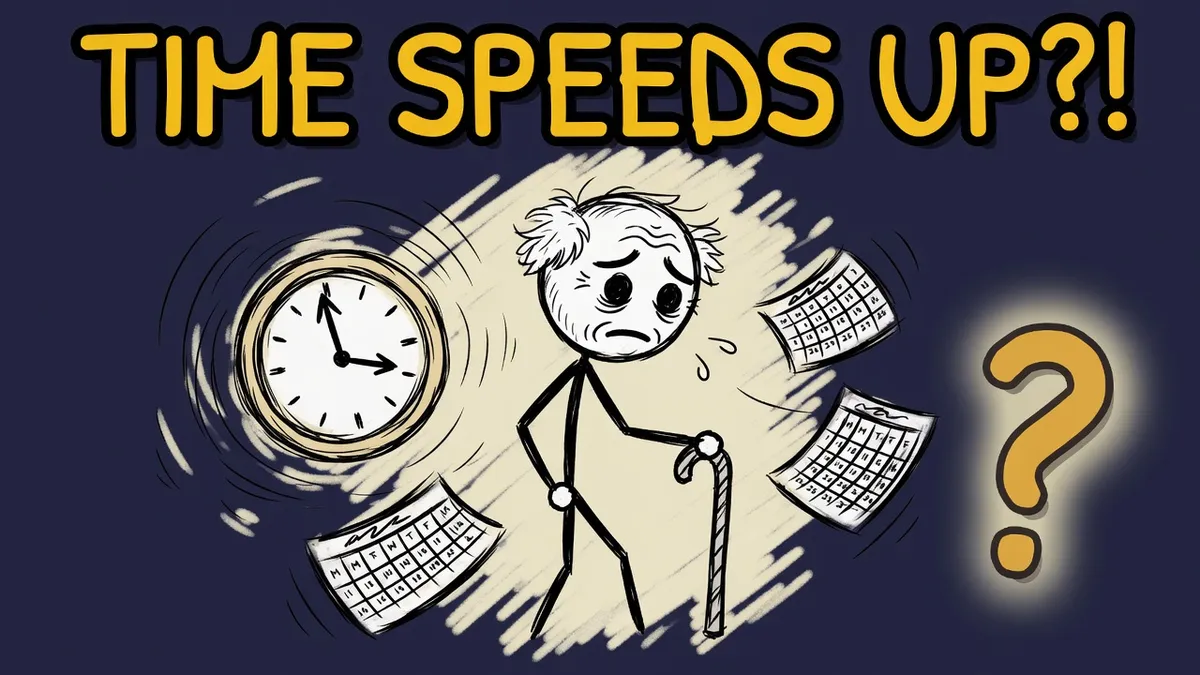
When you were eight, a single summer could last a geological age. The six weeks between the last day of school and the first day back stretched out like a continent, long enough to get properly, gloriously bored. And now? Now you blink, and it's December. Again. You've barely unpacked from last December. You are not imagining it: time really does seem to speed up as you get older. The strange part isn't that it happens. It's why, and the answer says something faintly alarming about how your brain has been quietly measuring your entire life.
01 · The mathsThe oldest, tidiest, not-quite-right idea
The simplest explanation is also the oldest. When you’re two years old, one year is half of your entire life, an eternity. When you’re fifty, that same year is one-fiftieth of it: a rounding error. A French philosopher named Paul Janet pointed this out back in 1877. Each year feels shorter than the last, he argued, because each year is a smaller slice of the life you’ve already lived.
It’s a lovely, tidy idea, and it isn’t wrong so much as incomplete. The trouble is it predicts your life should drain away at a perfectly smooth, mathematical rate, a bit shorter every year, forever. And that just isn’t how it feels. Some years crawl; some vanish. The proportion of your life can’t explain that. So most researchers now treat the fraction-of-life idea as one thread in the story, not the whole cloth.
02 · The mechanismYour brain keeps a filing cabinet, not a clock
Here’s the better answer. Your brain doesn’t actually keep a clock. It keeps a filing cabinet. When you look back and ask how long was that?, your brain doesn’t check a stopwatch: it checks how many memories it filed. A stretch of time crammed with new, vivid, first-time events feels long in hindsight. A stretch of nothing much feels like it barely happened.
This is the difference between living through time and remembering it, what researchers call prospective versus retrospective duration. And childhood is nothing but firsts. First day of school. First bike. First time you saw the sea. First friend, first fight, first heartbreak. Your young brain is laying down memories like a frantic court stenographer, and that dense, crowded record is exactly what it reads back, years later, as “that lasted forever.”
03 · The TuesdaysWhy adulthood empties the cabinet
Adulthood, by contrast, is mostly… Tuesday. Then another Tuesday. You drive the same route, eat the same lunch, have the same argument with the same person about the same thing. And your brain, sensibly, stops bothering to write it all down. Why file a fresh memory of a commute you’ve made four thousand times? Nothing new happened; nothing gets encoded.
So you reach New Year’s Eve, look back over twelve whole months, and the cabinet is nearly empty. And an empty cabinet reads as one thing only: that went fast. The years don’t feel short because they were short. They feel short because they left almost nothing behind.
04 · The paradoxThe holiday that flies by, then swells
There’s a lovely wrinkle here, which the writer Claudia Hammond named the holiday paradox. A week somewhere new feels fast while you’re in it, you’re busy, you’re absorbed, the days blur together and vanish. But look back a month later, and that one week feels enormous. Bigger than the three ordinary weeks on either side of it.
Novelty does the exact opposite of what you’d expect. It flies by in the moment, then stretches out in memory. Routine is the reverse: slow and sticky to live through, then gone without a trace. It’s the same machinery from the last section, seen from two angles, and it’s the clearest proof that what your brain measures isn’t seconds. It’s memories.
Time isn't speeding up. You are just recording less of it. The years feel fast because they've become forgettable, the calendar was never the problem, the sameness is.
05 · The shakier theoriesThe chemical explanations, handled honestly
Scientists have floated other explanations, and it’s only fair to say these stand on shakier ground. Some think it’s chemical, that the brain’s internal “pacemaker,” run partly on dopamine, simply ticks slower as we age, so the outside world appears to rush past it. The pacemaker model is real, but its link to age-related speed-up is genuinely unsettled: studies can’t even agree on whether more dopamine makes time feel faster or slower, depending on the setup.
Others, like the engineer Adrian Bejan, argue our brains literally process images more slowly over the years, fewer mental snapshots per second, so each second holds less. It’s an intriguing idea, published in 2019, but it’s a hypothesis, not a finding. These theories are worth knowing about. They’re also, politely, unproven. The memory explanation is the one that keeps surviving the experiments.
06 · The payoffSo what is a fast year, really?
It’s a forgettable one. That’s the whole trick, and it smuggles in some genuinely good news. If novelty is what stretches time, then a more memorable life is a longer-feeling one, for free. Take the different road home. Learn the awkward new thing. Go somewhere your brain has no file for yet. Each new experience is another entry in a cabinet that’s been running empty.
You can’t add hours to the day, and you can’t slow the calendar. But you can, genuinely, make a year feel like a year again, by giving your brain something worth writing down. Or you can do what most of us do: mean to start next Monday, forget, and find yourself right back here in twelve months, wondering where the time went. It went into Tuesdays.
The animated version
Same answer, told as a little animated story with the strange little stickman acting it out. Dry, quick, and, obviously, correct.
Quick questions
Why does time go faster the older you get?
Because your brain measures how long a period felt by counting the memories it stored during it, not by consulting a clock. Childhood is packed with first-time, novel experiences, so it lays down dense memories and feels long in hindsight. Adult life is mostly repetition, so the brain stops bothering to file it, and a near-empty stretch of memory reads back as "that flew by."
Is the "time speeds up" feeling real or just in my head?
It's in your head, but that's exactly where time perception lives, so it's completely real as an experience. Clock time never changes; your sense of how much time has passed does. Surveys consistently find older adults report time feeling faster, and the leading explanation ties it to how memory, not any external clock, is doing the measuring.
Why did summers feel so long when I was a kid?
Two reasons stack up. First, at eight years old a single year is a huge slice of your whole life, so it looms larger. Second, and more powerfully, childhood is relentlessly novel, new places, new firsts, new everything, so your brain files vivid memory after vivid memory. That density is what your mind reads, in hindsight, as "that lasted forever."
How can I make time feel slower again?
Feed your brain novelty. Because it's memory density that stretches time in hindsight, doing new and memorable things, travelling somewhere unfamiliar, learning an awkward new skill, taking a different route, lays down more distinct memories, and a richer record makes a stretch of time feel longer when you look back on it. You can't add hours to the day, but you can make a year feel like a year.
What is the holiday paradox?
A term coined by writer Claudia Hammond for a strange split: a good holiday feels like it whizzes by while you're on it, yet feels enormous when you look back a month later. Novelty flies by in the moment but stretches out in memory. Ordinary routine does the exact opposite, slow to live through, then gone without a trace.
Does time really speed up with age, or is it just a feeling?
Clock time obviously never changes: a year is a year. What changes is your read of it, and even that is subtler than the cliché. In a 2005 survey of 499 people aged 14 to 94, Marc Wittmann and Sandra Lehnhoff found that people of all ages felt recent hours, weeks and months passing at much the same rate. The one thing that shifted with age was the long view: older people felt the last ten years had flown. So it's real, but it lives in memory and hindsight rather than in the seconds, and even that effect is fairly small.
At what age does time start to speed up?
There's no single birthday where it switches on. A child's basic sense of duration is roughly adult-like by around eight, and from there the speeding-up is gradual and lifelong. If anything the steepest change is early: because each new year is a smaller slice of the life you've already lived, the proportional shrinkage is fastest in childhood and youth, then flattens. Most people just don't notice it until adulthood hands them a decade that seems to have vanished.
Why do summers feel shorter now that you're an adult?
Same machinery, run in reverse. A childhood summer was a pile of firsts, new places, new freedom, long empty days you had to fill, so your brain filed memory after memory and it reads back as vast. An adult summer is mostly more work, more Tuesdays, the usual route to the usual places. Fewer new memories get written down, so the season leaves a thinner trace, and a thin trace reads as short.
Why do routines make time fly by?
Because your brain barely bothers to record them. When you do the same commute, the same lunch, the same evening for the thousandth time, almost nothing new gets encoded: there's no fresh memory worth filing. So when you look back over a month or a year of routine, the record is nearly empty, and an empty stretch of memory reads as that went fast. Repetition doesn't just feel dull; in hindsight it's very nearly invisible.
Why does a boring afternoon feel long while you live it but short in memory?
Because you're running two different clocks. While it's happening, being bored means paying attention to time itself, and a watched pot drags. But boredom lays down almost no new memories, so afterwards there's nothing to look back on and the whole stretch collapses to nothing. Psychologists call this the split between prospective time (lived) and retrospective time (remembered), and the two routinely pull in opposite directions.
Does mindfulness or meditation slow time down?
There's some real evidence that it can, at least in the moment. Experienced meditators tend to report the present feeling stretched and more spacious, and studies find they judge ongoing durations as longer, probably because paying close, deliberate attention pours more detail into each passing second. It won't slow the calendar, and the research is still small, so hold it loosely, but the broader lesson holds: whatever makes you attend to the moment, or fills it with something new, buys back a little subjective time.
Is the fraction-of-life theory why time speeds up with age?
It is the oldest popular idea: a year is 1/10 of a ten-year-old's life but 1/50 of a fifty-year-old's, so it should feel shorter. Researchers treat it as one partial factor, not a settled single cause. Memory density and routine matter at least as much.
Why do novel holidays feel long in memory but short while they happen?
That is the holiday paradox. New places and events pack memory with distinct episodes, so the trip expands in hindsight. While you live it, busy attention can make hours fly. Routine does the reverse: slow in the moment, thin and short when you look back.
Take the quiz on this
A quick 4-question check on what you just read. Get them right to earn XP: no points for just scrolling.
Our sources 10 checked
// every claim on this page was checked before it went up