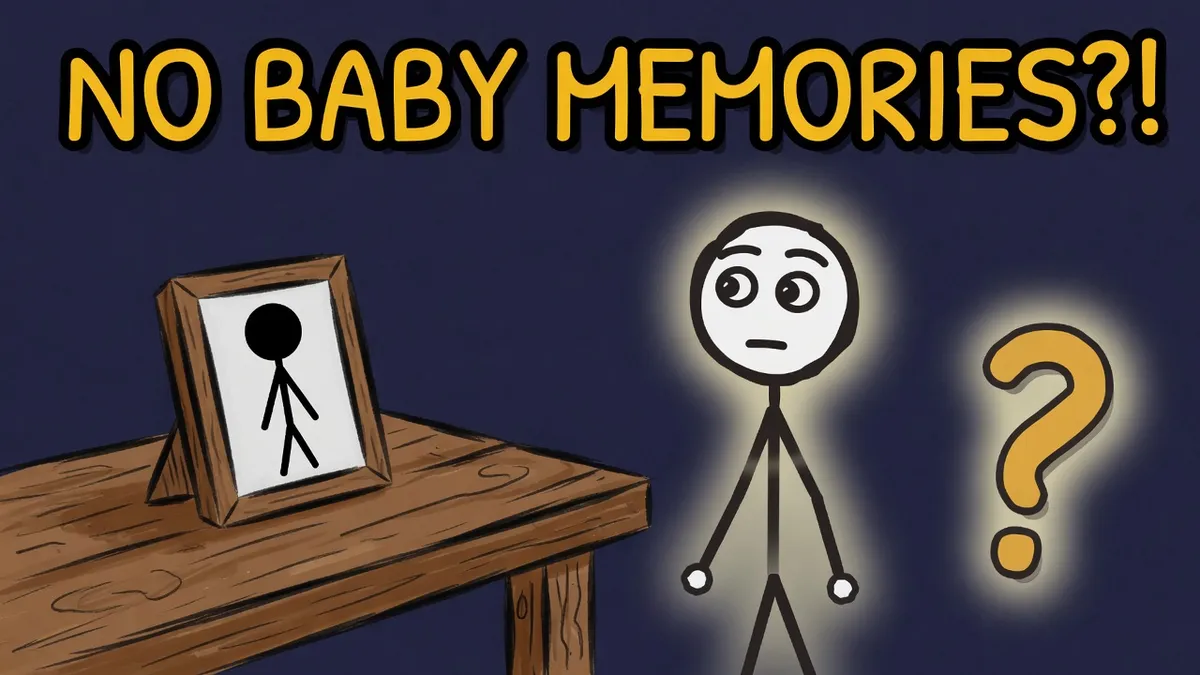
Picture the single busiest stretch of your entire life. You learned to walk. You learned to talk. You went from a blinking little stranger into an actual person, with opinions, a favourite toy, and a deeply held grudge against bath time. You will never again learn so much, so fast. It was the headline act of your whole existence. And you remember absolutely none of it.
01 · The black holeWhere did the first three years go?
For most people, the earliest memory you can dredge up lands somewhere around age three. Everything before that is gone, not blurry, not faded, just gone. Psychologists have a name for it: infantile amnesia (Freud coined the term in 1905, and it’s stuck ever since). It’s not a quirk of forgetful people, either. It happens to essentially everyone, across every culture. Which is odd, because the events it erases are the most important ones you’ll ever live through. So here’s a question that probably ought to bother you a little more than it does: where did all of it go?
02 · The old answer"Baby brains just can't save anything"
For about a century, the answer was simple and faintly insulting. Baby brains, we said, are just too undercooked to keep anything. The hippocampus, your brain’s memory-maker, isn’t finished wiring itself, so nothing gets properly saved. Tidy, confident, and easy to believe. There was even decent circumstantial evidence: the hippocampus does keep maturing into the preschool years, roughly when infantile amnesia lifts. Case closed, more or less. Except babies, quite obviously, do remember things. A newborn knows its mother’s face within days. A toddler learns an entire language from scratch, the single hardest thing you will ever do. That’s memory, working beautifully. So the tidy answer had a hole in it.
03 · The 2025 flipBabies watched forming a memory
In 2025, a team at Yale did something genuinely difficult: they slid awake infants into an fMRI scanner and watched their brains as they saw new things. The setup was clever. Show a baby an image, then later show it again alongside a brand-new one, and measure how long the baby stares. Babies look longer at things they recognise. That longer stare is the recognition. And the finding was striking: when a baby’s hippocampus lit up more strongly the first time it saw an image, that baby was more likely to appear to recognise it later. A memory being encoded, caught in the act, strongest in babies past their first birthday, but present well before the age our memories are supposed to begin.
So the memories aren't missing because they were never made. They were made. Which quietly swaps one question for a far stranger one: if it's all in there, why can't you reach it?
04 · The renovationA building site that never clocks off
Here’s the lead suspect. A baby’s hippocampus is a building site that never stops. New neurons are being wired in at a furious rate, far faster than in your slow, settled, adult head, and every new neuron reshuffles the existing circuit. The leading idea, from neuroscientists Sheena Josselyn and Paul Frankland, is that this relentless rewiring is exactly what buries the memories: the books don’t vanish from the library, but the map you’d use to find them keeps getting paved over. And in mice you can push the argument both ways. Crank up neurogenesis and the animals forget faster; damp it down and they hold on to their infancy for longer. It’s a hypothesis, not a closed case, but it’s the strongest one going.
05 · No words, no labelsThe warehouse of unmarked boxes
There’s a second problem, and it’s almost funny. To file a memory as yours, a thing that happened to you, you arguably need two things a young baby doesn’t have yet: language to tag the experience, and a stable sense of being a “you” at all to pin it to. So the experiences get recorded, but with nothing to label them by. Imagine a warehouse stacked to the rafters with unmarked boxes. Everything is in there. Good luck ever finding a single specific thing. This is a supporting idea rather than the whole story: the timing of language and self-recognition lines up suggestively with when memory starts to stick, but it’s hard to prove it’s the cause. Still, it fits the picture: the recording works long before the retrieval system does.
06 · The unreliable narratorYour earliest memory might be a fake
Here’s a twist that makes the blank stretch stranger still: even the memory you’d swear is your first, a birthday, a beach, the corridor when a sibling arrived, may not be a genuine recording at all. Memory isn’t a video you replay. It’s a story you rebuild each time from fragments, and your brain is perfectly happy to patch the gaps with photographs, home videos, and things you were simply told. When researchers asked thousands of people to date their earliest memory, close to 40% placed it at age two or younger, many at twelve months or less, deep inside the window where reliable episodic storage almost certainly hadn’t switched on yet. Their blunt conclusion: a huge share of “first memories” are fictional, reconstructions assembled later and mistaken for the real thing. And false childhood memories are unusually easy to plant, easier still for the very early years. So some of what you think survived from before the blank isn’t the tape at all. It’s a home movie your own brain shot, years after the fact.
07 · Still in there?The mouse memory that came back
Now the genuinely eerie part. In mice, scientists tagged the exact cells that stored a memory formed in infancy, a memory the mouse had apparently forgotten, and then, using light, switched those cells back on. The memory came flooding back, behaviourally intact, months later. Their conclusion: infantile forgetting is, at least partly, a reversible retrieval failure. Not deletion, misfiling. Now, a heavy caveat: this is mouse work, done with optogenetics, and nobody can do it in a human head. So it’s a spectacular clue, not proof about you. But it lines up unnervingly well with the human scanner data. The tape might still be there. You just don’t have the light switch.
08 · The payoffYou didn't lose those years, you became them
So the honest answer is this. You can’t remember being a baby not because your brain failed to record it, but, the best current evidence suggests, because those recordings were quietly buried by the very growth that was building your mind, and filed before you had the words or the self to label them. The footage may well still be in there, sealed behind a door nobody’s found the handle to. But don’t mourn the lost tape too hard. Those years weren’t wasted. You can’t replay them, but you’re standing on them: your first language, whether the world felt safe, the rough shape of the person you were going to be. The most important things that ever happened to you are the very things you’ll never remember. They didn’t stay as memories. They turned into you.
The animated version
Same answer, told as a little animated story with the strange little stickman acting it out. Dry, quick, and, obviously, correct.
Quick questions
What is infantile amnesia?
It's the near-total inability of adults to recall events from roughly the first three years of life, the reason your earliest memory tends to land around age three, and nothing before it survives. Freud named it in 1905, but the phenomenon itself is universal across cultures.
At what age is your earliest memory?
For most adults, the earliest retrievable memory sits somewhere around age three, with recall from the first two years essentially blank. The exact age varies a lot between people and cultures, and some claimed early memories turn out to be reconstructed from photos and family stories rather than genuinely remembered.
Do babies actually form memories?
Yes. A 2025 Yale study scanned awake infants in an fMRI machine and found their hippocampus, the brain's memory-maker, lit up while encoding new images, and the stronger it lit, the longer they later stared at the familiar picture. That's a memory being formed, caught in the act. So the memories are made; the problem is getting them back later.
Why can't we remember being babies if the memories are made?
The leading explanation is that early memories are encoded but later become inaccessible, a retrieval failure, not a recording failure. A prime suspect is the rapid growth of new neurons in a baby's hippocampus, which appears to keep reshuffling the circuit and paving over the paths you'd use to find old memories.
Is it true infant memories can be brought back?
In mice, yes, researchers optogenetically reactivated the exact cells that stored a forgotten infant memory and the memory returned intact, which they took as evidence that infantile forgetting is a reversible retrieval problem. That's mouse work, not a human party trick, so treat it as a striking clue rather than a settled fact about people.
Can you remember being born?
No, and no reliable technique recovers it. Birth sits deep inside the blank window, and even people with Highly Superior Autobiographical Memory, who can recall almost any day of their adult lives, don't remember it. Vivid "birth memories" that people occasionally report are reconstructions built from stories, images or suggestion, not verified recall.
Are early childhood memories real, or made up?
Often at least partly made up. Memory isn't a recording you replay, it's a story your brain rebuilds each time, and it happily fills gaps with photos, home videos and family lore. When researchers asked thousands of people to date their earliest memory, close to 40% placed it at age two or younger, inside the zone where reliable episodic storage almost certainly hadn't switched on, which the authors read as evidence that a large share of "first memories" are fictional reconstructions. Fake childhood memories are also unusually easy to plant.
At what age do memories start sticking?
Gradually, and later than most people assume. Isolated fragments can survive from around age three, but autobiographical memory doesn't become adult-like until roughly age six or seven. Childhood amnesia lifts slowly rather than switching off, many seven-year-olds still remember things from when they were three, then quietly lose those memories as they get older.
Why do some people remember more of their early childhood than others?
A few modest factors nudge the earliest memory earlier or later. On average, women report earlier first memories than men, people from individualistic cultures earlier than those from collectivist ones, and first-borns earlier than later-borns. Children whose parents reminisce in a detailed, elaborative way ("and then what did we see at the zoo?") tend to form earlier, richer memories too. The effects are real but small, and not every study finds them.
Do animals have infantile amnesia too?
Yes, it looks nearly universal in mammals. Baby rodents forget a freshly learned cue within a day or two, far faster than adults do. And crucially, as in the mouse engram experiments, the memories often aren't erased: they persist in a latent form and can be artificially switched back on, which is exactly the "stored but unreachable" picture the human work points to.
If I can't remember my early childhood, did those years still shape me?
Enormously. Even with no retrievable episodes, those years leave implicit traces. The attachment patterns and "internal working models" laid down in your first years, whether the world felt safe, whether people came when you cried, quietly shape adult relationships and emotional habits below conscious awareness. You can't replay the footage, but you're partly built out of it. (The link is partial, not destiny, later life reshapes it too.)
Is infantile amnesia the same as childhood amnesia?
They're used interchangeably for the same thing: the adult blank covering the earliest years. Some researchers reserve infantile amnesia for the near-total void of roughly the first two years and childhood amnesia for the sparser-than-expected memories of the preschool years, but the terms overlap and most people treat them as synonyms.
Why don't I remember being a baby?
Almost nobody does. Adults typically cannot retrieve events from roughly the first three years of life, a blank called infantile amnesia. The best current evidence says baby brains do encode memories (a 2025 Yale fMRI study caught infants forming them), so the problem is later retrieval: rapid hippocampal rewiring and a lack of language or stable self to file the episodes by.
What causes infantile amnesia?
There is no single closed answer, but the leading account is a retrieval failure, not a failure to record. Fast growth of new neurons in the infant hippocampus appears to reshuffle the circuits that would later find those memories, and early experiences are also filed without the language tags or sense of "me" that adult autobiographical memory relies on. In mice, lost infant memories can even be switched back on, which fits the "stored but unreachable" picture.
Take the quiz on this
A quick 4-question check on what you just read. Get them right to earn XP: no points for just scrolling.
Our sources 13 checked
// every claim on this page was checked before it went up