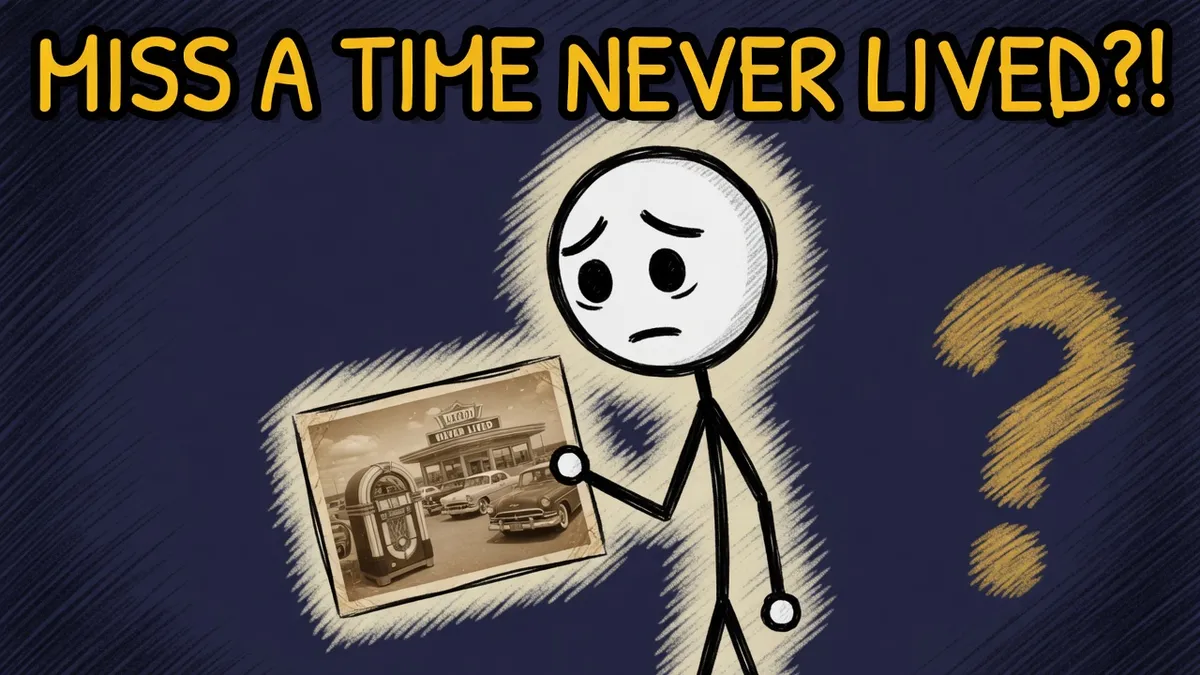
Here's a strange thing your mind can do. You see an old photograph of a street in the 1950s, a place you've never stood, full of people long gone, or you hear a crackly song recorded decades before you were born, and you feel a sudden, aching pull. A wistful longing for that world. It's a powerful homesickness for a time and a place you have never actually been. You miss it. And you were never there.
01 · The feelingA homesickness with no home
You’ve almost certainly felt it. It doesn’t need a photograph from the ’50s specifically, an old film reel, a black-and-white portrait, a piece of music from a decade you missed by half a century will all do it. There’s a longing there, and it points backwards, at a world you can only have seen second-hand. It behaves exactly like nostalgia. It just aims at somewhere your memory can’t possibly reach, because you weren’t alive for it.
02 · The wordSomeone had to invent a word for it
The feeling is so specific, and so strange, that English didn’t have a word for it, until, fairly recently, a writer named John Koenig made one up. Anemoia: nostalgia for a time you’ve never known. He coined it for his project The Dictionary of Obscure Sorrows, which invents beautiful words for feelings we all have but can’t quite name. He built it from the Greek ánemos, meaning wind, with an ending borrowed from words like paranoia, a state of mind, blowing in from somewhere you can’t see.
03 · The honest bitIt's a poem, not a diagnosis
Now, I should be straight with you right away. Anemoia is a poetic invention, not a scientific diagnosis. You won’t find it in a medical textbook, and no clinician has ever written it on a chart. It’s a made-up word for a made-up-feeling, except the feeling isn’t made up at all. That’s the genuinely interesting part. The word is an invention. The thing it describes is completely real, and the science of what’s going on underneath it is real too.
04 · The scienceUnderneath anemoia sits plain old nostalgia
Because sitting beneath anemoia is ordinary nostalgia, and nostalgia has had a serious scientific makeover. For centuries it was a disease: coined in 1688 by a Swiss doctor to describe homesick mercenaries wasting away far from their mountains, it was treated as a dangerous melancholy, something to be cured. But modern research, much of it led by psychologists at the University of Southampton, has flipped that completely. Nostalgia turns out to be mostly good for you. It’s a bittersweet emotion, but the studies find it leans far more sweet than bitter: when you feel nostalgic, you tend to feel more connected to others, more loved, less lonely, and quietly reassured that your life has meaning. It’s the mind’s own comfort blanket.
You'd assume all of this depends on real memories, things that actually happened to you. It doesn't. Researchers have a name for nostalgia about a past you never personally lived, and it works exactly the same way.
05 · The mechanismYour brain was never a video recorder
They call it vicarious nostalgia (or historical nostalgia), and it produces the same warm, connected, meaningful feeling from a past you only ever imagined. That’s possible because of something odd about memory itself: your brain was never really a video recorder in the first place. Memory isn’t a faithful playback of what happened. It’s a construction. Every time you remember, your mind actively rebuilds the scene, stitching together fragments, filling in the gaps, and quietly painting the whole thing in warm, rosy colours, a bias psychologists literally call rosy retrospection. And here’s the trick: it can run that exact same machinery on a past it borrowed. From a film. A song. An old photograph.
06 · The borrowed pastThe feeling machine doesn't check the receipts
So when that 1950s photograph hits you, your brain takes the borrowed images and builds a little world out of them, a world that feels warm, and safe, and meaningful, in exactly the way a real memory would. It doesn’t matter that you were never there. The feeling machine doesn’t check the receipts; it just runs. And it tends to run hardest when the present feels a bit thin. When you’re stressed, or lonely, or uneasy about the future, the mind goes looking for somewhere warmer to stand, and sometimes the cosiest-looking place is an imagined past. A simpler time that, crucially, never quite existed in the neat, golden form you’re picturing. But your brain doesn’t care. It just wants the comfort.
The biggest supplier of that borrowed material, these days, is media. Shows and films like Stranger Things or Mad Men painstakingly rebuild the textures of a decade, the clothes, the cars, the quality of the light, and hand you a version of it polished to a warm glow. Researchers call this mediated nostalgia, and it lands hardest when the portrayal leans on ideas like closeness, simplicity, or a bolder, more hopeful time. Which is the quiet catch: you’re not remembering the era. You’re missing someone else’s carefully art-directed postcard of it.
07 · The payoffHomesick for a home you invented
So that ache for a time you never lived isn’t a glitch, and it isn’t silly. It’s your mind doing one of the most human things it does: reaching for connection and meaning, and being perfectly willing to build them out of borrowed memories. Anemoia may be a made-up word, but the longing is absolutely real. You’re homesick for a home that only ever existed in your imagination, and somehow, it still feels like home.
The animated version
Same answer, told as a little animated story with the strange little stickman acting it out. Dry, quick, and, obviously, correct.
Quick questions
What is the word for missing a time you never lived through?
Anemoia, defined as "nostalgia for a time you've never known." It was coined by writer John Koenig for The Dictionary of Obscure Sorrows, a project that invents words for feelings we all have but can't quite name. It's a poetic neologism, not a medical or scientific term.
Is anemoia a real psychological condition?
Not as a diagnosis, you won't find it in a medical textbook. But the feeling it names is real, and the science underneath it is real. Psychologists study "vicarious" or "historical" nostalgia: nostalgia for a past you didn't personally live. So the word is invented, but what it points at is well documented.
Can you really feel nostalgic about something you never experienced?
Yes. It's called vicarious nostalgia, and studies show films, songs, and photographs can trigger the same warm, connected, meaningful feeling as a real memory. Your brain builds nostalgia from imagination and borrowed cultural memory, not only from things that happened to you.
Is nostalgia good or bad for you?
Modern research treats it as mostly good. Once considered a disease, nostalgia is now understood as a bittersweet but predominantly positive emotion that boosts social connectedness, counters loneliness, and infuses life with meaning.
Why does an imagined past feel so warm and safe?
Because memory is reconstructive, your mind builds scenes and quietly paints them in rosy colours, a bias called rosy retrospection. Run that machinery on a borrowed past and you get the same golden glow, even though that neat, simpler era never actually existed the way you're picturing it.
What is anemoia?
Anemoia (roughly an-uh-MOY-uh) is nostalgia for a time you've never known, a wistful longing for an era you weren't alive to experience. Writer John Koenig coined it for The Dictionary of Obscure Sorrows, building it from the Greek ánemos, "wind." It's a poetic word for a real, widely felt experience, not a clinical one.
How do you pronounce anemoia?
It's usually said an-uh-MOY-uh, four syllables, with the stress on "moy." It's a coined word rather than an established Greek one, so you'll hear small variations, but that's the version its creator and most write-ups use.
Is it normal to feel nostalgic for a time you never knew?
Completely. It appears to be increasingly common, especially among younger people who feel a pull toward decades they never lived. The feeling tends to grow when the present feels stressful or uncertain and an imagined past looks simpler and warmer, even though that tidy version never quite existed.
Why do I feel nostalgic for a decade I wasn't alive for, like the 80s or 90s?
That's vicarious, or "mediated", nostalgia, and media is the engine. Films and shows like Stranger Things or Mad Men lovingly reconstruct the look and mood of past decades, and your brain builds a warm, rosy version of that era out of those borrowed images. You end up missing a decade you only ever visited on screen.
Why do old photos make me feel nostalgic?
Old photographs are a direct line to a past that's gone, and memory fills in the rest with a golden tint (a bias called rosy retrospection). You don't even need to have been there: research finds people can feel genuine, warm nostalgia looking at strangers' old photos, the vicarious version of the feeling.
Can music make you feel nostalgic for a time you never lived?
Yes. A crackly recording from decades before you were born can trigger the same wistful pull as a photograph. Music is one of the most reliable nostalgia triggers there is, and, like film and images, it works even when the era it evokes is one you only know second-hand.
What's the difference between anemoia and ordinary nostalgia?
Classic nostalgia is built on your own memories, your childhood, an old friend, a place you actually lived. Anemoia is nostalgia for a past you never personally experienced, so your brain runs the same warm machinery on borrowed, imagined material instead of real memories. Psychologists call that broader category vicarious or historical nostalgia.
What does anemoia mean?
It means nostalgia for a time you've never known: a wistful ache for an era you weren't alive to live. John Koenig coined the word for The Dictionary of Obscure Sorrows, from Greek ánemos ("wind"). It is a poetic label for a real feeling, not a diagnosis or a technical psychology term.
Is anemoia real?
The word is invented; the experience is not. You will not find anemoia in a medical manual, but psychologists do study the same thing under names like vicarious or historical nostalgia: warm, meaningful longing for a past you only met through film, music, photos or stories. So the label is poetic; the machinery behind it is documented.
What is nostalgia for a time you never lived called?
In everyday English, the neat one-word answer is anemoia, John Koenig's coinage for nostalgia for a time you've never known. Psychologists more often say vicarious nostalgia or historical nostalgia: the same warm, connected feeling ordinary nostalgia brings, but aimed at a past you only imagined or absorbed from media.
Take the quiz on this
A quick 4-question check on what you just read. Get them right to earn XP: no points for just scrolling.
Our sources 12 checked
// every claim on this page was checked before it went up