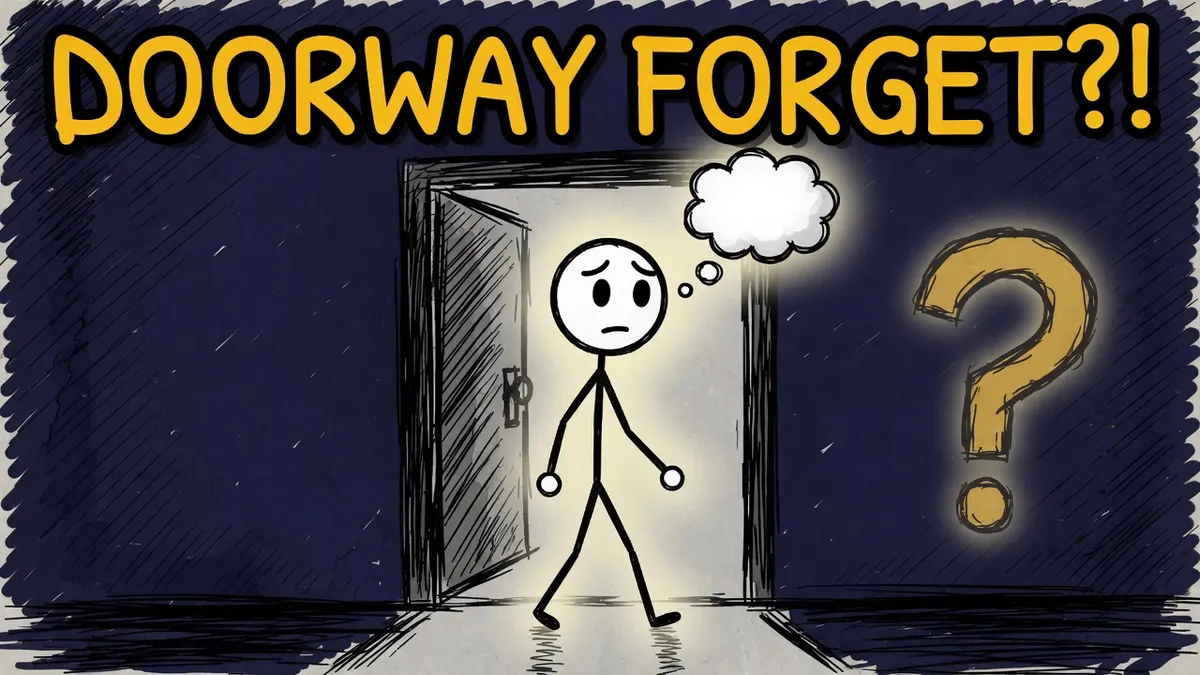
You stand up knowing exactly what you need to do. You have a mission. You stride across the lounge, full of purpose, straight through the kitchen door, and the instant you cross it, your mind goes completely, perfectly blank. You have no idea why you're here. You're just standing in the middle of the kitchen, holding nothing, quietly accusing the fridge. Four seconds ago, you knew. And now… nothing. This happens to everyone, so reliably that scientists gave it a name, and after years of chasing it, they cornered the culprit. It's the door.
01 · The suspectIt's not your age. It's the doorway.
The name is the doorway effect, and the finding is almost insultingly literal. Not your age. Not your attention span. Not your phone. The actual, physical door. The proof comes from Gabriel Radvansky, a memory researcher at the University of Notre Dame, and the setup was beautifully simple. People picked up an object, hid it in a box so they couldn’t peek, carried it a short distance, then tried to remember what they were holding.
Some walked across a large room. Others walked the exact same distance, but stepped through a doorway on the way. Same distance, same time, same task. And the people who went through the doorway forgot more. Radvansky ran it with real boxes in real rooms, then in virtual ones on a screen, and the result held. The destination didn’t matter. The walking didn’t matter. The only thing that mattered was the line they crossed.
02 · The mechanismYour brain chops your life into chapters
So why on earth would a door do that? Here’s the genuinely lovely part. Your brain does not store your life as one long, continuous film. It can’t: the sheer volume would bury it within a day. So instead it quietly chops your experience into chunks: scenes, little chapters it can label, file, and find again later.
To do that, it’s constantly predicting what happens next, and when something breaks the prediction, a new place, a new scene, it drops a marker: new chapter starts here. Researchers call these markers event boundaries, and the framework is Jeffrey Zacks’s Event Segmentation Theory. It’s the very same instinct that lets you watch a film cut from a car chase to a quiet kitchen and never feel lost, your mind was going to slice the world into scenes anyway. And there’s no cleaner scene-break in all of human life than walking through a door.
03 · The wipeThe model that gets closed and refiled
At any given moment, your brain runs a small, live model of your situation: where you are, what you’re doing, what you’re holding in mind. Back in the lounge, that model read I need batteries, they’re in the kitchen drawer. But the second you cross the threshold, your brain decides the chapter is finished. It closes the old model, files it away with everything in it, including your reason, and boots up a clean one for the new room.
And that fresh model knows exactly one thing: I am in the kitchen. The reason you came was in the last chapter. Brain-imaging work has actually caught this in the act: a little spike of activity right at these boundaries, in regions including the hippocampus, as the brain quietly hits save on the event it’s just finished. The blank you feel is that save completing on a scene you no longer need, with the thing you did need still inside it.
04 · The honest catchThe door is a trigger, not an eraser
Now, the grown-up version, because the science got more interesting, and more honest. When other researchers tried hard to repeat the original result, the doorway all by itself often did nothing at all. In some experiments the door changed precisely nothing… right up until they handed people a second task to juggle at the same time. Then, and only then, the forgetting appeared.
So the door isn’t erasing your memory. It’s filing your paperwork at the worst possible second, right when your overloaded brain was barely clinging to the thought in the first place. The doorway is just the trigger; a busy, crowded mind is what was loaded behind it. Which is oddly reassuring: the blank moment isn’t a flaw in the door or a fault in you, it’s what happens when a normal filing system meets a mind that had too many tabs open.
The cure is context. Walk back into the room where the thought was actually born, and it very often comes flooding right back, because your brain didn't lose the intention, it filed it together with that place.
05 · The fixWhy walking back actually works
Memory is strangely glued to location. Your intention wasn’t deleted, it was tucked into the same file as the lounge, the sofa, the moment you thought of it. So returning to that scene hands your brain the retrieval cue it needs, and the thought resurfaces. This is why walking back to where you started isn’t daft at all: you’re literally returning to the scene where the memory was filed.
The most famous illustration is an old one, and it comes with a caveat worth being straight about. In a 1975 study, deep-sea divers learned lists of words either on dry land or underwater, and recalled them best back in the place they’d learned them: words learned underwater stayed underwater. It’s a vivid demonstration of context-dependent memory, though a 2021 attempt to replicate it didn’t find the same effect, so how strong and reliable this is remains debated. The everyday version, though, is one you’ve probably tested yourself: go back to the lounge, and, batteries.
06 · The reframeSo what is that blank moment, really?
That baffled pause in the doorway is not a sign your memory is failing. If anything, it’s the opposite. It’s the receipt for a mind organised enough to find things at all, the very same chapter-making machinery that lets you remember your life as a story you can navigate, instead of one endless, seamless, unsearchable blur.
Which is comforting. Mostly. Right up until you march back to the lounge, remember it was the batteries, feel a brief and glorious wave of triumph, and then forget the entire thing all over again the instant you step back into the kitchen. Two doorways. One absolute genius.
The animated version
Same answer, told as a little animated story with the strange little stickman acting it out. Dry, quick, and, obviously, correct.
Quick questions
Why do I forget what I was doing when I walk into a room?
Because your brain segments experience into discrete 'events,' and crossing a doorway is a powerful event boundary. At that boundary your brain files away the model of the room you just left, including the intention you formed there, and loads a fresh model for the new room. The plan didn't vanish; it got shelved with the old scene, and the new scene doesn't have it.
Is the doorway effect a sign of memory problems or dementia?
No. It happens to healthy people of all ages, and researchers frame it as a normal by-product of an efficient memory system, the very machinery that organises your life into retrievable chapters. It becomes noticeable mainly when your working memory is already loaded up, not because anything is failing.
How do I stop forgetting why I came into a room?
Two things help. Say the thing out loud or hold it firmly in mind as you move, so a busy brain doesn't drop it at the threshold. And if you've already blanked, walk back to the room where the thought started, returning to that context very often brings the intention straight back, because your brain filed it together with that place.
Does walking through a doorway actually cause the forgetting?
It's the trigger, not the eraser. Gabriel Radvansky's original studies pinned the effect on the doorway itself, people forgot more crossing one than covering the same distance in a single room. But later work found the doorway alone often did little until people were also juggling a demanding second task. So the door files your paperwork at the worst possible second; a crowded mind is what makes it stick.
What is an 'event boundary' in the brain?
It's the moment your brain decides one 'chapter' of experience has ended and a new one has begun, usually because something changed: a new place, a new activity, a new set of people. Brain imaging shows a burst of activity around these boundaries, associated with encoding the just-finished event into memory. A doorway is about as clean an event boundary as everyday life offers.
Does the doorway effect get worse as you get older?
Reassuringly, it doesn't seem to. When researchers ran the doorway experiment on both younger and older adults, the memory hit from crossing a threshold was about the same size in both groups, the event-segmentation machinery behind it holds up well with age. Prospective memory (remembering to do things later) does soften a little across a lifetime, but the doorway effect specifically isn't an age story.
Why do I forget things so easily in general?
Usually because of how attention and working memory work, not because anything is wrong. Working memory only holds a few things at once and quietly drops whatever you didn't actively lock in, so if you skimmed, multitasked, or never attached meaning to something, it often never got saved in the first place. Stress, poor sleep and tiredness make this worse by eating the very attention you'd need. Everyday forgetting like this is normal: it's your brain clearing space, not failing.
Can stress, tiredness or anxiety make it worse?
Yes, and this fits what the careful studies found. The doorway effect bites hardest when your mind is already loaded, and stress, fatigue and multitasking all tax the same executive-function and attention systems that were holding your intention in place. Anxiety is a double hit: worrying about forgetting consumes mental resources, which nudges you toward forgetting, a small self-fulfilling loop.
Is it normal to forget why you walked into a room?
Completely. It happens to healthy people of every age, and researchers treat it as a normal by-product of an efficient memory, not a warning sign. If your memory reliably comes back once you retrace your steps or get a cue, that's the ordinary version working exactly as designed.
Why do I remember what I wanted the moment I walk back?
Because your intention was filed together with the place you formed it. Walking back into that room hands your brain the matching cue, and the thought resurfaces, the everyday face of what psychologists call context-dependent memory. One honest caveat: the famous 1975 divers study that first showed this was later hard to replicate, so the effect is real but its strength is debated. The walk-back trick, though, is one most people have quietly tested for themselves.
When is forgetfulness more than the doorway effect, could it be dementia?
The doorway blank is not a dementia sign. The rough line doctors draw: normal forgetting doesn't derail daily life, and the memory comes back with a cue or a moment. Worth getting checked are patterns like memory loss that disrupts everyday activities, repeatedly forgetting recent conversations or events, getting lost in familiar places, or struggling with tasks you've always done easily. If forgetfulness is clearly worsening or interfering with life, it's reasonable to see a doctor, but forgetting why you came into the kitchen, on its own, isn't it.
What is the doorway effect?
The tendency to forget what you intended to do just after walking through a doorway. Lab work suggests the brain treats a spatial boundary as a chance to dump or update short-term goals, so the intention formed in the previous room is harder to retrieve until a cue brings it back.
Does the doorway effect mean my memory is bad?
No. It is a normal, situational glitch in how event boundaries are encoded, not a sign of early dementia or general memory failure. The thought usually returns when you go back or when something reminds you of the original goal.
Take the quiz on this
A quick 4-question check on what you just read. Get them right to earn XP: no points for just scrolling.
Our sources 11 checked
// every claim on this page was checked before it went up