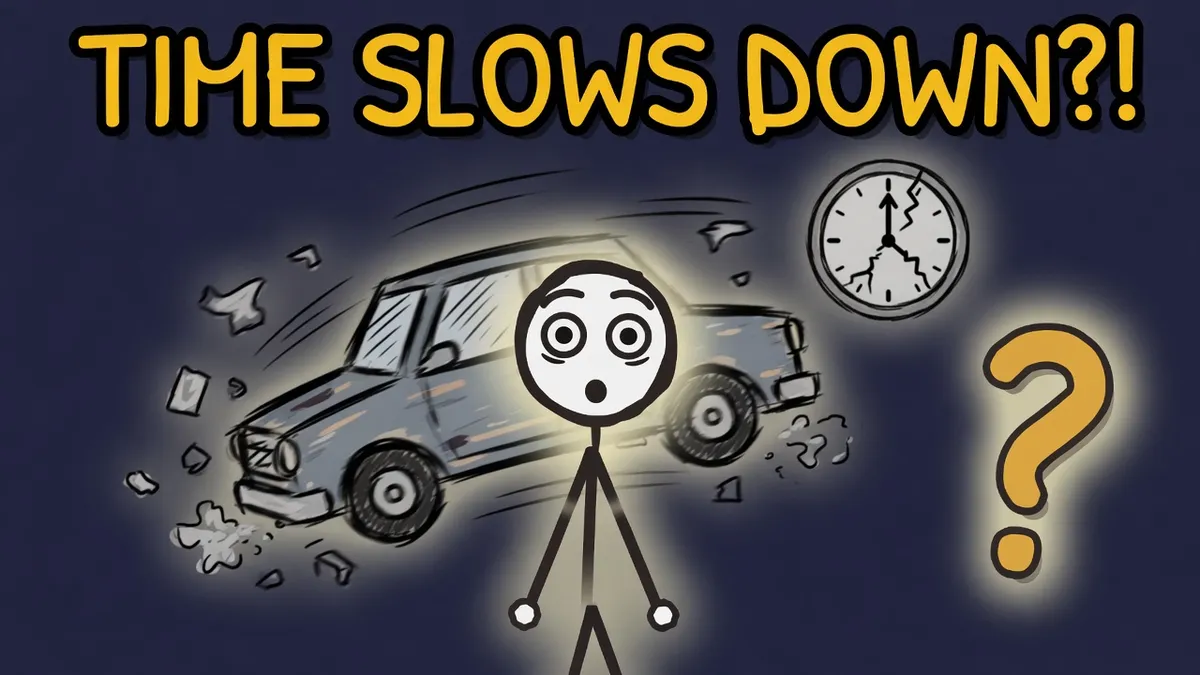
Almost everyone who's been in a car crash, or a bad fall, describes the same uncanny thing. In the split second before impact, time seems to stretch. The world slows to a crawl. You notice tiny details, the other driver's face, a cup tumbling off the dashboard, and it all unfolds with a strange, dreamy slowness. It feels less like an accident and more like a scene played back at half speed. So here's the twist: as far as anyone can measure, it never actually slowed down at all.
01 · The mythThe heroic explanation feels perfect
The obvious story is almost flattering. In an emergency, the idea goes, your brain shifts into a higher gear, it starts running faster than normal, so the outside world appears to slow down, buying you precious extra time to react. Bullet time, essentially, like a movie hero dodging danger in slow motion.
It’s a lovely idea, and it’s very widely believed. It also makes a clean, testable prediction: if your perception genuinely speeds up during terror, then you should be able to see faster, to resolve detail in the moment that you’d normally miss. Which means someone could, in principle, actually check. So someone did.
02 · The setupHow to terrify people on purpose
The neuroscientist David Eagleman needed to genuinely frighten people, safely, and measure them while he did it. So his team used a ride called a Suspended Catch Air Device: you’re hauled up about fifteen storeys, then dropped, backwards, in total free fall, for roughly 150 feet (about 31 metres), before a net catches you. No ropes slowing the descent. Just under three seconds of real, screaming fear.
This wasn’t a mild thrill. Participants consistently rated the fall as truly frightening, which was the entire point. To test whether terror slows time, you first need people who are actually terrified.
03 · The trapA number you can't read, unless you speed up
Here’s the clever bit. Eagleman’s team strapped a small screen to each person’s wrist, a perceptual chronometer. It flashed a number rapidly alternating with its own negative image, tuned to flicker just a touch too fast for that person to read on the ground. Normally it’s a useless blur.
But that blur was the whole experiment. If terror really did speed your brain into slow motion, then during the fall the flickering should effectively slow down enough for you to suddenly read the number. The wrist display was, in effect, a lie detector for the bullet-time myth.
04 · The resultStill just a blur
So they fell. They were genuinely terrified, hearts hammering, adrenaline flooding. And they still could not read the number. It stayed a useless blur mid-fall, exactly as it had on the ground. There was no measurable jump in temporal resolution. No slow motion. No bullet time. Their perception, in the moment, hadn’t sped up by even a fraction.
Which should have been the end of the story, except it wasn’t, because of what those same people said afterward.
When Eagleman asked each faller to estimate how long their own drop had lasted, they overshot, by about a third. On average they judged their own fall roughly 36% longer than the identical falls they'd watched others take. So it genuinely felt longer to them, even though their in-the-moment perception was totally normal speed. Both things were true at once.
05 · The answerThe slow motion is built out of memory
So how can a fall feel long but not run slow? The leading explanation is that the time-slowing isn’t happening live, during the event. It’s being built afterwards, out of memory.
In a calm, ordinary moment, your brain records the world lightly, just the gist. But in a flash of terror, your amygdala flips your memory system to maximum. It lays down an incredibly dense, detailed recording: the same few seconds, but packed with vastly more information than usual. That’s why people in accidents remember the tiny things, the tumbling cup, the exact expression on a face. Their brain was, briefly, filming in obsessive high definition.
(It’s worth being honest that this is an interpretation, not a proven mechanism, but it’s the account the researchers themselves reached, and it fits the data cleanly.)
06 · No stopwatchYour brain guesses duration from memory
And this is the key move. Your brain doesn’t have a literal stopwatch running inside it for events like these. So to judge how long something took, it uses a shortcut: it essentially asks, how much do I remember from that? More memory, it assumes, must mean more time.
So when it later replays a terrifying event stuffed with detail, it reads all that richness back as duration and concludes the event must have lasted a long while. The slow motion you “remember” was never something you experienced as it happened: it’s a reconstruction, played back so full and so rich that your brain reads the tape as long and stretched and slow.
07 · EverywhereWhy a dull month vanishes
Once you see it, it’s everywhere, and it runs both directions. A week packed with brand-new experiences feels huge when you look back on it, because it left behind so much to remember. A month of identical, forgettable days seems to shrink into almost nothing, because there was barely anything to record. For your brain, felt time really is just a measure of how much you remember. (It’s the same reason time seems to accelerate as you get older, as novelty fades and days start to blur together.)
So no, tragically, you don’t get a superpower in a crisis. You never actually got slow motion, and it couldn’t have helped you if you had, because it arrives after the fact. Your brain simply filmed those few seconds in breathtaking, obsessive detail, then played them back so rich and so full that it felt, forever after, like they went on and on.
The animated version
Same answer, told as a little animated story with the strange little stickman acting it out. Dry, quick, and, obviously, correct.
Quick questions
Does time actually slow down during a car crash?
No, not in the moment. Careful experiments show your perception doesn't speed up and the world doesn't literally slow. What happens is that fear makes your brain record the event in unusually dense detail, and when you recall it afterward, all that detail makes it feel like it lasted much longer. The slow motion is a memory effect, not a real-time one.
What was the Eagleman falling experiment?
In a 2007 study, David Eagleman's lab dropped volunteers roughly 150 feet in genuine free fall into a net, wearing a wrist device that flashed numbers just slightly too fast to read. If fear truly sped up perception, they should have been able to read the numbers mid-fall. They couldn't, no faster perception. But they still remembered the fall as about a third longer than it was.
Why do people notice tiny details in an accident?
Because fear cranks up memory encoding. The amygdala flips your memory system into overdrive, so the same few seconds get recorded with far more detail than a calm moment would. That dense recording is what you replay afterward, which is also why it feels stretched out and slow.
Is the 'brain speeds up in danger' idea true?
It's a very appealing idea, but the direct test doesn't support it. Perception doesn't run faster; reaction time isn't magically enhanced. What's real is the vivid, detailed memory, which arrives after the fact, not during, so it can't actually help you dodge anything.
Why does felt time depend on memory?
Your brain has no literal internal stopwatch for events like this, so it uses a shortcut: it estimates how long something took by how much it can recall of it. More memory reads as more time. That's the leading interpretation of Eagleman's result: a rich, dense recording gets read back as a long one.
Why does a boring week feel short but an exciting one feel long?
Same mechanism. New, vivid experiences are encoded in rich detail, so in hindsight that stretch of time feels large. Routine, repetitive days get recorded lightly, little to remember, so they seem to shrink and vanish when you look back. It's also part of why time seems to speed up as you get older.
Do near-death experiences really slow down time?
People who survive falls, drownings and crashes very often report time stretching, or even a sense of complete timelessness, surveys of near-death experiences put time distortion among the most commonly reported features. But 'reported' is the key word. The leading read is the same as Eagleman's: a hyper-detailed memory laid down under threat, later mistaken for a long one, rather than the outside world genuinely slowing. It's a real and near-universal experience; the slow motion itself still looks like it's built after the fact.
Does adrenaline slow down time?
Not literally, as far as anyone can measure. Adrenaline and fear raise arousal, and there's evidence that high arousal can nudge a hypothesized internal 'clock' to tick faster, which makes people overestimate how long a frightening moment lasted. But the direct free-fall test found no real speed-up of perception in the instant itself. So adrenaline stretches felt and remembered duration: it doesn't actually hand you slow motion to act inside.
Why do athletes say time slows down 'in the zone'?
This one is a genuine wrinkle. Separate from the crash research, a 2012 study found that simply preparing to move can stretch your sense of time a little, with visual processing ramping up in the moment just before an action, and elite performers may do this more strongly. Ted Williams swore he could see the stitches on a 100 mph fastball. So unlike the purely retrospective slow-mo of an accident, there may be a small, real, in-the-moment time-expansion tied to skilled action. It's still debated, and it's modest, not the dramatic bullet-time of the movies.
Can you train yourself to slow down time in an emergency?
You can train your reactions: repeated practice under stress genuinely sharpens response times, but that isn't the same as the slow-motion feeling. Remember the free-fall result: perception didn't actually speed up, and the vivid 'slow' memory arrives after the event, so it can't help you dodge anything while it's happening. The takeaway is deflating but useful: prepare and rehearse for a crisis, rather than counting on a time-warp superpower to save you.
Why does time crawl when you're bored or in pain, the opposite of a crash?
That's the flip side, and it runs by a different route. When you're bored, waiting, or hurting, you keep attending to time itself, and the more attention you pay to its passing, the slower it seems to go in the moment (the watched-pot effect). That's the opposite of a crash, where you're utterly absorbed and only judge the duration afterward, from memory. So time can drag live (boredom) or stretch in hindsight (terror) for two entirely separate reasons.
Does adrenaline make you see in slow motion during danger?
It can change arousal and how richly the moment is encoded, but the free-fall experiments found no real-time boost in how fine a detail people could read. The slow-motion story is mostly a memory effect: fear lays down denser memories, so the event expands when you replay it.
Why do boring waits feel long but short when you look back?
Because prospective and retrospective time diverge. Watching the clock makes the present drag. Looking back, a dull stretch left few distinct memories, so it shrinks. A crash or fall does the opposite in memory: high arousal, high detail, longer in hindsight.
Take the quiz on this
A quick 4-question check on what you just read. Get them right to earn XP: no points for just scrolling.
Our sources 11 checked
// every claim on this page was checked before it went up