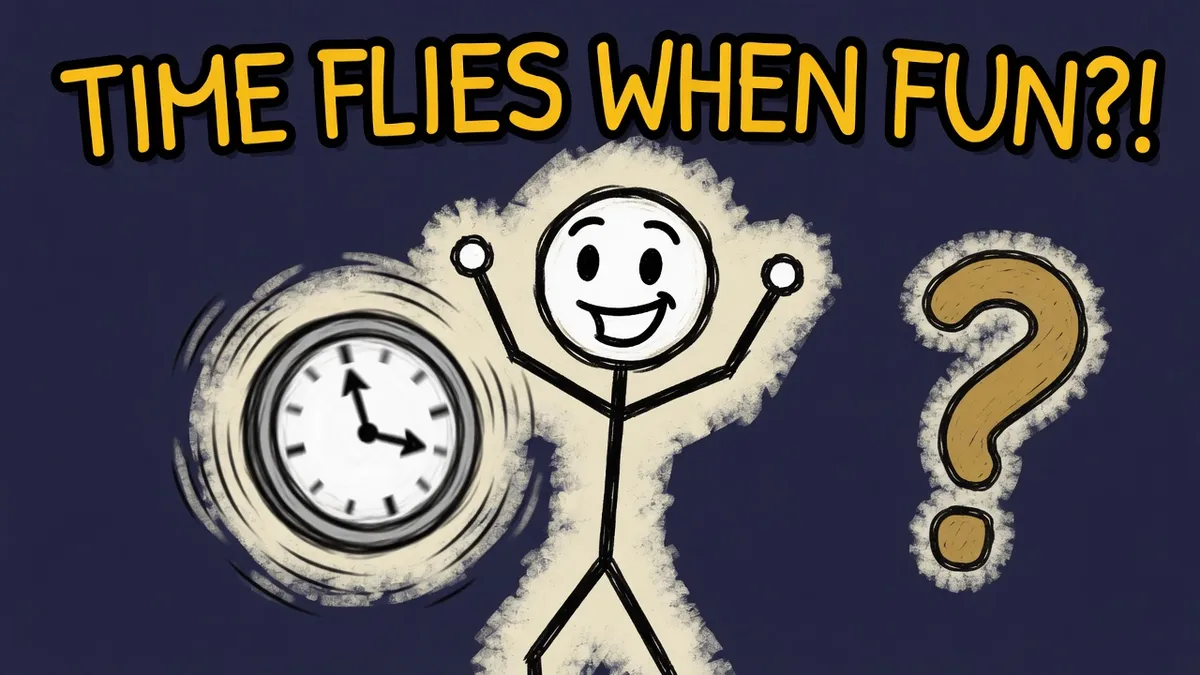
A brilliant evening with people you love is over in what feels like twenty minutes. A dull afternoon meeting, roughly the same length on the clock, seems to last most of a working life. You already know this in your bones. What you might not know is the genuinely odd part underneath it: your brain isn't running one clock that speeds and slows. It's running two, and on the very same afternoon they will flatly disagree with each other. Fun, it turns out, is short and long at the same time.
01 · The gateYour brain only counts time when it's watching for it
Start with the moment itself. The most influential explanation of how we feel time passing is the attentional-gate model, developed by the psychologists Dan Zakay and Richard Block. Picture a little pacemaker in your head, ticking out steady pulses, and between it and a mental counter sits a gate. The pulses only get counted if the gate is open, and the gate opens when you pay attention to time.
That single mechanism does a lot of work. When you’re having fun, your attention is poured into the activity, the conversation, the game, the film, and almost none of it is left over to watch the clock. So the gate mostly stays shut, few pulses get counted, and when you finally surface, hours have passed that your brain never tallied. It feels short because, as far as your internal counter is concerned, not much time was recorded at all.
02 · The crawlWhy boredom does the exact opposite
Now run it backwards. Boredom is the state of having plenty of attention and nothing worth spending it on. So what do you spend it on? Time. You check the clock, you count the minutes, you notice each one arriving. The gate is wedged wide open, and every pulse gets dutifully counted.
The result is that a boring stretch swells. The old saying that a watched pot never boils is, it turns out, decent cognitive science: the watching is precisely what makes it feel endless. Fun and boredom aren’t opposite amounts of fun. They’re opposite amounts of attention paid to time, which is why the empty afternoon and the wonderful evening can run the same length and feel like completely different quantities of life.
03 · The two clocksLived time and remembered time are not the same thing
Here’s where it gets properly strange, and where most explanations stop too early. Everything above is about prospective time: duration as you live it, moment to moment, governed by attention. But there’s a second clock entirely, retrospective time: how long a period feels when you look back on it later. And that one isn’t driven by attention at all. It’s driven by memory.
When you look back and ask “how long was that?”, your brain doesn’t replay a stopwatch. It checks how much it filed. A period stuffed with new, vivid experiences reads, in hindsight, as long. A period of near-nothing reads as short. Which sets up a collision, because the two clocks measure the same afternoon by opposite rules.
A fun, packed afternoon feels short while it happens (your attention was on the fun, not the clock) but long in memory (it laid down a pile of new experiences). A boring afternoon does the exact reverse: it crawls as you live it, then vanishes to almost nothing when you look back.
04 · The holiday paradoxWhy a great week is over in a flash, then feels enormous
The science writer Claudia Hammond gave this collision a name: the holiday paradox. Think of a genuinely good week somewhere new. While you’re in it, it flies, you’re absorbed, the days blur happily together and it’s gone before you’re ready. Then you get home, and a month later that same week feels huge in memory, bigger than the three ordinary weeks that followed it.
Both feelings are correct, because they’re reports from different clocks. The lived week was short (attention on the experience). The remembered week is long (crammed with novelty worth filing). Routine does the whole thing in reverse: a normal Tuesday is slow to sit through and then leaves no trace at all. This is exactly why “time flies when you’re having fun” and “where did that holiday go?” are two halves of the same mechanism, seen from the front and from behind.
05 · FlowThe extreme version, where hours simply disappear
If absorption is what makes time fly, then total absorption should make it vanish, and it does. The psychologist Mihaly Csikszentmihalyi called this state flow: the complete immersion of a musician mid-performance, a coder lost in a problem, a climber who forgets there is a world below the rock. Action and awareness merge, the self-critical inner voice goes quiet, and one of flow’s defining features is that time warps, usually collapsing, so that four hours feel like forty minutes.
Flow is time-flying turned up to its maximum, and it fits the gate model exactly. Your attention is so fully committed to the task that there is essentially nothing left over to monitor time with. The gate isn’t just narrowed, it’s shut. You don’t lose track of time in flow because you’re having fun, exactly. You lose it because there is no spare attention left to keep track with.
06 · The scary exceptionWhen fear seems to slow time down (and the catch)
There’s an apparent counterexample worth handling honestly: terror. In a car crash or a fall, time seems to slow to a crawl, the opposite of flying. Doesn’t that break the model? Arousal is thought to speed up the internal pacemaker, so a frightening moment does pump out more pulses. But the neuroscientist David Eagleman put the dramatic version to the test in 2007, dropping volunteers 150 feet in free fall wearing a device that flashed numbers too fast to normally read.
If time truly slowed in real time, they should have been able to read those numbers mid-plunge. They couldn’t, no better than normal. Yet afterwards they judged their own fall to have lasted about a third longer than it really did. The conclusion: the slow-motion of a crisis is a memory effect, not enhanced live perception. Fear lays down an unusually dense, detailed memory, and in hindsight all that detail reads as “that took ages.” (There’s a whole story in that one, told in why time slows down in a crash.)
07 · The payoffSo why does time fly when you're having fun?
Because “having fun” almost always means “being absorbed,” and absorption steals your attention away from the clock, so your brain counts far fewer of its own ticks and the hours slip by unrecorded. That’s the whole trick of the moment. But don’t mistake it for the whole story, because the second clock is quietly doing the opposite: a good time flies as you live it precisely because it’s rich enough to feel long when you remember it.
And that’s the neat inversion worth holding onto. This is the mirror image of why time feels faster as you get older: that one is about hindsight, whole routine years reading as fast because they left nothing behind. This one is about the living moment. Put them together and you get the small, usable secret of subjective time: the afternoons that fly by are often the ones you’ll remember as long, and the ones that crawl are the ones that disappear. Fun is short now and long later. Boredom is long now and gone forever. Choose accordingly.
Quick questions
Why does time fly when you're having fun?
Because fun usually means absorption, and when your attention is fully on an activity, it isn't on the clock. The leading model says your brain only counts the passage of time when it's paying attention to time. Engrossed in something enjoyable, it counts far fewer of those internal 'ticks', so when you finally look up, far more clock-time has passed than it felt like.
Why does time drag when you're bored?
For the exact opposite reason. Boredom means you've got attention to spare and nothing to spend it on, so you spend it watching time itself, checking the clock, counting the minutes. That constant monitoring means your brain registers more of its internal time-pulses, and the interval swells. A watched pot really does feel like it never boils.
What is the attentional gate model?
It's the most influential explanation of moment-to-moment time perception, developed by Dan Zakay and Richard Block. The idea: a mental pacemaker produces steady pulses, and an attentional 'gate' controls how many reach a counter. Pay attention to time and the gate opens wide, so lots of pulses accumulate and the interval feels long. Focus on a task instead and the gate narrows, fewer pulses get through, and time feels short.
What is the holiday paradox?
A phrase popularised by science writer Claudia Hammond for a strange split: a novel, packed holiday seems to fly by while you're on it, yet feels enormous when you look back weeks later. The reason is that you're running two clocks. In the moment, absorption makes time feel fast; in memory, the pile of new experiences makes the same period feel long. Fun is short to live and long to remember.
Why does a fun afternoon feel short but a boring one feel long, yet swap around in memory?
Because 'lived time' and 'remembered time' are measured differently. While it happens, duration depends on attention: absorbed (fun) feels short, clock-watching (boredom) feels long. Afterwards, duration depends on memory: the fun afternoon laid down lots of new memories and feels long in hindsight, while the boring one left almost nothing and collapses to a blip. The two clocks routinely disagree about the same afternoon.
What is a flow state?
Flow is the psychologist Mihaly Csikszentmihalyi's term for total absorption in a challenging task, when action and awareness merge and self-consciousness fades. One of its hallmark features is a distorted sense of time, usually that hours have compressed into what felt like minutes. It's the most extreme everyday version of time flying, because your attention is so fully committed to the task that essentially none is left to monitor the clock.
Why does time slow down when you're scared or in an accident?
In a frightening moment, arousal spikes and you encode an unusually dense, detailed memory, which makes the event feel, in hindsight, as though it played out in slow motion. But this is a memory effect, not real-time super-vision: David Eagleman's 2007 free-fall experiment found people falling from a tower could not read fast-flashing numbers any better than normal, even though they later estimated their own fall as much longer than it was. For more, see why time slows down in a crash.
Is this the same reason time speeds up as you get older?
No, and that's the neat part: they run in opposite directions. Time flying 'when you're having fun' is mostly about the present moment, absorption closing the attentional gate. Time speeding up 'as you get older' is about memory in hindsight, adult routine filing fewer new memories so whole years read as fast. One is a live effect, the other a retrospective one. See why time feels faster as you get older for that side of it.
Does dopamine control our sense of time?
It seems to play a role, but hold the specifics loosely. Arousal is thought to speed up the internal pacemaker, and much of the neuroscience points to dopamine as a modulator: lower dopamine (as in Parkinson's) tends to slow the internal clock. But a lot of this evidence comes from animal studies and drug experiments, and results conflict on whether raising dopamine makes time feel faster or slower, so it's an active area of research rather than a settled story.
Does being absorbed in your phone make time fly?
Often, yes, for the same reason any absorbing activity does: scrolling captures your attention, so you stop monitoring the clock and the minutes slip past unnoticed. But there's a catch built into the second clock. Because passive scrolling lays down very few distinct memories, that vanished hour also leaves almost no trace in hindsight, so it feels both fast in the moment and, later, like it barely happened. Fun and forgettable at once.
Can you make an enjoyable moment last longer?
You can't slow the clock, but you can thicken the memory. Because remembered duration depends on how much new detail you encode, deliberately paying attention to a good moment, noticing the specifics rather than rushing through, tends to make it feel longer in hindsight. It won't stop a great evening flying by as you live it, but it can stop it vanishing afterwards.
Why does time feel different when you're waiting for something?
Waiting is concentrated clock-watching. When you want a moment to arrive, your attention fixes on time itself, which is exactly the condition that makes the attentional gate open wide and pulses pile up, so the wait drags. The dread or anticipation adds arousal on top, which can stretch it further. It's boredom's impatient cousin: the more you watch for the end, the longer it takes to come.
Does time really fly, or does it just feel that way?
It just feels that way, but 'feels that way' is the entire phenomenon: clock time is fixed, and time perception is by definition about your subjective read of it. The interesting science isn't whether the clock changed (it never does) but why your sense of duration bends so reliably with attention, novelty and emotion, and why the version you live can disagree so sharply with the version you remember.
Take the quiz on this
A quick 4-question check on what you just read. Get them right to earn XP: no points for just scrolling.
Our sources 7 checked
// every claim on this page was checked before it went up