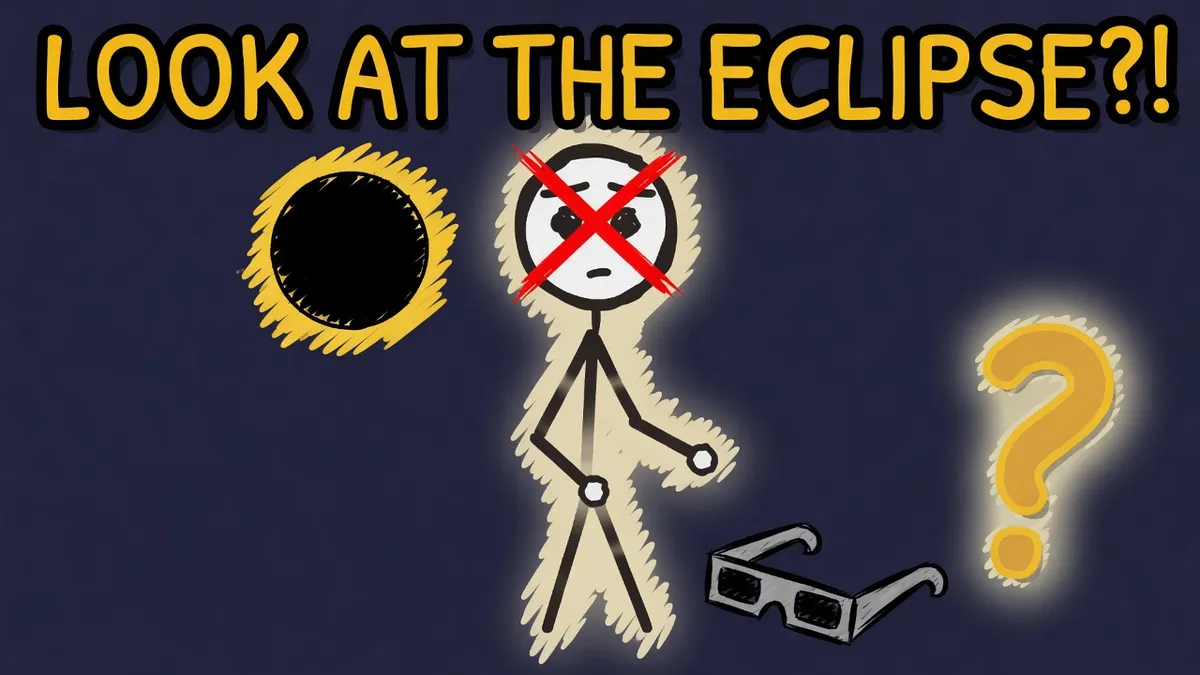
Here is the genuinely unsettling part, the reason this is not just another "don't do that" warning. When you stare at the Sun, it quietly burns the back of your eye, and you feel absolutely nothing. No sting. No heat. No ache to make you flinch away. The tissue being cooked is the one place in your body with no way to shout for help. So the alarm never comes, and the damage announces itself later, often the next morning, as a hole punched in the middle of everything you look at.
01 · The silenceThe burn you can't feel
The retina is the sheet of light-sensing cells lining the back of your eye, the film in the camera. It is exquisitely sensitive to light, which is the whole point of it. What it does not have is a single pain nerve. Nowhere in the retina is there a receptor for pain, because for most of evolutionary history nothing could reach back there to hurt it. So when focused sunlight starts damaging those cells, there is no signal. Your eyes will water and you will squint, but that is machinery in the front of the eye reacting to brightness. The actual injury, at the back, happens in complete silence.
That silence is the danger. Almost every other way you can hurt yourself comes with an instant, insistent alarm: touch a hot pan and you snatch your hand back before you can think. Here, the reflex that should save you never fires, because the burn gives it nothing to fire on. You can do permanent damage while feeling nothing but the vague discomfort of a bright light, which is not enough to make anyone look away.
02 · The mechanismIt's a chemical burn, not just a hot one
You might picture the Sun cooking your retina like a magnifying glass frying an ant, and there is a little of that, a real thermal component. But the main event is stranger and quieter. Solar retinopathy is mostly a photochemical injury: it is the light itself, not the heat, doing the damage. The high-energy short-wavelength part of sunlight, the blue and the ultraviolet, is absorbed by molecules in the retina and kicks off a cascade of destructive chemistry.
Specifically, that absorbed light energy generates free radicals and reactive oxygen species, unstable molecules that tear into the surrounding cells. The damage lands hardest on the retinal pigment epithelium, a support layer beneath the photoreceptors, and on the light-sensing photoreceptors themselves, right in the macula, the small central patch of retina that gives you sharp, detailed, straight-ahead vision. That focus on the centre is exactly why the injury is so cruel: it takes out the part of your sight you use to read, to recognise faces, to look directly at anything.
03 · The delayWhy you find out the next morning
Because the damage is chemical and silent, the symptoms run on a delay. People typically notice nothing during the eclipse and nothing for hours afterward. Then, commonly that evening or the next morning, the vision in the affected eye is wrong. There is a blind or grey spot parked in the centre of your view, one you cannot blink or look away from because it moves with your gaze. Straight lines look bent or warped, a distortion doctors call metamorphopsia. Colours can look faded or off.
In the best-documented modern case, a woman who had looked at the partially eclipsed Sun first noticed the trouble about four hours later: blurred vision, distortion, and colour that had gone strange. That gap between the act and the consequence is part of what makes solar viewing so deceptively risky. Nothing about the moment feels harmful, and by the time your eyes tell you otherwise, the damage is already done and there is nothing to undo it with.
During totality, the few minutes when the Moon completely hides the Sun's bright surface, it is genuinely safe to look with your naked eyes. The Sun is not the enemy. Its blinding surface is. And that surface comes roaring back without warning the instant totality ends.
04 · The safe windowThe one time you can look, and the trap around it
This is the fact that surprises people, and it is worth stating precisely because getting it wrong is how eclipses hurt eyes. When the Moon slides fully in front of the Sun and blocks the entire bright disc, there is nothing dangerously bright left to see, and you can and should take your glasses off and look directly at the ghostly corona. That is the sight people cross the world for. Totality itself is safe.
The trap is everything on either side of it. In the seconds before totality begins and the seconds after it ends, a dazzling sliver of the Sun’s surface blazes out from behind the Moon, the famous “diamond ring.” Even that thin edge is bright enough to burn your retina. And totality does not fade out gently, it ends in an instant. One moment there is safe darkness, the next the diamond ring flares back, and anyone still staring with a naked eye catches the full Sun square in the retina. The rule is strict: you may look only while no part of the bright Sun is visible, and the moment you see the faintest bright edge return, your eyes go elsewhere or the certified glasses go straight back on.
There is a nasty accomplice here, too. As the sky darkens during the partial phases, your pupils widen to gather more light, exactly as they do at dusk. A wider pupil funnels more of the Sun’s focused light onto the retina. So the very dimness that makes an eclipse feel gentle and safe to gaze at is quietly loading more damage into your eye, and tempting you to stare longer while it does.
05 · The gearWhy your sunglasses are useless
For every moment that is not totality, you need a real filter, and the numbers explain why the obvious options fail. The Sun is roughly 100,000 times too bright to look at safely. A proper solar filter has to block about 99.999% of the light, transmitting only around one part in a hundred thousand. Ordinary sunglasses, even the darkest, most expensive polarised pair, block nowhere near that. They cut glare for a day at the beach; they are laughably short of what direct sunlight requires. Stacking two or three pairs does not close the gap either.
What does work: eclipse glasses that genuinely meet the international safety standard, ISO 12312-2, which are thousands of times darker than sunglasses and block the harmful visible, infrared and ultraviolet light. Buy them from a reputable source, because fakes exist, and if a filter lets you see anything other than the Sun itself, it is not dark enough. A shade 14 or darker welder’s glass works too, a rule NASA and the American Astronomical Society both note. And the humble champion is the pinhole projector: a small hole in a card that casts a live image of the crescent Sun onto a surface behind you, so your eyes never point at the Sun at all. It is the safest method going, and it is why, during an eclipse, the gaps between tree leaves scatter tiny crescents all over the ground.
06 · The evidenceThe crescent burned onto a retina
None of this is hypothetical. After the total eclipse that crossed the United States on 21 August 2017, a 26-year-old woman named Nia Payne, from Staten Island, looked at the partially eclipsed Sun. She glanced at it directly for a few seconds, then borrowed what she believed were eclipse glasses and looked again for another 15 to 20 seconds. About four hours later, her central vision was distorted and a dark spot had appeared. She was diagnosed with solar retinopathy, worse in her dominant left eye.
Her doctors at the New York Eye and Ear Infirmary imaged the damage at the cellular level using adaptive optics, and reported it in JAMA Ophthalmology in 2017. What they found is the detail that stays with you: the patch of damaged photoreceptors was shaped like the crescent of the partial eclipse. The Sun had, in effect, printed its own eclipsed silhouette onto the back of her eye, matching the blind spot she drew when asked to map what she could no longer see. Six weeks on, that central blind spot was still there.
07 · The myth and the payoffGalileo, and what all this actually means
One story usually gets dragged into this: that Galileo went blind from staring at the Sun through his telescope. It is a tidy morality tale, and it is almost certainly wrong. Galileo lost his sight in his early 70s, about a quarter of a century after his solar observations, and the likely culprits were cataracts and glaucoma, ordinary ailments of age. He was also careful with the Sun, observing it low on the horizon at sunrise and sunset, and later by projecting its image rather than looking through the eyepiece. The timeline and his methods both point away from sun-gazing. Blame the years, not the eclipse.
So, whole and honest: you cannot look at a solar eclipse, or the Sun on any ordinary day, because focused sunlight sets off a silent chemical burn in the one tissue that cannot warn you it is being hurt. The damage lands in the centre of your sight, arrives hours late, and often does not heal. The single exception is the handful of minutes of true totality, when the bright Sun is fully hidden and the greatest sight in the sky is briefly safe to meet with your own eyes. Everything around that window needs a proper filter or a pinhole and a bit of patience. It is a small price for the one part of your body you can never replace.
Quick questions
Why can't you look at a solar eclipse?
Because focused sunlight burns the retina, the light-sensing tissue at the back of your eye, and that tissue has no pain nerves, so you feel nothing while the damage happens. The injury is called solar retinopathy. It is mostly a photochemical reaction, blue and ultraviolet light driving destructive free-radical chemistry in the retina, and the symptoms usually turn up hours later rather than at the time.
Does looking at the Sun hurt your eyes?
Not in the moment, which is exactly what makes it dangerous. The retina contains no pain receptors, so a burn there produces no sting, no ache, nothing. Your eyes may water and you will squint against the brightness, but those are reflexes in the front of the eye. The actual damage at the back is silent, and you usually only discover it hours later when a blurred or blank spot appears in your vision.
How long does it take to damage your eyes looking at the Sun?
There is no proven safe number of seconds. In a documented 2017 case, a woman suffered permanent damage after looking at the partially eclipsed Sun for a matter of seconds without proper protection. Sunlight is intense enough that even brief direct staring can start the photochemical injury, and because you feel nothing, there is no reliable signal telling you when you have looked too long.
What is solar retinopathy?
It is the medical name for retinal damage caused by staring at the Sun. Intense light, especially the blue and ultraviolet part of the spectrum, drives a photochemical reaction that produces free radicals and damages the retinal pigment layer and the photoreceptors in the macula, the small central patch of retina responsible for sharp, detailed vision. There is also a smaller thermal (heat) element. The result is a blind spot or distortion right in the centre of your sight.
Is the damage from a solar eclipse permanent?
It can be either. Some people recover partly over weeks to months as the retina settles; others are left with a permanent central blind spot or distortion. There is no treatment that reverses solar retinopathy, no drug or surgery that regrows the damaged cells. In the well-documented 2017 case, the patient still had a central blind spot six weeks later. The honest answer is that it is a gamble you cannot win, because there is no upside to the risk.
Why is it safe to look during totality but not before or after?
During totality the Moon completely covers the Sun's blindingly bright surface, so for those brief minutes there is nothing dangerous left to look at, and it is genuinely safe with the naked eye. That is the whole reason people travel to see it. The danger is the moments on either side: even a sliver of the Sun's surface, the dazzling burst called the diamond ring, is bright enough to burn, and it reappears without warning the instant totality ends.
When is it safe to take off eclipse glasses during a total eclipse?
Only once the Moon has fully covered the Sun and no part of the bright surface is visible, when you can no longer see anything through your eclipse glasses. At that point totality has begun and you may look directly. The critical rule is the reverse: the moment you see even a thin bright edge of the Sun reappear, put the glasses back on immediately. Totality ends abruptly, and the returning diamond ring is exactly as dangerous as the Sun before the eclipse.
Can you look at a partial solar eclipse without glasses?
No. A partial eclipse, or the partial phases before and after totality, is just the ordinary Sun with a bite taken out of it, and the exposed part is as dangerous as the Sun on any normal day. It looks safer because the sky dims and the glare drops, but that dimming is a trap: your pupils widen and let in more light, and the exposed crescent is still bright enough to burn. You need proper filters for every moment except totality itself.
Why does the dimming during an eclipse make it more dangerous?
Because your pupils respond to the overall darkness by opening wider to gather more light, the same as they do at dusk. A wider pupil lets more of the Sun's focused light reach the retina. So during a partial eclipse you get a false sense of safety, the scene is dim and comfortable, while your dilated eye is actually funnelling more damaging light onto the retina than usual. The comfort is exactly why people stare longer.
Do normal sunglasses protect you during an eclipse?
No, not even close, and this misconception genuinely injures people. The Sun is roughly 100,000 times too bright to look at safely, meaning a safe filter has to block about 99.999% of the light. Ordinary sunglasses, even very dark or polarised ones, block only a small fraction of that and let through vastly too much. Stacking several pairs does not help either. You need purpose-made solar filters, nothing else counts.
What are ISO 12312-2 eclipse glasses?
ISO 12312-2 is the international safety standard for filters made specifically for looking directly at the Sun. Glasses that genuinely meet it block essentially all of the harmful visible, infrared and ultraviolet light and are thousands of times darker than sunglasses. Buy from a reputable supplier, since counterfeit and non-compliant 'eclipse glasses' do exist. If a filter lets you see anything other than the Sun itself, it is not dark enough.
Can you use welder's glass to look at the Sun?
Only shade 14 or darker, and no lower. Welding filters are rated by shade number, and NASA and the American Astronomical Society note that a shade 14 welder's glass is dark enough for direct solar viewing. Anything lighter, shade 12 or below, lets through too much and is not safe. If you are unsure of a welding filter's exact shade, do not use it; a certified pair of eclipse glasses removes the guesswork.
How does a pinhole projector work for viewing an eclipse?
A pinhole projector lets you watch the eclipse safely without ever looking at the Sun. You poke a small hole in card and let sunlight pass through it onto a second surface, which casts a live image of the crescent Sun that you view by turning your back to the Sun. It is the safest method of all because your eyes are pointed away from the Sun entirely. Even the gaps between tree leaves do it, scattering little crescents across the ground during an eclipse.
Did Galileo go blind from looking at the Sun?
Almost certainly not, despite the popular story. Galileo went blind in his early 70s, roughly a quarter of a century after his solar observations, and the likely causes were cataracts and glaucoma, not sun damage. He also observed the Sun sensibly, near the horizon at sunrise and sunset, and later by projecting its image rather than looking through the telescope. The timeline and his methods both argue against sun-gazing as the cause.
Take the quiz on this
A quick 4-question check on what you just read. Get them right to earn XP: no points for just scrolling.
Our sources 10 checked
// every claim on this page was checked before it went up