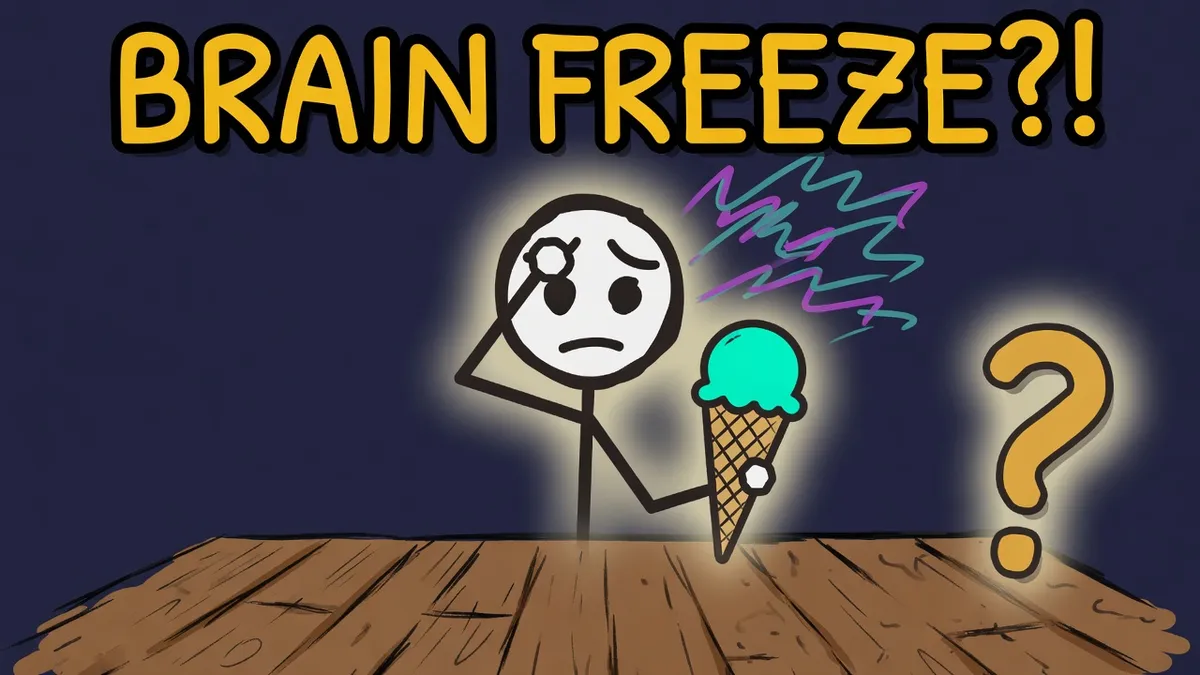
You take a big, greedy bite of ice cream, and for one glorious second everything is perfect. Then a stabbing, splitting pain spikes up right between your eyes. Here's the genuinely strange part: the cold is in your mouth. It never went anywhere near your forehead. So why does it feel like someone is stabbing you in the head?
01 · The fancy nameA tiny agony with an enormous title
This little moment of misery has a gloriously oversized name: sphenopalatine ganglioneuralgia. Doctors more plainly call it a cold-stimulus headache. And it’s genuinely special, because it’s one of the only headaches on Earth you can summon completely on demand, which, as we’ll see, makes it a real gift to the scientists who study pain.
02 · The palateIt all begins on the roof of your mouth
It doesn’t start in your head at all. It starts on your palate, the roof of your mouth. Slam something freezing against it and you’re not just chilling a bit of skin. Sitting just above that palate is a busy little junction box of nerves, right alongside some of the major arteries carrying blood up into your brain. Cool that spot fast enough, and you set the whole chain reaction going.
03 · The arteryThe blood vessel that panics
Those arteries really do not like sudden cold, and in 2012, a researcher named Jorge Serrador actually watched this happen in real time using ultrasound. His team had people sip ice-cold water while a transcranial Doppler tracked blood flow at the front of the brain. As the brain-freeze pain arrived, the anterior cerebral artery flooded wide open, a sudden surge of blood right at the front of the skull. And here’s the tell: the moment the artery clamped back down, the pain vanished. Give the volunteers warm water and you could switch the artery, and the pain, off on cue.
04 · The wrong addressWhy the pain rings in your forehead
Now for the good bit: the alarm rings in completely the wrong place. The culprit is one specific nerve, the trigeminal, the great sensory cable for your entire face. Crucially, that same nerve carries signals from both the roof of your mouth and your forehead. So when a panic signal comes screaming up from your palate, your brain looks at the line it arrived on, can’t pin down exactly where along that shared cable it started, and simply guesses it must be the forehead.
This is referred pain, pain that is completely real, but delivered to the wrong address. It’s the same trick behind a heart attack that aches in the left arm. Nothing whatsoever is wrong with your forehead. It’s an honest filing error.
The single most useless-feeling pain you own turns out to be one of science's favourite tools. Brain freeze is the only headache you can reliably switch on and off at will, a safe, tiny, on-demand model of a far nastier problem.
05 · The migraine windowWhy scientists actually want your brain freeze
That on-demand quality is why researchers are so fascinated by it. Most headaches you can’t schedule; this one you can trigger with a spoon. And there’s a tantalizing link: people who suffer from migraines are noticeably more likely to get brain freeze, and some of the same nerve and blood-vessel plumbing appears to be involved. The hope, and it’s still a hope, not a cure, is that studying this harmless little headache might help crack the properly debilitating kind. (Worth hedging: migraine is a complex brain disorder, not simply a blood-vessel problem, so brain freeze is a window, not the whole picture.)
The leading idea for why your body does any of this is that it’s trying to protect you. Your brain runs best at a steady temperature, so the rush of warm blood is probably a frantic attempt to keep it toasty, and the pressure spike that comes with it gets an emergency pain signal slapped on top. In effect: stop, slow down, you are freezing the single most important organ you own.
06 · The cureHow to switch it off in thirty seconds
Happily, the mechanism tells you exactly how to stop it. You don’t need painkillers, you need warmth, fast. Press your tongue flat against the roof of your mouth. Sip something warm. Or just breathe through your mouth for a moment to push warm air over the palate. Re-warm that spot and the artery settles, the alarm switches off, and the pain is usually gone within about thirty seconds. You can dodge it entirely, of course, by eating cold things more slowly, but let’s both be honest here. You won’t.
So a brain freeze isn’t really a headache at all. It’s your brain briefly panicking about its own temperature, then posting the bill to entirely the wrong part of your face.
The animated version
Same answer, told as a little animated story with the strange little stickman acting it out. Dry, quick, and, obviously, correct.
Quick questions
Why does brain freeze hurt my forehead when the cold is in my mouth?
It's a phenomenon called referred pain. The trigeminal nerve carries sensation from both the roof of your mouth and your forehead. When a cold signal comes screaming up from your palate, your brain can't pin down exactly where on that shared line it started, so it guesses, and picks the bigger, more familiar spot: your forehead. Nothing is actually wrong there.
What is the medical name for brain freeze?
Sphenopalatine ganglioneuralgia, a gloriously oversized name for a tiny moment of pain. More plainly, doctors call it a cold-stimulus headache or ice-cream headache.
How do you get rid of brain freeze fast?
Re-warm your palate. Press your tongue flat against the roof of your mouth, sip something warm, or just breathe through your mouth for a moment. Warmth calms the artery down, and the pain usually fades within about 30 seconds. You can also head it off by eating cold things more slowly.
Is brain freeze dangerous or bad for your brain?
No. It's brief and harmless. The pain is a false alarm, a real pain signal delivered to the wrong address. In most people it lasts under five minutes, and nothing is being damaged. It may even be protective, prompting you to slow down before you over-chill things.
Why do some people get brain freeze and others don't?
It partly comes down to how quickly you eat cold food and how sensitive your trigeminal system is. Notably, people who get migraines are more likely to get brain freeze: the same nerve pathways seem to be more reactive, which is one reason scientists study brain freeze as a safe, on-demand model for migraine.
How long does brain freeze last?
Not long, that's the mercy of it. The pain peaks within seconds of the cold hitting your palate and is usually gone within about 20 to 60 seconds. In roughly 98% of people it clears in under five minutes, with no painkillers, no aftermath, and nothing left behind.
How do you prevent brain freeze?
Slow down, and keep the cold off the roof of your mouth. Take smaller bites, let each one warm at the front of your mouth before it reaches your palate, and pause between mouthfuls. Licking a cone rather than spooning it in, and sipping a slushie from the side of the glass rather than firing it straight up through a straw, both help. The trigger is fast, hard cooling of the palate, remove that and there's no chain reaction to start.
Does warm water actually help brain freeze?
Yes, and there's real evidence for it. In the 2012 Doppler study, giving volunteers warm water made the over-dilated artery clamp back down, and the pain went with it. Anything that re-warms the roof of your mouth does the same job: warm water, your own tongue pressed flat against your palate, or a few breaths of warm air. You're simply undoing the cold that started it.
What actually causes brain freeze?
Something very cold cools the roof of your mouth fast, which rattles the arteries feeding the front of your brain, one of them suddenly floods wide open. The cold-and-pressure alarm rides up the trigeminal nerve, the same nerve that also serves your forehead, so your brain misreads where the pain is coming from and posts it to your forehead. Cold palate, panicked artery, misdelivered pain, that's the whole recipe.
Do children get brain freeze more than adults?
They do, and it's not only because they eat ice cream faster. Children have smaller mouths, so a cold spoonful chills the palate more quickly and completely. Reported rates vary wildly between studies, but they run higher in kids, one large survey of Taiwanese schoolchildren found around 40% got brain freeze, and people do seem to grow a little more resistant with age. Treat the exact numbers as a rough range rather than a hard fact.
Can you get brain freeze from cold drinks and slushies, not just ice cream?
Absolutely. Ice cream just takes the blame. Any hard hit of cold on the palate can do it, which is why slushies, frozen drinks, milkshakes and even a big gulp of ice water are classic culprits. The formal medical definition even covers cold you breathe in, like a lungful of freezing air. It's the cold and the speed that matter, not what's delivering it.
What is the medical name for brain freeze?
Sphenopalatine ganglioneuralgia, more often called cold-stimulus headache. It is a short, sharp pain from cold on the palate, not from your brain tissue actually freezing.
How do you stop brain freeze quickly?
Warm the palate. Press your tongue flat against the roof of your mouth, sip a warm drink, or breathe warm air. Pain usually lasts only about 20 to 60 seconds and resolves in under five minutes in almost every case once the cold stimulus is gone.
Take the quiz on this
A quick 4-question check on what you just read. Get them right to earn XP: no points for just scrolling.
Our sources 11 checked
// every claim on this page was checked before it went up