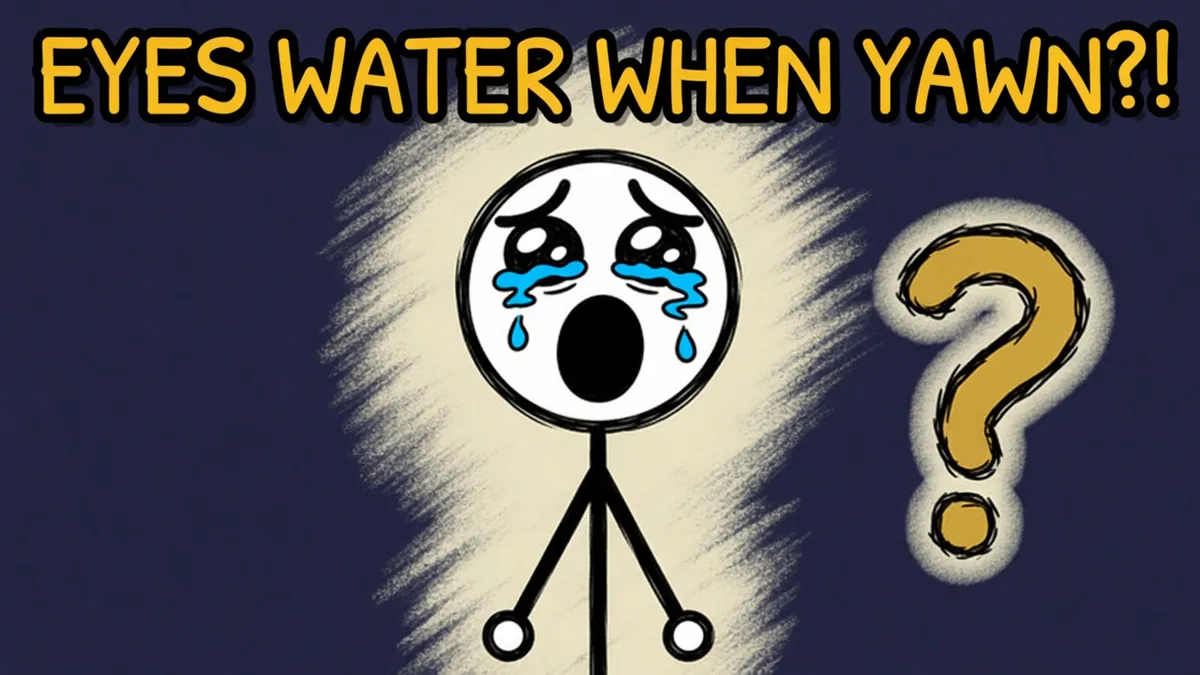
You feel a really big yawn coming, the deep, full-body kind, and you surrender to it completely. And when it passes and your vision clears, your eyes are brimming, maybe even spilling over. But you're not sad. You weren't even that tired. So where did the tears come from? The answer is a small, surprising piece of plumbing, and the yawn itself is almost a red herring.
01 · A yawn is a whole-face event
Here’s the first thing to notice: a proper yawn isn’t just an open mouth. As your jaw stretches wide and you drag in that huge breath, you almost always scrunch your eyes shut, hard. That involuntary squint is powered by the orbicularis oculi, the ring-shaped muscle that circles each eye socket and clamps the lids together. And a big yawn clenches it tight. That clench, not the yawn, not the breath, is where the tears begin.
02 · Wringing the spongeSqueezing the tear gland
Just above the outer part of each eye sits the lacrimal gland, the little factory that makes the watery part of your tears. There’s always some tear fluid sitting in and around it. When the orbicularis oculi clenches during a yawn, it presses on that gland and the tissue around it, and the effect is exactly like wringing a sponge: it pushes a slug of fluid out onto the surface of your eye, all at once. Nothing is being newly produced from sadness or emotion. You’re just squeezing out what was already loaded and ready.
03 · Kinking the drainWhy it actually overflows
But squeezing more fluid out isn’t quite enough to explain the overflow. The second half is about where tears normally go. Tears don’t just evaporate; they drain. After washing across your eye, they exit through tiny holes called puncta in the inner corners of your lids, run down small canals, and empty through a duct into your nose. (That’s why a good cry, or a big yawn, leaves you sniffly.) During a hard eye-scrunch, the muscles squeezing your tear glands also pinch that drainage plumbing, so tears leave more slowly than usual. More fluid pushed out, less fluid draining away: the surplus pools, and spills.
The watering has almost nothing to do with the yawn itself. It's the squint. Any forceful eye-scrunch does the exact same thing: a hard sneeze, a big belly laugh, a strained grimace. The yawn just happens to be the everyday moment when we reliably clench our eyes that tightly.
04 · Not the crying kind
It’s worth being clear about what these tears are not. Your body actually makes three different kinds of tears: basal tears that constantly lubricate the eye, reflex tears that flush out irritants like onion fumes, and emotional tears that come with genuine feeling. Yawn tears are firmly in the mechanical camp, just ordinary lubricating fluid squeezed out and briefly overflowing. You’re not welling up. A muscle simply pressed on the tap and kinked the drain at the same moment.
05 · Why not everyone brims
If it’s all just muscle mechanics, why do some people flood with every yawn while others rarely notice? Because the details vary from person to person: how forcefully you yawn, how tightly you actually screw your eyes shut, and the precise anatomy of your glands and drainage ducts. There’s also a stacking effect. If your eyes are already tired and a little dry (say, late at night, when the yawns come thick and fast), they’re primed to produce extra fluid anyway, and the yawn’s squeeze pushes it over the edge. A sleepy yawn tends to water you up far more than an alert one.
06 · The honest footnoteAn under-studied little mystery
One last, fair admission. The anatomy here, the glands, the muscle, the drainage, is extremely well understood. But the specific link between yawning and watery eyes has barely been studied on its own. The pressure-and-drainage explanation is a very reasonable deduction from known plumbing, not the conclusion of dedicated experiments. So treat it as the best current answer rather than a sealed case. Which is oddly fitting, because we don’t fully know why we yawn at all. The watery eyes are a small, well-explained side effect of a much larger reflex that science still hasn’t entirely figured out.
Quick questions
Why do my eyes water when I yawn?
When you yawn you usually squeeze your eyes shut hard. That muscle contraction presses on your tear glands, pushing out tear fluid, while also partly pinching the tear drainage ducts closed. More tears come out and fewer drain away, so a little pools and can spill over.
Is it normal for your eyes to water when you yawn?
Yes, completely normal. It is a harmless mechanical side effect of scrunching your eyes during a big yawn. Some people notice it every time and others rarely, mostly due to how forcefully they yawn and their individual anatomy.
Which muscle makes your eyes water when you yawn?
The orbicularis oculi, the ring-shaped muscle that circles each eye and snaps your eyelids shut. When it clenches hard during a yawn, it presses on the nearby tear gland and drainage system.
Are yawn tears the same as crying?
No. Crying produces emotional tears tied to feelings, while yawn tears are just ordinary lubricating fluid squeezed out mechanically. You are not sad, your eye muscles simply pushed some fluid out.
Where do tears go when they drain?
Tears exit through tiny holes called puncta in the inner corners of your eyelids, travel down small canals and the nasolacrimal duct, and empty into your nose. That is why hard crying or big yawns can make your nose run.
Why do I tear up more when I yawn if I'm tired?
Tired, dry eyes are already primed to produce a bit more fluid, and a yawn adds a burst of pressure on the tear glands. The two effects stack, so a sleepy yawn often waters your eyes more than an alert one.
Does everyone's eyes water when they yawn?
No. It depends on how forcefully you yawn, how tightly you close your eyes, and your individual gland and duct anatomy. Some people water up almost every yawn, others almost never.
Why does yawning make my nose run too?
Because tears drain from your eyes into your nose through the nasolacrimal duct. A yawn that pushes out extra tears sends that surplus fluid toward the nose, so you may sniffle right after.
Can sneezing or laughing make your eyes water like yawning?
Yes. Any forceful eye-scrunch, sneezing, hard laughing or straining, squeezes the tear gland and drainage ducts the same way a yawn does. The trigger is the eye closure, not the yawn specifically.
Are watery eyes when yawning a sign of a problem?
Almost never on their own. Occasional yawn tears are normal. If your eyes water constantly, feel gritty, or your vision blurs, that points to dry eye or a blocked tear duct and is worth an eye exam, but yawning itself is not the cause.
What are the three types of tears?
Basal tears constantly lubricate and protect the eye, reflex tears flush out irritants like smoke or onions, and emotional tears come with strong feelings. Yawn tears are basically basal or reflex fluid overflowing mechanically.
Why do we yawn in the first place?
Scientists are not fully sure. The leading idea is that yawning helps cool the brain, and it is also strongly linked to tiredness and social contagion, but no single explanation is settled.
How long does the watering last after a yawn?
Just a moment. Once the yawn ends and your eye muscles relax, the tear drain reopens and any pooled fluid clears within a few seconds. It is a brief overflow, not lasting watering.
Our sources 8 checked
// every claim on this page was checked before it went up