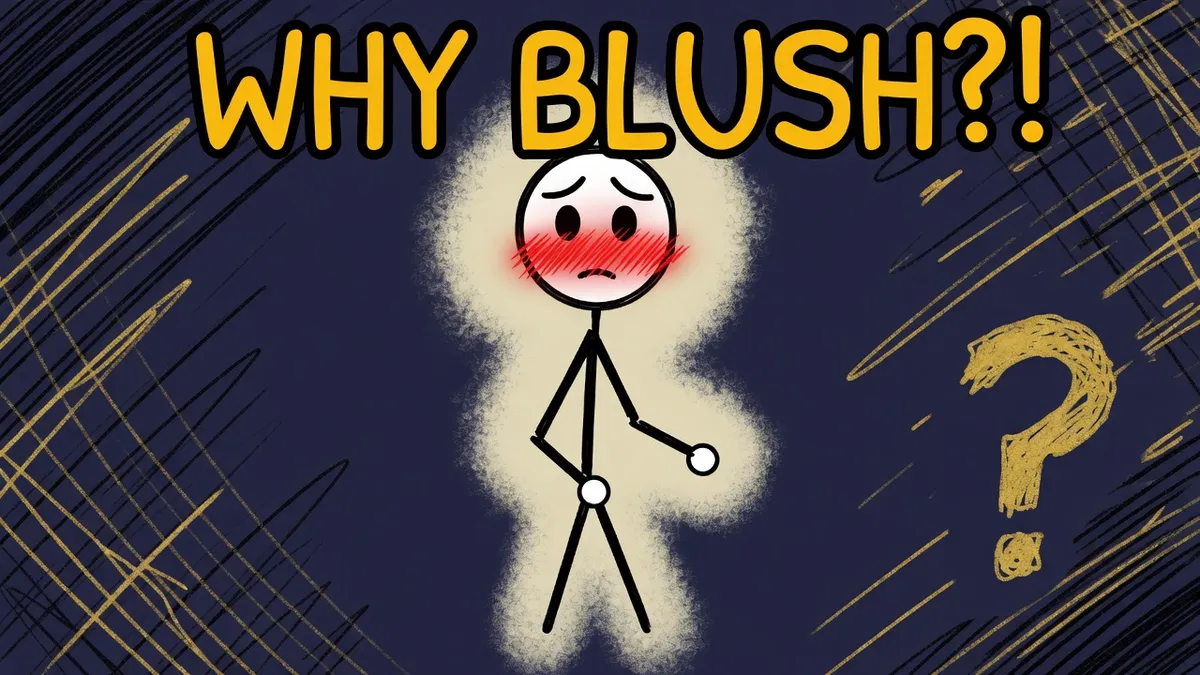
There is one feeling your body absolutely refuses to keep secret. Someone says your name across a crowded room, every head turns, and in an instant your face is on fire, hot, scarlet, glowing. You'd give anything to make it stop, and the wanting is what makes it worse. Here's the genuinely strange part: this is the one expression you have no control over whatsoever. You can fake a smile. You can force a tear. But nobody, anywhere, can fake a blush. And that turns out to be the entire point.
01 · The mysteryThe most human expression there is
Charles Darwin was so taken with blushing that he made it the final chapter of his book on human emotion, and called it the most peculiar, and the most human, of all expressions. Peculiar, because it seems to work against you. Human, because, as far as anyone can tell, no other animal on Earth does it. Some creatures redden from heat or exertion, but a facial flush that fires the moment you sense other people judging you appears to belong to us alone. It seems to need something quite sophisticated: the ability to imagine what someone else is thinking about you.
02 · The triggerA jolt, then a shot of adrenaline
It begins with a social jolt (embarrassment, sudden attention, unexpected praise), and your fight-or-flight system firing off a shot of adrenaline. Notice that the trigger isn’t really shame; it’s exposure. The feeling of being seen. That’s why a compliment can set you off just as easily as a blunder: both put you suddenly on stage, and your nervous system responds to the spotlight, not the emotion.
03 · The paradoxThe same chemical that makes you pale
Now, here’s where it gets counterintuitive. In most of your body, that adrenaline does exactly one thing to your blood vessels: it squeezes them shut. That’s why a fright can drain the colour clean out of your skin and leave you white as a sheet. Same chemical, same fight-or-flight surge, and the result is pallor. So by rights, a stressful social moment should make you go pale, not red.
04 · The rebelsWhy your face does the opposite
But the blood vessels in your face are rebels. Hit the cutaneous vessels of your cheeks with that same adrenaline and they do the reverse of everywhere else: they fling themselves wide open. Warm blood comes flooding up into your face, and your cheeks turn red, and hot, and impossible to ignore. The maddening part is that none of it is up to you. It runs on the sympathetic nervous system, the same automatic wiring that governs your heartbeat, so you can no more decide to stop a blush than decide to stop your pulse. An actor can summon tears on cue. Nobody can summon a blush.
05 · The puzzleWhy build a feature that betrays you?
Which is genuinely baffling from an evolutionary standpoint. The precise moment you most want to disappear, your body throws up a giant glowing sign that screams I am mortified. It broadcasts your embarrassment to everyone in the room, loudly, in a colour you can’t turn off. Why on earth would evolution build a feature whose only apparent job is to make your most vulnerable moment maximally visible?
The very thing that makes a blush feel like a betrayal, that you can't fake it and can't fake your way out of it, is what makes it valuable. An un-fakeable signal is a trustworthy one.
06 · The answerAn apology you can't fake
Here’s the resolution. Precisely because you can’t produce a blush at will, a blush is an honest signal. It can’t be counterfeited by someone who doesn’t actually care, which is what makes it worth reading. Without a single word, it tells everyone watching: I know I slipped. I care what you think. I’m not shameless. In small, tightly bound ancestral groups, where reputation was survival, and a wrongdoer had to be seen to feel it, a genuine, un-fakeable flag of remorse would have been enormously useful. It does the apologising for you before your brain has even caught up.
And it measurably pays off. In the 2011 study memorably titled Saved by the Blush, researchers had people watch a partner defect on them in a trust game, then showed a photo of that partner either blushing or not. The blushers were subsequently trusted with more money, expected to behave better, and judged more positively. Across this line of research, people who go red after a blunder are trusted more, liked more, and forgiven faster than those who stay coolly composed. The blush works as a character reference you didn’t ask for.
07 · The newest clueInside the blushing brain
For all Darwin’s certainty that blushing needs a mind imagining other minds, the newest evidence complicates the story in a lovely way. In 2024, researchers slid volunteers aged 16 to 20 into an MRI scanner and made them watch videos of themselves singing karaoke, about as exposed as a person can feel. The ones who blushed hardest didn’t light up the brain’s mentalizing network, the circuitry we use to work out what other people are thinking of us. Instead, the extra activity showed up in regions tied to raw emotional arousal, the cerebellum and the early visual areas. It’s a single, small study, so hold it lightly. But it hints that a blush might be less a deliberate thought, they’re judging me, and more an immediate, bodily jolt to the simple fact of being watched. Which means the deepest question here, whether blushing needs sophisticated self-awareness at all, is still genuinely open.
08 · The payoffSo what is a blush, really?
It’s not a weakness, and it isn’t your body betraying you. It’s the single most honest apology your body can make, an involuntary, un-fakeable flag that says I’m sorry, and I’m one of you. The same surge that pales the rest of you floods your face on purpose, running a signal older than language over the top of your embarrassment. So the next time your whole face goes nuclear in front of everyone, try to relax. It isn’t humiliating you. It’s quietly vouching for you. Loudly. In red.

The animated version
Same answer, told as a little animated story with the strange little stickman acting it out. Dry, quick, and, obviously, correct.
Quick questions
Why does my face go red when I'm not even that embarrassed?
Because a blush isn't triggered by embarrassment specifically: it's triggered by sudden social attention. Praise, being caught out, even just having every head in a room turn toward you flips your body into its fight-or-flight state and releases adrenaline, which is what actually reaches the blood vessels in your face and opens them up.
Why can't I stop myself blushing?
Because it runs on your sympathetic (fight-or-flight) nervous system, which isn't under conscious control. You can't consciously dilate the tiny vessels in your cheeks any more than you can slow your own racing heart by deciding to. Trying to stop it usually raises your arousal further, which only feeds the blush.
Why does adrenaline make the rest of my body go pale but my face go red?
In most of your skin, adrenaline constricts blood vessels, which is why a fright can drain the colour from your face and leave you white as a sheet. But the cutaneous vessels of the face are unusually responsive and dilate instead, so the same chemical that pales your body floods your cheeks.
Do animals blush?
As far as we can tell, no. Some animals redden from heat or exertion, but a socially triggered, involuntary facial flush appears to be uniquely human, which is exactly why Darwin was so fascinated by it. Blushing seems to require the ability to imagine what others are thinking about you.
Is blushing actually a bad thing socially?
The research suggests the opposite. A blush after a slip signals that you know you've slipped and that you care, an honest apology your body makes before your brain can. In studies, blushers are trusted with more, judged more positively, and forgiven faster than people who stay composed.
How do I stop blushing in the moment?
You can't switch a blush off by willpower, but you can take the edge off. Slow, deep breathing nudges your parasympathetic ('rest and digest') system, which pushes back against the adrenaline surge; something cold against the face or neck helps too. The most effective move, though, is mental: the more you panic about blushing, the harder you blush, so deliberately putting your attention back on the conversation, rather than on your own cheeks, tends to let it fade. For blushing that genuinely distresses you, cognitive behavioural therapy is the best-evidenced longer-term fix.
Why do I blush so easily when other people don't?
Some of it is temperament: people prone to social anxiety or high self-consciousness blush more, partly because they pay closer attention to being watched, which feeds the response. There may be a physical element too: some researchers suspect small differences in the sympathetic nerve wiring make certain faces flush more readily. And blushing is self-reinforcing. The more you dread it, the more reliably it turns up.
Is blushing attractive?
Often, yes, even though blushers rarely believe it. Because a blush signals sensitivity to others and can't be faked, people who go red tend to be judged as more trustworthy, more generous and more likeable, and are forgiven their slips more readily. There's a real gap here: the person doing the blushing usually rates it as mortifying, while the people watching read it as endearing.
Is blushing a sign of anxiety?
Not on its own, everyone blushes, and an occasional flush is just normal social wiring. But blushing and social anxiety often travel together, and when the fear of blushing becomes intense it has its own name: erythrophobia. It runs on a vicious loop: you dread going red, the dread spikes your arousal, and that makes you go red, which is exactly the loop therapy aims to break.
Why do I blush for no reason?
Usually there is a reason, just not an obvious one: the real trigger is attention, not embarrassment, so simply feeling watched, or even anticipating it, can set you off with nothing 'wrong' happening. Worth knowing, though, that not every red face is an emotional blush. Rosacea, hot flushes, alcohol, spicy food and exercise all redden the face through different plumbing, and those don't need a social trigger at all.
Can blushing be cured?
For most people it's managed, not cured: cognitive behavioural therapy, which targets the fear rather than the flush, is the first-line approach and helps many. A surgery called endoscopic thoracic sympathectomy, which cuts the nerves driving the response, does stop facial blushing in most patients, but it's treated as a genuine last resort: it commonly causes heavy compensatory sweating elsewhere on the body, and many surgeons won't recommend it.
What does brain imaging show about blushing?
A 2024 study put 16-to-20-year-olds in an MRI scanner and had them watch videos of themselves singing karaoke, about as exposed as it gets. The ones who blushed most showed extra activity in regions tied to emotional arousal (the cerebellum and early visual areas) rather than in the 'mentalizing' regions we use to reason about what others think of us. It's one small study, so hold it lightly, but it hints that a blush may be a fast, bodily reaction to being watched, not a slow calculation about being judged, which keeps the old debate about why we blush very much open.
Take the quiz on this
A quick 4-question check on what you just read. Get them right to earn XP: no points for just scrolling.
Our sources 11 checked
// every claim on this page was checked before it went up