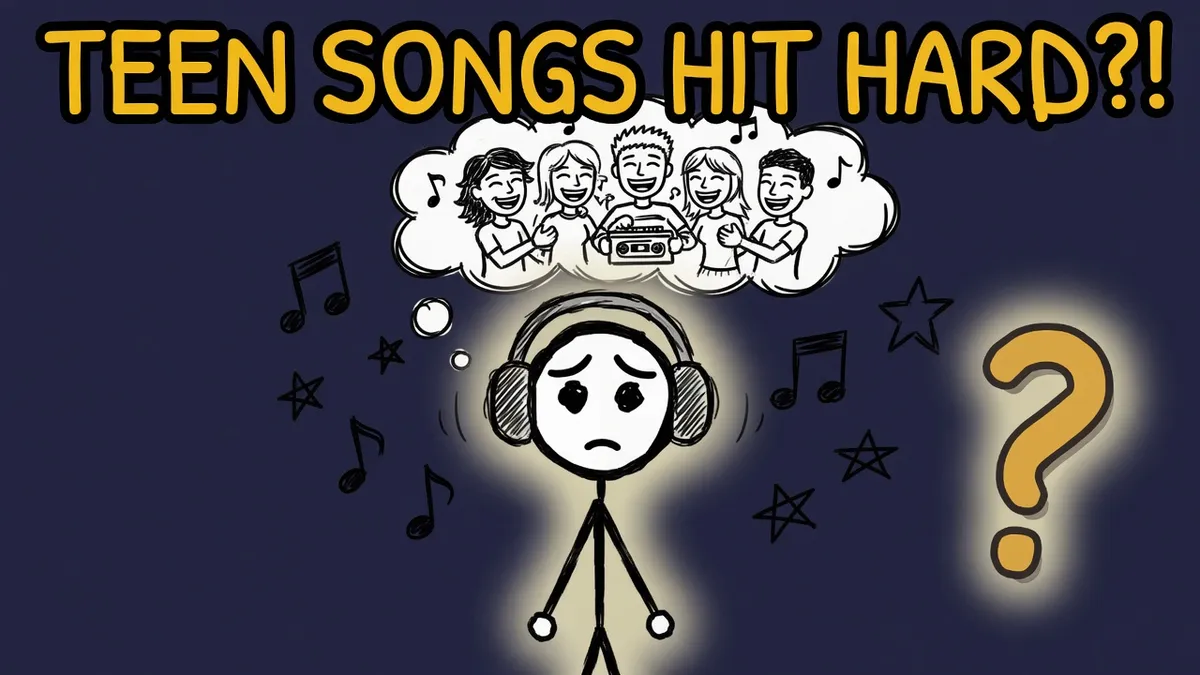
Try this. Picture the song you loved most at fifteen or sixteen. The whole thing probably arrives instantly: the lyrics, the feeling, maybe the exact bedroom or car it played in. Now try to name a song you loved four years ago, in your ordinary adult life. Harder, isn't it, and blurrier. That is genuinely strange. The teenage memory is decades older, yet it is sharper. Something about that particular stretch of your life got recorded in a different, deeper ink, and it never faded.
01 · The patternYour memory has a hump in it
This is not a feeling. It is a measurable shape. If you ask older people to list their life memories and plot how many come from each year, you do not get a smooth slope. You get a distinct hill rising over one specific decade. Researchers call it the reminiscence bump, and it is one of the most reliable findings in all of memory science. People over 40 recall a disproportionate share of everything from roughly ages 10 to 30. A 2018 review that pooled 68 separate studies landed on almost exactly that window. The recent past should be freshest. Instead, your teens and early twenties quietly out-remember it.
02 · Why that decadeThe years you were becoming someone
So why does the brain play favourites with that one stretch? Several forces pile up. Those years are stuffed with firsts, first love, first job, leaving home, and novelty is memorable in a way that the hundredth ordinary Tuesday is not. The brain is also near peak learning ability. But the deepest explanation is about identity. Ages 10 to 30 are when you assemble a durable sense of who you are, and the mind treats self-defining memories as premium storage. Work by Rathbone, Moulin and Conway found that memory bumps cluster right where new self-images are born. You do not just remember the era. You remember it because it is where “you” got built.
03 · The music angleSongs are identity work, not background noise
Now fold music into that. In adolescence, a song is never just a song. What you listen to is a flag: it announces your tribe, your mood, your idea of yourself, at the precise moment you are desperate to have one. So the music does not sit beside your forming identity. It gets welded into it. And it is stamped in by a brain that will never be this receptive again. Adolescence is a window of heightened neural plasticity and turned-up reward and emotion, which is why a favourite track at 17 does not just play, it lands, and stays. The songs of your youth are, quite literally, part of the scaffolding you built yourself on.
04 · The numbersSomewhere between 17 and 24
Researchers have tried to pin the exact musical peak, and the honest answer is that it depends how you measure. A classic 1989 study by Holbrook and Schindler asked people aged 16 to 86 to rate old hits and found preference peaked for songs heard around age 23 or 24. A very different, much larger 2025 study, nearly 2,000 people across 84 countries, tracked emotional connection instead and found it peaked closer to age 17. It even split by sex: the peak came earlier in men, around 16, and later in women, after 19. The precise crest wanders a little, but every study points at the same neighbourhood: your teens sliding into your early twenties. That is the era with your name on it.
The bump does not only point backward at your own youth. It cascades, so you can feel deep nostalgia for hit songs from before you were even born.
05 · The cascadeWhy you love your parents' music too
Here is the finding that turns the whole thing sideways. In 2013, Cornell researchers Krumhansl and Zupnick played college students Billboard hits spanning 1955 to 2009 and measured their memories and feelings for each. Sure enough, the students lit up for the music of their own youth. But they also showed a second, unexpected bump for their parents’ and grandparents’ era, the hits of the 1960s and 1980s, decades before these students existed. The music had been playing in the house during childhood, passed down like a family heirloom, and it left its own imprint. So nostalgia is not sealed to your personal timeline. It leaks backward through generations, which is why a 20-year-old can ache for a song from 1968.
06 · The chill factorWhy the old ones still hit hardest
There is one more layer, and it is chemical. When a piece of music hits an emotional peak, your brain releases dopamine in its reward circuitry, the same system tied to food and other pleasures. That was shown directly in a 2011 brain-imaging study. In adolescence, that reward system is dialled up and the brain is at its most mouldable, so those dopamine-soaked musical moments get bonded far more deeply than they will in your calmer, more settled adult years. New songs now land on a self that is already built and a reward system that has cooled off. They can still be good. They just cannot get the grip on you that a song did when you were 16 and everything mattered too much.
07 · The payoffSo why do they feel important forever?
Because they are not really about the music. They are about you. Those songs arrived during the one window when your brain was building a permanent self and recording everything in deeper ink, and the music got folded into that self as it set. A track from your teens is not a favourite tune you happen to keep. It is a working index card to an entire era of becoming who you are, tagged with dopamine and welded to your identity at the exact moment identity was being poured. That is why last year’s hit slides off and the song from the summer you were 16 does not. One landed on a finished person. The other helped build one.
Quick questions
What is the reminiscence bump?
It is the tendency for people over about 40 to recall a disproportionate share of their life memories from roughly ages 10 to 30. Plot how many memories come from each year of someone's life and you get a hump over adolescence and early adulthood. It is one of the most reliable patterns in autobiographical-memory research.
Why do the years 10 to 30 get remembered best?
Several reasons stack up. Those years are full of firsts (first love, first job, leaving home), and novelty is memorable. The brain is at peak learning ability. And crucially, it is when you build a lasting identity, so those memories get filed as self-defining and stay easy to reach.
Why does music specifically stick to that period?
Because music in adolescence is not background, it is identity work. The songs you pick signal who you are and who your tribe is. Bonded to a forming self, and stamped in by a brain running high on dopamine and emotion, those tracks get an unusually deep imprint that outlasts almost everything else from the era.
What age is the musical peak, exactly?
Estimates vary by method. A classic 1989 study put peak song preference near age 23 or 24. A large 2025 global study found the emotional peak closer to age 17. Broadly, the teens into the early twenties is the window that leaves the deepest musical mark.
Does the reminiscence bump apply to more than music?
Yes. It shows up for books, films, public events, and life memories in general. Music is just an unusually strong example, because it fuses sound, emotion, and social identity all at once, which is a very sticky combination for memory.
Why do I love my parents' music from before I was born?
That is the 'cascading' reminiscence bump. A 2013 Cornell study found young adults showed memory bumps not just for the hits of their own youth but for their parents' and even grandparents' era. Music passed down during childhood leaves its own imprint, so nostalgia can reach back generations.
Is the reminiscence bump the same for everyone?
The overall pattern is remarkably consistent across cultures, but details shift. A 2025 study found the musical peak came earlier in men (around 16) and later in women (after 19), and personal, self-defining songs can create smaller bumps at other ages too.
Why does old music feel more emotional than new music?
Partly the bump, and partly a real change with age. As you get older you tend to hear less genuinely new music, and the adolescent brain that once stamped songs in so deeply has settled down. New tracks rarely land on a self that is still being built, so they struggle to bond the way the old ones did.
Does everyone get nostalgic for their teenage music?
Most people show the pattern, but strength varies. How much a song moves you is also tied to personality (openness to experience predicts strong musical responses) and to how bound up that music was with formative events. Some people simply route music through the brain differently.
Can you form a strong musical bond later in life?
You can, but it is harder. A song tied to a powerful adult event (a wedding, a loss, a huge life change) can still create a lasting bond outside the bump. But the default machinery, a plastic brain fusing sound to a forming identity, mostly runs in youth and does not fully return.
Why do old songs bring back such specific memories?
Music is a powerful memory cue because it is processed alongside emotion and often tied to a specific time and place. A song from your teens is essentially an index card for a whole era of your life, so hearing it can pull back the room, the people, and the feeling in startling detail.
Is it bad that I only listen to old music?
Not at all, it is the brain working as designed. The pull toward the music of your youth is a normal feature of how memory and identity are wired, not a sign of being stuck. Plenty of people keep exploring new music too, but the old favourites keep their special grip for a reason.
Do other animals have a reminiscence bump?
It has really only been studied in humans, and it seems tied to distinctly human things: autobiographical memory, a narrative sense of self, and culture-wide expectations about what a life should look like. So while the underlying brain plasticity is not unique to us, the bump as measured is a human phenomenon.
Take the quiz on this
A quick 4-question check on what you just read. Get them right to earn XP: no points for just scrolling.
Our sources 8 checked
// every claim on this page was checked before it went up