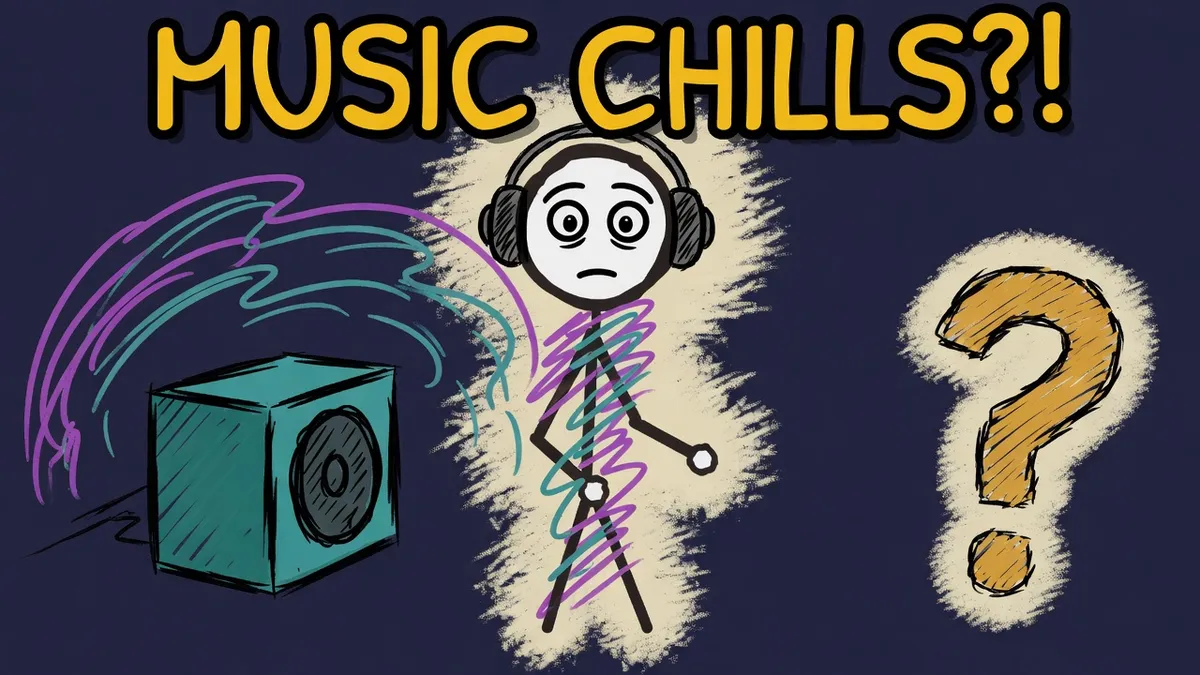
You know the exact moment. The music is building, a voice climbs higher, a chord suddenly opens up, and a wave of goosebumps sweeps down your neck, your arms, your spine. It can feel almost overwhelming, like being physically moved. And yet absolutely nothing has touched you. It's just air, vibrating. So why does your body react as though something enormous just happened?
01 · The nameIt's called frisson, and not everyone gets it
The shiver has a name: frisson, sometimes dressed up as “aesthetic chills.” And it’s strangely divisive. Depending on the study, somewhere between about half and three-quarters of people report feeling it: estimates run roughly from 55% to 86%, which is a wide range and a sign the science is still pinning down the exact number. Either way, it means there’s a genuine group of people who never feel a thing, and are quietly baffled that the rest of us do. If you’re one of those people, hold on, there’s a decent theory for why.
02 · The reflexThose shivers are literally goosebumps
Here’s the first oddity. Those chills aren’t a metaphor: they’re literally goosebumps. Tiny muscles at the base of each hair, yanking it upright. And that’s an ancient survival reflex: the same one that puffs a frightened cat up to look bigger, and the one that traps a layer of warm air against your skin when you’re cold. Which is genuinely strange when you stop to think about it. Why on earth would a beautiful piece of music trigger a reflex built for fear and cold? A lovely melody is neither threatening you nor freezing you. And yet your skin responds as if it were.
03 · The hijackMusic sneaks into your reward system
The answer is that music slips into one of your oldest circuits: reward. Whenever you do something good for survival, eating when you’re starving, say, your brain pays you in dopamine, the very same chemical behind craving, and sex, and addictive drugs. It’s the machinery that makes survival feel good so you’ll do it again. And somehow, patterns of pure sound plug directly into that ancient reward circuit, no survival value attached. Music tricks a system built for food and safety into firing over an arrangement of notes.
In 2011, scientists scanned people's brains at the precise instant the chills struck, and watched dopamine come flooding out in two separate waves. One as the music built, in pure anticipation. Then a second, bigger surge at the emotional peak itself.
04 · The scanDopamine, caught in two waves
That landmark study is worth sitting with. Using brain imaging that could track dopamine directly, researchers found the chemical wasn’t released just once, at the payoff. It came in two anatomically distinct waves. First, a release in the anticipation phase, as the music built toward a peak the listener could feel coming. Then a second, larger surge at the peak itself, the exact moment the chills landed. A 2013 follow-up drove the point home: activity in the brain’s core reward hub predicted how much money people were willing to pay for music they’d never heard before. Your brain treats a great song as something genuinely worth having.
05 · The gapHalf the pleasure is in the wanting
And that first wave, the anticipation, is the secret. Your brain is a relentless prediction machine, always guessing the next note before it arrives. So when a piece of music promises a resolution, teases it, holds it back, and then finally delivers, the payoff lands far harder than a simple, predictable line ever could. Frisson lives right there, in the gap between expectation and surprise, a build-up that’s honoured, or a swerve that turns out, in hindsight, to be exactly right. In practice the reliable triggers are the moments that break a pattern and then resolve it: a sudden crescendo, an unexpected key change, a voice cracking with feeling, a choir sweeping in from nowhere. One 2021 study even found that dark, loud, lower-pitched sounds were particularly potent at setting the shiver off. This is the leading account rather than the whole story, but it explains why the same predictable pop hook can thrill you the first week and leave you cold the tenth.
06 · The wiringWhy some people never feel it
So why do some people never get a single shiver? The leading idea is simply wiring. Brain scans suggest that people who feel frisson have denser connections between the hearing part of their brain and its emotional and reward regions, literally more “cable” running between sound and feeling. If those bridges are thinner, the music may reach the ear but never quite reach the switch. It’s a compelling finding, though it comes from relatively small studies, so it’s best read as the strongest current explanation rather than a settled fact. Wiring isn’t the only difference between people, either: the single personality trait most reliably linked to frisson is openness to experience, and a 2016 study suggested that what really matters may be how attentively you engage with the music rather than how emotional you are. Some people simply aren’t wired to be moved by sound in this particular, physical way, and that’s not a flaw, just a different set of connections.
07 · The payoffSo why does music give you chills?
It isn’t only music, by the way. A breathtaking view, a single perfect line in a film, a wave of awe, even a beautiful idea clicking into place, all can set off the same shiver. Frisson is really your reward system standing up and saluting something it finds profoundly, movingly right.
So your goosebumps at a piece of music aren’t a glitch. They’re the same reflex that once braced your ancestors against a charging predator or a bitter wind, now firing for something with no survival value whatsoever. A melody. Your body, moved so deeply by pure pattern that it braces as if something enormous just happened. Because, as far as your brain is concerned, something did.
The animated version
Same answer, told as a little animated story with the strange little stickman acting it out. Dry, quick, and, obviously, correct.
Quick questions
Why does music give you chills?
Because certain moments in music plug into your brain's reward system and release dopamine, the same chemical tied to food, sex and drugs. That jolt of reward at an emotional peak sets off goosebumps, a reflex normally reserved for cold and fear. The chills are your body reacting to pure sound as if something important just happened.
What is frisson?
Frisson is the technical name for the wave of goosebumps and shivers people feel at an aesthetic peak, a soaring voice, a key change, a swelling chorus. It's sometimes called 'aesthetic chills' or, more colourfully, a 'skin orgasm.' Roughly 55 to 86% of people report feeling it, depending on the study.
Why do some people never get chills from music?
The leading idea is brain wiring. Brain-imaging work suggests people who feel frisson have denser white-matter connections between the hearing part of the brain and its emotional and reward regions, more 'cable' between sound and feeling. If those connections are thinner, the music may simply never reach the switch. This is a promising finding from small samples, so treat it as the best current explanation rather than the final word.
Why do goosebumps happen for a happy song?
Because goosebumps aren't really about the emotion: they're a general 'something significant is happening' alarm, driven by your reward and arousal systems. A powerful piece of music trips that alarm just like cold or fear would. The reflex is the same; only the trigger is different.
What kinds of music are most likely to give you chills?
There's no single 'chills chord,' but a handful of moves show up again and again: a sudden swell in volume, an unexpected harmony or key change, a voice that soars or cracks with feeling, and a new instrument or a whole choir entering out of nowhere. What they share is surprise, a moment that breaks what your brain predicted, then resolves in a way that feels right. One 2021 study even found that dark, loud, lower-pitched sounds were especially good at setting frisson off.
Does a song stop giving you chills once you've heard it a hundred times?
Usually not, and that's a clue about what's really going on. If frisson were pure surprise, a song you know by heart would stop working. Instead, knowing exactly when the big moment is coming can make the chills stronger, because the anticipation is half the reward. Brand-new, unfamiliar sounds can habituate and fade with repetition, but a beloved track often keeps delivering for years.
What personality traits are linked to getting chills from music?
The strongest known predictor is a trait called openness to experience, the Big Five dimension covering imagination, curiosity, and a deep appreciation of art and beauty. In a 2016 study, people who scored higher on openness felt frisson more often, and the researchers suspected it may be less about raw emotion than about how closely and attentively you engage with the music. So it may not be that some people 'feel more': they may simply be more absorbed.
Why do some songs make you cry instead of giving you chills?
Chills and tears are two different peak responses, with different fingerprints. A 2017 study found that chill-inducing music tended to feel both happy and sad and drove arousal up, faster heart rate, sweatier skin, while tear-inducing music felt purely sad and calming, with slower breathing. Both are genuinely pleasurable. They're just your body reacting to two different flavours of being moved.
Is getting chills from music the same as ASMR?
No, though they're cousins. Frisson is a brief, exciting rush, goosebumps, a quickened heart, a jolt of reward, usually set off by music or a powerful moment. ASMR is the slow, tingly, deeply relaxing sensation some people get from whispers, tapping or close personal attention, and it tends to lower the heart rate rather than raise it. Same word ('tingles'), different physiology.
Can you give yourself chills on purpose?
To a degree. You can't force it, but you can stack the odds: pick music you love with a clear emotional peak, listen closely on headphones rather than as background, and let the build-up land. Some people find a slightly cool room helps, since the goosebump reflex is easier to trip when you're already a touch cold. But if you're simply not wired for frisson, no technique reliably summons it, and that's normal.
Is getting chills from music a sign of anything?
Mostly it's a harmless, pleasurable quirk of a well-connected brain. It's been linked to higher openness to experience and to denser wiring between the brain's hearing and emotional regions, so if anything, it's a marker of how deeply you engage with music, not a medical sign of anything. Feeling it a lot, a little, or never are all perfectly normal.
Can things other than music give you frisson?
Yes. A breathtaking view, a perfect line in a film, a wave of awe, even a beautiful idea clicking into place, all can set off the same shiver. Frisson is really your reward system saluting anything it finds profoundly, movingly right.
Take the quiz on this
A quick 4-question check on what you just read. Get them right to earn XP: no points for just scrolling.
Our sources 13 checked
// every claim on this page was checked before it went up