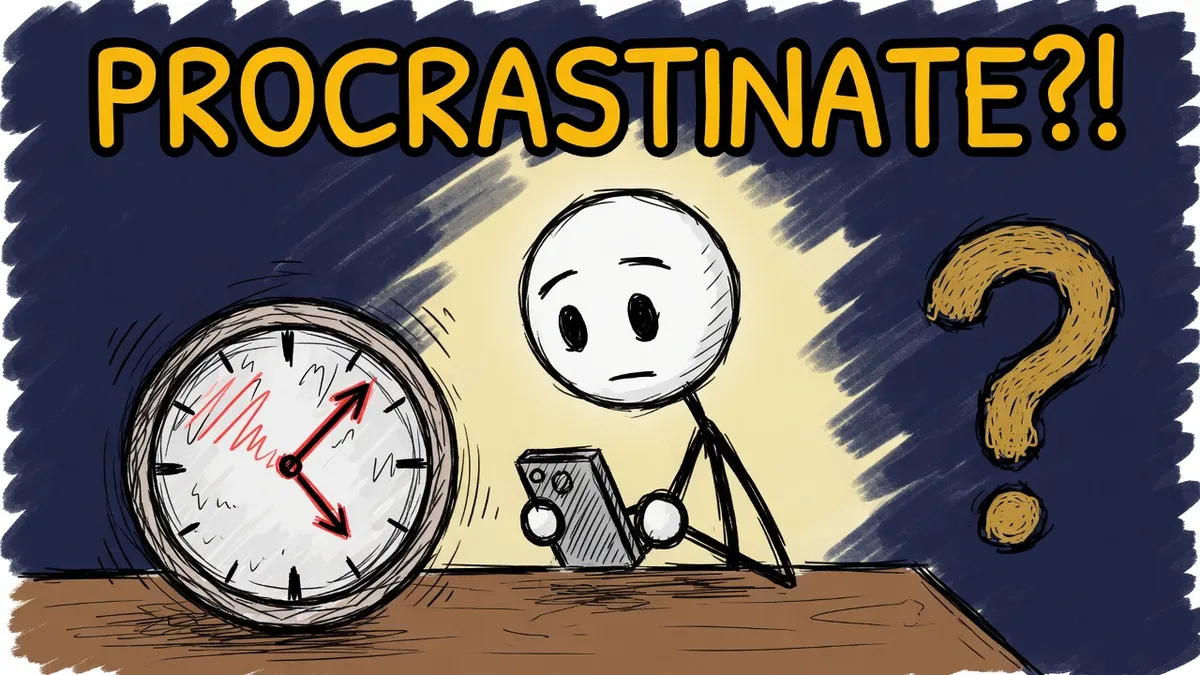
Here is the strange thing about procrastination: you are not confused. You know exactly what needs doing, roughly how long it will take, and precisely how bad you'll feel when it's late. You may even want it done. And yet you find yourself watching a video about the history of the paperclip instead, at 11pm, the night before. That gap, between what you fully intend and what you actually do, is the whole mystery. And for a long time we've been solving it wrong.
01 · The definitionIt's irrational, and that's official
Start with what procrastination actually is, because the standard scientific definition is oddly precise. In his landmark 2007 review, the psychologist Piers Steel defined it as “to voluntarily delay an intended course of action despite expecting to be worse off for the delay.”
Read that again, because every word is load-bearing. Voluntarily: nobody is forcing you. Intended: you meant to do it. Despite expecting to be worse off: you already know this ends badly. Which means procrastination is, by its own definition, irrational. It is choosing the option you fully expect to regret. That’s not a scheduling hiccup. Something stranger is going on, and it isn’t in your calendar.
02 · The wrong diagnosisWhy time management doesn't fix it
The instinctive explanation is that procrastination is a time-management problem: you’re disorganised, you misjudged the hours, you need a better system. So people buy the planner, download the app, colour-code the week. And for chronic procrastinators, it mostly doesn’t work.
The reason it doesn’t work is that it treats the wrong disease. If procrastination were really about managing time, then better tools would fix it, the way a better map fixes getting lost. But procrastinators aren’t lost. They can see the destination perfectly. What stops them isn’t a missing plan. It’s something the plan can’t touch: a feeling.
03 · The real mechanismYou're not avoiding the task. You're avoiding the feeling
Here is the shift that reframes everything. The researchers Fuschia Sirois and Tim Pychyl proposed that procrastination is not a time-management problem at all. It’s an emotion-management problem.
The logic goes like this. Every task you dread carries a feeling attached: boredom, anxiety, resentment, the quiet fear that you’ll do it badly. When you turn toward the task, you feel that. When you turn away, the feeling stops, instantly. So avoidance isn’t really about the report or the email or the tax return. It’s about escaping the unpleasant emotion the report stirs up. Procrastination, in their phrase, is “the primacy of short-term mood repair” over long-term goals. You are, quite literally, trading a bad feeling now for a worse one later. And that reframing explains a fact that laziness never could: procrastination correlates with poor emotion regulation, not with low willpower or a weak work ethic.
04 · The engineWhy 'later you' always loses the vote
If avoidance feels good now, why don’t we course-correct, knowing the bill comes due? Because of how the brain values time. We are wired with a heavy present bias: immediate rewards and costs feel enormous, while future ones get steeply discounted, shrunk down until they barely register. Relief you can have this second beats a crisis that’s still a week away, even when the crisis is much bigger.
Steel folded this into what he called temporal motivation theory, which is really a tidy little equation for the pull of any task: it rises with how much you expect to succeed and how much you value the outcome, and it falls the more impulsive you are and the further away the reward sits. Boring, unpleasant, far-off, uncertain tasks score terribly on every term at once. Which is exactly the profile of everything you’ve ever put off.
05 · The mythsPerfectionism and the last-minute hero
Two comforting stories deserve to be dismantled. The first is that procrastinators are secret perfectionists, too afraid of imperfect work to start. It’s a flattering theory, and the evidence barely supports it. Across studies, general perfectionism has close to no relationship with procrastination. There’s a modest link with one narrow strand, socially prescribed perfectionism, the anxious sense that other people demand you be flawless, but even that is a small effect, not a master key. Most procrastination has nothing to do with high standards.
The second myth is the beloved one: “I work better under pressure.” This one the evidence flatly contradicts. When researchers put procrastinators under real time pressure, they made more mistakes and finished less than everyone else, and they were more stressed and, over a term, physically sicker. The last-minute triumph you remember is a trick of memory: a dramatic rescue is vivid and rewarding, so it lodges in the mind, while the boring truth, that you’d have done better with more time and slept better too, quietly disappears.
The thing that reliably reduces future procrastination isn't more discipline. It's forgiving yourself for the last time you procrastinated. Guilt makes the task feel worse, so you avoid it harder. Let the guilt go, and the task loses its sting.
06 · The costWhat chronic delay does to a body
Because procrastination looks harmless, one task at a time, it’s easy to miss what it does in bulk. Fuschia Sirois has spent years tracking the health of chronic procrastinators, and the picture is consistently grim: more stress, more headaches and colds, worse sleep, and higher rates of hypertension and heart disease, even after accounting for other personality traits.
The honest caveat matters here, so hold this loosely: all of that is correlational. No study has proven that procrastinating gives you heart disease. But the proposed mechanism is plausible and unglamorous: chronic delay is a chronic stressor, and it pushes back the healthy things too, the check-up, the exercise, the early night. Stress you keep manufacturing, and care you keep deferring, are not a great long-term combination.
07 · The exitWhat actually helps, and it isn't willpower
If procrastination is an emotion problem wearing a time-management costume, then the fixes follow logically, and none of them is “try harder.” Three have real support behind them.
First, shrink the first step until it’s too small to dread. Not “write the essay” but “open the document and type one bad sentence.” The emotional resistance is concentrated at the starting line, so you make the starting line trivial. Second, use an implementation intention: a specific if-then plan, “if it is 9am, then I open the file,” that decides in advance so your feelings don’t get a vote in the moment. And third, the counterintuitive one: self-forgiveness. In a 2010 study, students who forgave themselves for procrastinating before one exam procrastinated less before the next, because letting go of the guilt made the task less aversive to approach.
Notice what they all have in common. None of them adds discipline or pressure. They remove the emotional charge instead of trying to overpower it. That’s the real answer to why you procrastinate, and how to stop: you were never fighting a lazy streak. You were flinching from a feeling. Turn down the feeling, and the task you’ve been dreading turns out to be, mostly, just a task.
Quick questions
Is procrastination a sign of laziness?
No, and the two are almost opposites. Lazy people don't want to do the thing and feel fine about not doing it. Procrastinators do want it done, intend to do it, and feel worse for the delay. The best current model treats procrastination as a failure of emotion regulation, not effort: you're avoiding an uncomfortable feeling, which often takes more mental energy than the task would have.
Why do I procrastinate on things I actually want to do?
Because wanting the outcome and dreading the process are two different things. Even a task you care about can carry boredom, anxiety, or fear of doing it badly, and it's that feeling you flinch from, not the goal. Avoiding the task gives you an instant hit of relief, which your brain records as a reward, so the pattern gets reinforced every time.
Is procrastination just bad time management?
Mostly no. If it were purely a scheduling problem, a better calendar would fix it, and for chronic procrastinators it rarely does. The research reframes it as an emotion-regulation problem: people delay to escape negative feelings, not because they miscounted the hours. That's why the fixes that work are about defusing the feeling, not squeezing the timetable.
Do procrastinators really work better under pressure?
The evidence says no. In controlled studies, procrastinators under time pressure made more errors and got less done than non-procrastinators, and they reported more stress and worse health. The feeling of 'nailing it at the last minute' is partly a memory trick: a last-minute rescue is vivid and rewarding, so it sticks, while the quieter fact that you'd have done better with more time fades.
Are procrastinators just perfectionists?
This is a popular myth, and it's mostly overstated. Across the research, general perfectionism has close to no link with procrastination. There's a modest association with one specific flavour, socially prescribed perfectionism (feeling that others demand you be perfect), roughly a small correlation, not a defining cause. So some anxious perfectionists procrastinate, but 'I'm a perfectionist' is not the reason most people delay.
What actually is present bias?
It's your brain's tendency to weigh immediate rewards and costs far more heavily than future ones. A small relief right now (avoiding the task) can outweigh a large cost later (the deadline crunch), simply because 'now' feels realer than 'later'. Steel's temporal motivation theory folds this together with how much you expect to succeed and how much you value the task, which is why boring, unpleasant, far-off tasks are the easiest to put off.
Why does procrastinating make me feel guilty and anxious?
Because the relief is only ever temporary. You dodge the bad feeling for now, but the task, plus a new layer of self-blame, is still waiting. That guilt is itself an aversive feeling, which makes the task even more repellent next time, so you avoid it again. It's a loop: procrastination relieves stress in the short term and manufactures more of it in the long term.
Does procrastination affect your health?
It's linked to worse health, though the evidence is correlational, so read it carefully. Studies by Fuschia Sirois find chronic procrastinators report more stress, more headaches and colds, worse sleep, and higher rates of hypertension and cardiovascular disease, even after controlling for other traits. The leading explanation is that chronic delay generates ongoing stress and pushes back healthy behaviours (like seeing a doctor), but no study has proven procrastination directly causes disease.
How do I stop procrastinating?
Stop treating it as a discipline problem. The techniques with the best support work on the feeling and the friction: make the first step trivially small (open the file, write one sentence), use an 'if-then' plan that names the exact moment you'll start, and forgive yourself for past delays instead of piling on shame. Adding more pressure and self-criticism tends to make avoidance worse, not better.
What is an implementation intention?
It's a simple, specific 'if-then' plan that pre-decides your behaviour: 'If it is 9am, then I open the document and write one line.' By tying the action to a concrete cue (a time, a place, an event), you take the decision out of the heat of the moment, when your feelings are loudest. Decades of research show these plans reliably close the gap between intending to act and actually acting.
Why does forgiving yourself help you procrastinate less?
It sounds backwards, but it's well documented. In a 2010 study, students who forgave themselves for procrastinating before one exam procrastinated less before the next one. The reason fits the emotion model: self-forgiveness lowers the guilt attached to the task, and with less dread hanging over it, the task becomes less aversive to approach. Beating yourself up does the opposite: it makes the task feel worse.
Is procrastination linked to ADHD or depression?
It can be. Procrastination correlates with impulsiveness and low self-control, which overlap with ADHD, and with the low energy and negative mood of depression and anxiety. For many people it's an ordinary habit rather than a symptom, but if delay is severe, constant, and wrecking your work or wellbeing, it's worth treating as a possible sign of an underlying condition rather than a character flaw.
Why do I procrastinate more when I'm stressed or tired?
Because self-regulation runs on a limited budget. When you're stressed, tired, or already low, you have less capacity to tolerate an unpleasant feeling, so the pull toward instant relief wins more easily. That's also why procrastination and stress feed each other: the more frazzled you are, the more you avoid, and the more you avoid, the more frazzled you get.
What's the difference between procrastination and just deciding to wait?
Intent and expected cost. Choosing to delay something because it's genuinely the smart move (waiting for better information, prioritising something more urgent) is strategic delay, and it's rational. Procrastination is delay you didn't really choose and expect to regret: you meant to act, you know putting it off makes things worse, and you do it anyway. That gap between intention and action is the whole definition.
Take the quiz on this
A quick 4-question check on what you just read. Get them right to earn XP: no points for just scrolling.
Our sources 9 checked
// every claim on this page was checked before it went up