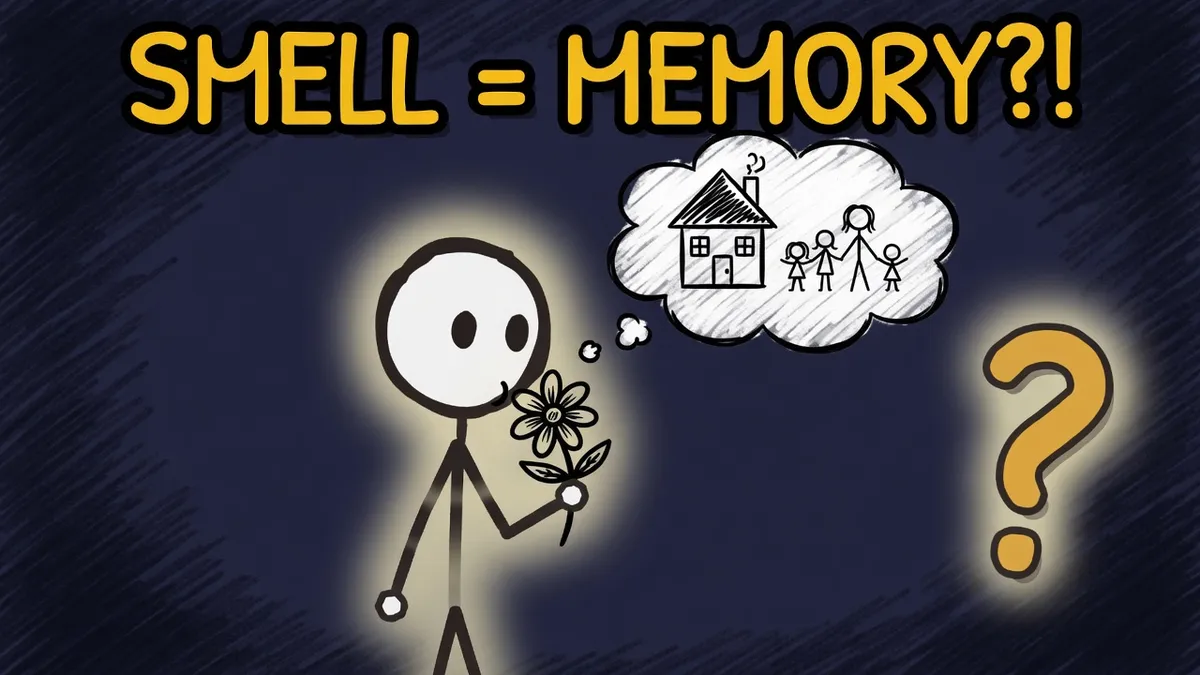
Here is something quietly strange about the machinery in your head: a song can remind you of the past, and a photo can remind you of the past, but a smell doesn't remind you of anything. It drops you straight back into it. One stray whiff, sun cream, an old book, a particular perfume, and without any warning you are seven years old, standing in a place you haven't thought about in decades, the whole feeling arriving intact. Every other memory politely knocks. Smell kicks the door in. So why is your nose so absurdly good at time travel?
01 · The nameProust and his little cake
This effect is famous enough to have a name. It’s the Proust effect, after the French novelist Marcel Proust, who spent pages and pages of In Search of Lost Time on a single moment: his narrator dips a little shell-shaped cake, a madeleine, into a spoonful of tea, and the taste and smell drag up an entire lost childhood, unbidden and complete. It became the definitive literary description of a thing everyone has felt but few can explain. Modern psychologists borrowed the name wholesale: “odour-evoked autobiographical memory,” or, more fondly, the Proust effect. And the reason it works comes down to a shortcut wired deep into your brain.
02 · The checkpointEvery other sense queues at the door
Start with how the rest of your senses work, because it’s the contrast that matters. What you see, hear, touch and taste doesn’t travel straight to the parts of your brain that make sense of it. It all has to pass through a central relay station first, a structure called the thalamus, which sorts the incoming signals and forwards them on to the right cortical departments for processing. Sight, sound, touch, taste: all of them queue up at this checkpoint and get filtered before they ever reach the deeper, older parts of you. It’s an efficient system. It’s also, for most senses, an unavoidable one.
03 · The shortcutSmell has a private line
All of them, that is, except one. Smell is the single sense that skips the checkpoint entirely. Signals from your nose run from the olfactory bulb straight past the thalamus and plug directly into two ancient structures of the limbic system: the amygdala, which handles emotion, and the hippocampus, which builds memories. No relay, no filtering queue, a private, unfiltered cable wired right into the parts of your brain that feel things and remember things. (To be precise: olfaction does keep some slower, indirect links for higher-order recognition. But the fast, emotional route, the one that does the ambushing, is the direct one.)
04 · The feelingNot a description, a reinstatement
That direct line changes the whole character of the memory. Because a smell reaches your emotion and memory centres almost instantly, often before your conscious mind has even worked out what you’re smelling, it doesn’t hand you a tidy summary of the past. Other senses give you a description: here is a photo of the beach, here is the sound of the sea. A smell skips the description and reinstates the feeling. This isn’t just a poetic distinction. In a naturalistic study by Rachel Herz and Jonathan Schooler, memories triggered by odours were rated as more emotional, and came with a markedly stronger sense of being brought back in time, than the same memories cued by a photo or a word. That’s the difference you feel in your chest: less like remembering, more like being physically returned.
The memories a smell unlocks aren't just more vivid, they're older. Scent reaches back past the point where your other memories run out, all the way into a childhood you can't otherwise retrieve.
05 · The oldest memoriesA cable back to before you could talk
Here’s the last clue, and it’s a good one. When researchers give older adults different cues and ask what memory each one dredges up, the memories don’t come from the same era. In a much-cited 2006 study by Johan Willander and Maria Larsson, words and pictures pulled up memories that peaked in the teens and twenties, the usual pattern. But odours pulled up memories from the first decade of life, before the age of ten. Smell reaches further back than any other cue can. The leading explanation is disarmingly simple: this scent-to-memory wiring is laid down very early, before you had words to file memories under, so your nose ended up with a direct cable to your earliest years that nothing else quite reaches. That last part is still the best hypothesis rather than settled fact, so hold it loosely. But the pattern itself is real.
06 · The shadow sideWhen the door opens on something dark
That same unguarded wiring cuts both ways. If a scent can flood you with a warm afternoon from before you could read, it can just as easily flood someone with the worst moment of their life. Clinicians have long noted that in post-traumatic stress disorder, a specific smell tied to the trauma, an attacker’s aftershave, diesel and smoke for a combat veteran, hospital antiseptic, is one of the most reliable triggers of a flashback, and for the very same reason nostalgia is: odour reaches the emotion centres in as few as two synapses, before the thinking brain gets a vote. The shortcut that makes scent memory so tender is the shortcut that makes it, for some people, impossible to outrun. If that’s you, it’s a recognised and treatable part of trauma, not a personal failing of your nose.
07 · The payoffSo what is a scent memory, really?
It’s not a sentimental quirk, and it’s not nostalgia getting the better of you. It’s the one sense with a direct, unguarded line into the emotional, memory-keeping heart of your brain, a line that was wired before you could even speak, running below the checkpoint every other sense has to clear. It doesn’t politely describe where you’ve been. It quietly reinstates it: the whole feeling, all at once, in the half-second before you’ve consciously registered a thing. So the next time a random smell ambushes you and floods you with a moment from when you were six, don’t brush it off. That’s your oldest, most primal sense, casually kicking down a door that every other sense has to knock on.
The animated version
Same answer, told as a little animated story with the strange little stickman acting it out. Dry, quick, and, obviously, correct.
Quick questions
Why do smells trigger memories more than photos or music?
Because smell has a physical shortcut the other senses don't. Sight and sound get routed through the thalamus first, but odour signals plug straight into the amygdala and hippocampus, the brain's emotion and memory hubs. A photo hands you a description of the past; a smell reinstates the feeling of it, which is why scent memories tend to be more emotional and vivid.
What is the Proust effect?
It's the sudden, involuntary flood of a vivid autobiographical memory triggered by a smell or taste. It's named for Marcel Proust, whose narrator dips a little cake (a madeleine) in tea and is swept back into childhood. Psychologists now use "the Proust effect" as shorthand for odour-evoked memory.
Why are smell memories usually from childhood?
In one well-known study, odour cues pulled up memories from people's first decade of life, while words and pictures mostly surfaced memories from their teens and twenties. The leading explanation is simply that the scent-to-memory wiring is laid down very early, so smells have a cable back to your earliest years that other cues can't quite reach. It's still a hedge, not a settled fact.
Does smell really skip the thalamus?
The fast, direct route does. Every other sense relays through the thalamus before reaching the cortex; olfactory signals run from the olfactory bulb straight into the limbic system, reaching your emotion and memory centres without that stopover. (Olfaction does have some slower, indirect thalamic links for higher-order processing, but the express lane to feeling and memory is the direct one.)
Why does a smell hit before I even know what it is?
Because the direct line to your emotion centre is faster than conscious identification. The feeling, comfort, unease, a rush of somewhere-else, can arrive before the thinking part of your brain has worked out that you're smelling, say, your grandmother's kitchen.
Why is smell so strongly linked to emotion and memory?
It's anatomy, not poetry. Your smell signals reach the amygdala, the brain's emotion hub, in as few as two synapses, and the hippocampus, its memory-builder, in about three. No other sense sits that close to the feeling-and-remembering machinery, which is why a scent can move you before you've even named it. It's less a metaphor than a wiring diagram.
Why do certain smells trigger nostalgia?
Because a scent you met early and often gets welded to the emotional texture of that time, so meeting it again reinstates the mood, not just the fact. Researchers find odour-evoked nostalgia skews strongly positive: nostalgic smells tend to bring warmth, comfort and a sense of connection more than sadness. The specific scent is deeply personal, though: the same perfume is one person's mother and another's first love.
Can a smell trigger trauma or a PTSD flashback?
Yes, and it's well documented. The same direct line that makes a nice smell so evocative makes a trauma-linked one a powerful, involuntary trigger: an attacker's cologne, diesel and smoke for a combat veteran, hospital disinfectant. Clinicians treat odour as one of the more reliable flashback cues in PTSD, precisely because it reaches the emotion centres before the conscious brain can step in. If scent triggers are disrupting your life, that's a recognised, treatable part of trauma, worth raising with a professional.
Why do smell-triggered memories feel so vivid?
Two things stack up. The scent hits your emotion centres almost instantly and with little filtering, so the memory arrives soaked in feeling rather than as a dry fact, and studies rate odour-cued memories as more emotional and more 'back there' than the same memories jogged by a word or a photo. Layer on that they tend to be very old, and you get that whole-body vividness a caption could never manage.
What smells trigger memories the most?
There's no single champion: the most powerful scent is whatever your own early life happened to marinate in. That said, some categories come up again and again: baking and cooking smells, sun cream and chlorine, cut grass, old books, a particular perfume or aftershave, rain on hot pavement. What they share isn't the molecule; it's that you met them young, repeatedly, while feeling something.
Can you use smell to help you study or remember?
Possibly. There's real research into targeted memory reactivation, pairing a distinctive scent with material as you learn it, then re-exposing yourself to that same scent (even during sleep) to strengthen the memory. Some studies report striking gains, including one that piped a nightly fragrance to older adults for months and measured a large jump on a memory test. It's a promising but still-early area, so treat it as 'worth trying', not a proven hack.
Why does losing your sense of smell affect your mood and memories?
Because the smell system plugs straight into the emotional, memory-keeping parts of the brain, losing it does more than dull dinner. People with anosmia often describe feeling flattened and cut off, and studies link poor smell to a higher risk of low mood and depression, partly biology, partly the quiet loss of a direct sentimental route back to the past. It's one of the underrated reasons smell loss, after a virus, injury or with age, hits harder than people expect.
Take the quiz on this
A quick 4-question check on what you just read. Get them right to earn XP: no points for just scrolling.
Our sources 11 checked
// every claim on this page was checked before it went up