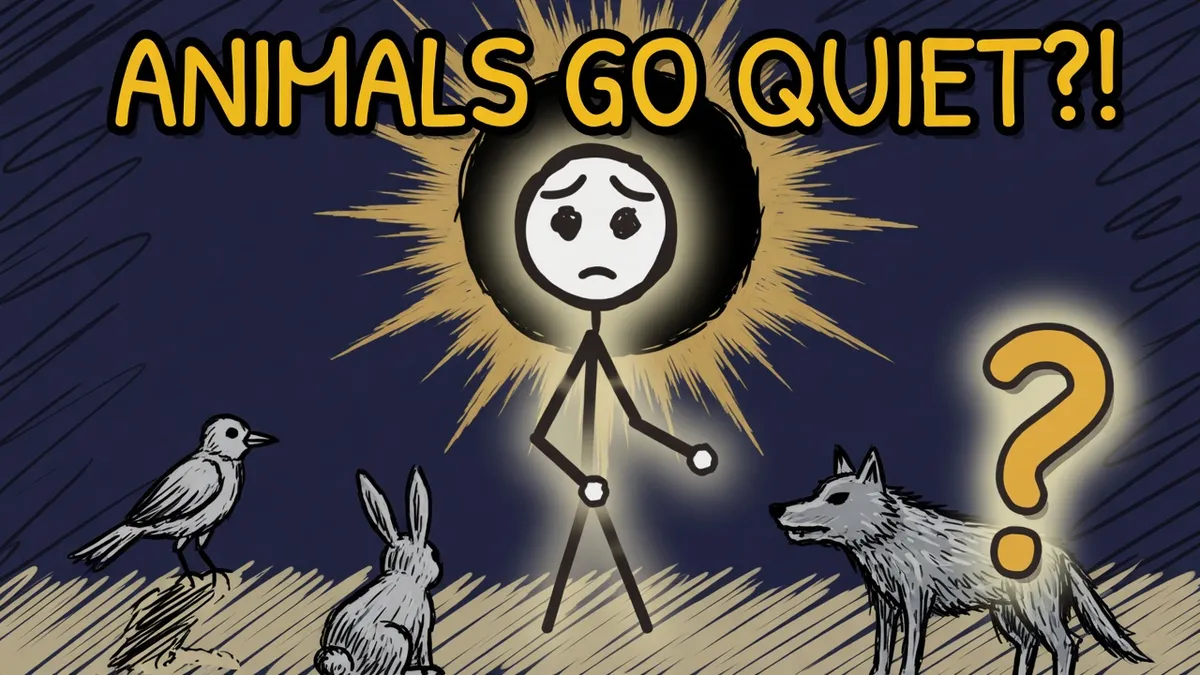
Here is the eerie part, the part people who have stood under a total eclipse never quite get over. It is not just the black disc where the sun should be. It is the sound. In the minute before totality the birds stop singing, and then, out of the sudden dusk, the crickets start up, exactly as they would at nightfall. For about two minutes an entire ecosystem quietly changes shift, convinced the day is ending, when in fact the day has barely moved at all. Every creature within the shadow has been fooled by the same thing: a light that dropped out of the sky at the wrong time.
01 · The hushWhat actually happens when the light goes
Run down the list and it reads like a normal evening compressed into two minutes. Daytime birds fall quiet or fly off to roost. Crickets, katydids and some cicadas strike up the dusk chorus they usually save for sunset. Bats have been seen slipping out to hunt. In the old accounts, cattle drift toward the barn and chickens head back to the coop, doing their going-to-bed routine in the middle of the afternoon. Even the orb-weaving spiders join in, starting to take down the webs they normally dismantle at the end of the day.
The through-line is that almost none of these animals keep time by a clock they can check. They keep time by light. Bright means day, and day has its jobs: forage, sing, defend a patch. Dark means the day is over, so pack up. When totality slams the light down to something like deep twilight, the animals do not reason about eclipses. They simply run whichever routine the darkness calls for, and the whole community swaps day-shift for night-shift at once.
02 · The zooSeventy-six percent changed their behaviour
The best single dataset we have comes from a zoo. When the 2017 total eclipse crossed the United States, a team led by Adam Hartstone-Rose stationed observers around Riverbanks Zoo in Columbia, South Carolina, and watched 17 species through the whole event. Their headline finding, published in the journal Animals in 2020, is that about 76% of the observed species did something different from their ordinary baseline as totality hit.
Most of the changes fell into two buckets. Some looked like a tidy evening routine: gorillas seemed to head for bed, and several species settled as if night had come. Others looked like plain unease. Giraffes gathered together and started moving, and animals from baboons to flamingos showed what the researchers read as anxiety. That second bucket matters, because it hints the darkness is not always experienced as a calm, familiar dusk. Sometimes it looks a lot more like alarm.
The Galapagos tortoises, animals the researchers described as normally doing almost nothing all day, became visibly more active as the sky dimmed. And then, at the peak of the eclipse, a group of them started to breed. Nobody has a clean explanation for it. Two minutes of false dusk, and the least hurried animals in the zoo suddenly had somewhere to be.
03 · The mechanismA light switch, not a reset clock
It is tempting to say the eclipse “resets the animals’ body clocks,” and it is worth being precise, because that is not what happens. A circadian clock is a genuine internal rhythm, roughly 24 hours long, and shifting it takes repeated days of altered light and dark. That is why jet lag lingers for a week. Totality lasts around two minutes. It could not move a body clock if it tried.
So the clock is not being reset. It is being briefly overruled. Biologists call this masking: the internal rhythm keeps ticking underneath, unchanged, while the outward behaviour is temporarily hijacked by a sudden environmental cue. In this case the cue is light, and the behaviour is whatever light usually governs. The animals emerge from totality with their real clocks intact, as if nothing had happened, which, as far as their internal timekeeping is concerned, is true. The eclipse only ever touched the behaviour, never the clock behind it.
04 · The waterEven the plankton fall for it
The fooling is not limited to the land. Every night, in oceans and lakes the world over, staggering numbers of tiny drifting animals, the zooplankton, rise toward the surface under cover of darkness and sink back down by day. It is the largest movement of living things on the planet, and it runs on light: dark draws them up, light pushes them down.
During the 2017 eclipse, an instrumented ocean observatory off the coast of Oregon caught the plankton doing it in miniature. As the sky darkened, the acoustic instruments recorded the zooplankton beginning to rise, exactly as they would at dusk. When the sun came back, they sank again. A false night a couple of minutes long, and even creatures with no eyes to speak of, kilometres out to sea and metres underwater, started their evening commute on cue.
05 · The spidersThe neat little experiment hidden in an eclipse
Most eclipse observations are just that, observations, but now and then someone turns one into a genuine experiment. During a total eclipse in 1991, a team studying colonial orb-weaving spiders watched many of them begin dismantling their webs as totality arrived, which is what these spiders normally do at the end of the day, and then rebuild them once the sun returned. On its own that is a nice anecdote.
What makes it science is what they did next. They artificially lit up part of the colony during totality. The spiders in the dark took their webs down. The spiders under the extra light did not. Same eclipse, same species, same moment, and the only thing that differed was the light hitting them, which is about as clean a demonstration as you could ask for that the trigger is the light itself and not some internal sense of time. It is one of the few eclipse studies with a built-in control, and it is worth its weight because of it.
06 · The honest bitWhy to take the confident stories with salt
Now for the caveat the fun articles usually skip. A great deal of what gets said about animals and eclipses is anecdotal, and for a good reason: a total eclipse passes over any given spot for a couple of minutes once in a great while, so you almost never get a proper experiment. You get one shot, no rehearsal, no control group, and a crowd of excited observers half-expecting the animals to act strangely, which is a recipe for observer bias. People notice the dog that howls and forget the ten that dozed.
So it is worth holding two things at once. The broad claim, that animals respond to the sudden darkness, is well supported, turning up again and again across species, centuries and methods. But the confident specifics, “cows always lie down,” “every bird falls silent,” deserve a raised eyebrow. The tortoises really did breed at Riverbanks, but that is one troop, one zoo, one eclipse. A hedged truth here is far more honest than a tidy law, and the good researchers in this field are the first to say so.
07 · The payoffAn ecosystem, briefly convinced
That, in the end, is what makes an eclipse so strange to stand under. It is not only the spectacle overhead. It is the realisation that everything alive around you is reading the sky and getting the same wrong answer at the same instant. The birds file off to roost, the crickets tune up, the bats stir, the plankton rise, the spiders reach for their webs, all of them running a nightfall that will be over before it properly begins. Nothing on Earth has actually changed except the light, and for two minutes that turns out to be the only clock most of nature keeps. The most quietly astonishing thing about an eclipse may be how completely, and how briefly, the living world takes the bait.
Quick questions
Why do birds go quiet during a solar eclipse?
Because the falling light reads to them as the end of the day. Many songbirds wind down their singing as dusk arrives and head for a roost, and totality delivers that dusk cue in minutes. Observers repeatedly describe daytime birdsong dropping away as the sky darkens, then a burst of dawn-style song as the sun returns. It is the same routine they run every evening, just triggered by the wrong kind of darkness.
Do crickets and cicadas chirp during an eclipse?
Often, yes. Crickets, katydids and some cicadas are cued by falling light to start their dusk and evening chorus, so a deep enough eclipse can set them off in the middle of the afternoon. This was one of the most commonly reported observations in the public accounts of the 1932 eclipse, and it still shows up in modern recordings, though how strongly it happens varies with the species, the location and how dark totality actually gets.
Do animals think an eclipse is nighttime?
In effect, their bodies respond as if it were dusk, but that does not mean they understand what is happening. Most animals schedule behaviour like foraging, singing and roosting around light levels, so when the light crashes they run the relevant routine. It is better described as an automatic response to a cue than as an animal being consciously fooled, and some also show signs of agitation, which suggests it is not a calm, ordinary nightfall to them.
Does an eclipse reset an animal's body clock?
No, and this is the key distinction. A circadian clock is an internal roughly-24-hour rhythm that takes repeated days of light and dark to shift. Totality lasts only a couple of minutes, far too brief to move a clock, so what you are seeing is the clock being briefly overridden by a sudden light cue. Scientists call this masking: the underlying rhythm is untouched, but the outward behaviour is temporarily driven by the light instead.
What did the 2017 Riverbanks Zoo eclipse study find?
A team led by Adam Hartstone-Rose observed 17 species at Riverbanks Zoo during the 2017 total eclipse and found that about 76% of them changed their behaviour. Most of the changes looked like either normal evening routines or apparent anxiety. Giraffes gathered and began to move, gorillas seemed to prepare for bed, and several species, including baboons and flamingos, showed signs of unease. The results were published in the journal Animals in 2020.
Did Galapagos tortoises really start mating during the eclipse?
That is what the Riverbanks Zoo team reported. Galapagos tortoises, which the researchers described as normally doing very little all day, became notably more active as totality approached, and a group of them began breeding. It is one of the odder findings in the study and nobody is quite sure why it happened, so it is best treated as a striking observation rather than a fully explained result.
What do bats and nocturnal animals do during an eclipse?
They tend to wake up and get going, as the darkness reads as their cue to become active. Bats have been reported emerging during totality, and other night-active animals stir as the light fails. The catch is that totality ends within minutes, so any nocturnal animal that rouses is quickly caught out when full daylight returns, which is part of why the whole event looks like an ecosystem briefly running the wrong schedule.
How do farm animals like cattle and chickens react?
The classic anecdotes have cattle heading toward the barn and chickens returning to the coop as if night were falling, which fits their light-cued evening behaviour. These reports go back centuries and are genuinely common, but they are also mostly informal observations rather than controlled studies, so while the pattern is believable, the strength and consistency of it are not as well pinned down as the stories suggest.
Do spiders take down their webs during an eclipse?
Some do. In a study of colonial orb-weaving spiders during the 1991 total eclipse, many spiders began dismantling their webs at totality, which is part of their normal end-of-day routine, then rebuilt them once the sun returned. Cleverly, the researchers lit up part of the colony artificially, and those illuminated spiders did not take their webs down. That neatly showed the behaviour was driven by the drop in light, not an internal clock.
What happens to ocean life during an eclipse?
The daily up-and-down movement of tiny drifting animals shifts too. Each night, huge amounts of zooplankton rise toward the surface and sink again by day, tracking the light. During the 2017 eclipse, an instrumented ocean observatory off the Oregon coast recorded zooplankton beginning to rise as the sky darkened, then dropping back down once the sun returned. It is the same light-following behaviour, briefly triggered at the wrong time of day.
Is the science on eclipse animal behavior actually reliable?
Some of it is solid and some of it is not, and it is worth being honest about which. A total eclipse over any given place is rare and brief, so most studies are opportunistic snapshots with no control group, small samples and a real risk of observers noticing what they expect to see. The broad picture, that animals respond to the sudden darkness, is well supported. The confident, specific claims that a particular species always does a particular thing are on much shakier ground.
What was the 1932 eclipse animal study?
After a total eclipse crossed the northeastern United States and Canada in 1932, the Boston Society of Natural History, working with the entomologist William Morton Wheeler, asked the public to send in what they had seen animals do. Hundreds of observations came back, from crickets chirping to bees returning to their hives, making it one of the earliest large citizen-science efforts on eclipse behaviour. Its scale was impressive, though as uncontrolled public reports the accounts have to be read with care.
Can I help scientists study animals during an eclipse?
Yes, this is one of the friendliest kinds of science to join. Projects have invited the public to log what they observe, from the Life Responds initiative to NASA's Eclipse Soundscapes project, which deliberately revived the 1932 study using modern audio recorders and multisensory notes. The appeal is simple: an eclipse passes over a huge area at once, so many ordinary observers spread across the land can gather far more than any single research team could.
Do animals get stressed or scared during an eclipse?
Some clearly do. Alongside the calm bedtime behaviours, researchers have logged apparent anxiety in several species during totality, such as pacing, vocalising or huddling. One reading is that a sudden, out-of-order darkness is more alarming than a normal slow dusk, so the response is not always a peaceful winding-down. As with much of this field, it is a real and repeated observation that is still short on controlled explanation.
Take the quiz on this
A quick 4-question check on what you just read. Get them right to earn XP: no points for just scrolling.
Our sources 8 checked
// every claim on this page was checked before it went up