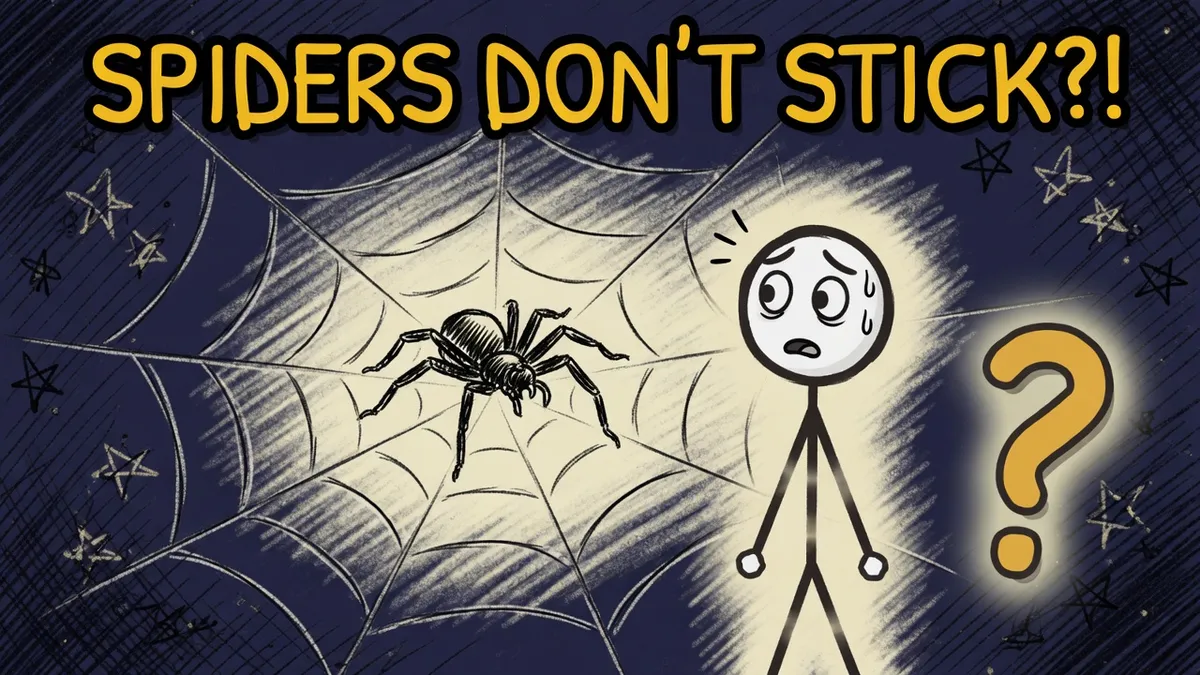
Watch a spider stroll casually across the web that just snared a struggling fly, and a fair question springs to mind: why doesn't it get stuck? The web is a death trap for anything that touches it, yet its maker wanders about like it's carpet. If you learned an answer in school, it was probably "spiders have oily legs," or "they only walk on the non-sticky threads." Here's the surprising part: both are wrong, or at least badly incomplete. The real answer is a three-part trick, and the clincher is an experiment where scientists washed a spider's legs and watched it start sticking to its own trap.
01 · The web that isn't all stickyTwo kinds of silk
The first thing to unlearn is that a web is uniformly sticky. It isn’t. A classic orb web is built from more than one kind of silk. The spokes radiating out from the centre, and the frame around the edge, are dry, tough, non-sticky dragline silk. Only the spiral thread that loops round and round, the capture spiral, is armed with glue. So a spider crossing its web is, for much of the journey, walking on dry scaffolding and never touching adhesive at all. That is a genuine and large part of the answer. But it is not the whole answer, and this is where the old story falls apart.
02 · The problem with the easy answerThey touch the glue constantly
If spiders simply avoided the sticky threads, the mystery would be solved and we could all go home. But in 2012, researchers Daniel Briceno and William Eberhard filmed orb weavers’ legs up close and found something inconvenient for the tidy explanation: spiders press against the sticky capture lines all the time, pushing on them with their hind legs hundreds, even thousands of times while building a single web. So “they only walk on the dry bits” cannot be right. They’re in contact with the glue over and over, and still don’t get caught. Something has to be protecting the legs when they do touch it.
03 · The footwork and the hairsBarely touching on purpose
That something turned out to be two things working together. The first is behaviour: the spider engages and lifts each leg with careful, controlled movements, minimising how much of the leg meets the glue and never yanking hard against a droplet. The second is anatomy: a spider’s legs are covered in dense arrays of tiny branched hairs with fine tips. These hairs drastically cut down the actual surface area that touches any glue droplet, and the droplets tend to slide along the bristly hairs rather than grab hold. Less contact means less stick. The spider is, in effect, tiptoeing on a bed of microscopic bristles.
The third factor is the one that buries the old "oily legs" myth for good, because the scientists tested it directly. There really is a chemical coating on a spider's legs that reduces adhesion. So they washed it off, using solvent to strip the coating, and then touched the cleaned legs to the silk. The legs stuck more strongly. In other words, a spider's non-stick property isn't a permanent feature of its body, it's a coating it maintains, and strip that coating away and the spider starts getting caught in its own web. The non-stick spider is a spider keeping its shoes clean.
04 · The glue itselfBeads on a string
It’s worth appreciating what the spider is up against, because the glue is beautifully engineered too. The stickiness doesn’t come from a uniformly tacky thread; it comes from a row of tiny glue droplets strung along the capture spiral like beads. Inside each droplet is a glycoprotein adhesive, plus water, salts and moisture-attracting compounds that keep it soft and grabby across different humidities. The droplets even form themselves: a smooth coating on the thread spontaneously breaks into evenly spaced beads through surface tension. When a fly hits the web, the droplets seize it and the stretchy thread absorbs the struggle. It is a superb trap, which is exactly why the maker needs three separate tricks to survive walking on it.
05 · The clawsHeld on, not stuck on
One last piece explains the spider’s easy confidence. It doesn’t rely on stickiness to hold its position at all, quite the opposite. A web-building spider grips individual threads mechanically, with tiny claws at the tips of its legs, orb weavers typically having three, including a hooked middle claw made for working a silk line. So the spider hooks and releases threads deliberately, walking its web like a climber on a rope rather than a fly caught in glue. Deft claws for grip, bristly coated legs for when it must touch the glue, and mostly dry roads to travel on: that’s a spider that owns its web instead of being trapped by it.
06 · The payoffSo why don't spiders stick to their own webs?
Not for the one neat reason you were told, but for four reasons stacked together. Most of the web is dry silk they simply walk on. When they do meet the glue, careful footwork and a fuzz of branched hairs keep contact to a minimum. A real chemical coating on the legs actively fights the adhesion, so effectively that scrubbing it off makes them stick. And their clawed feet grip the threads deliberately rather than getting caught. The schoolbook answer, “oily legs,” turns out to be a fragment of a far cleverer truth. A spider doesn’t avoid its own trap by luck or by staying off the sticky parts. It avoids it by being, from the tips of its bristly legs up, a machine purpose-built to walk on glue.
Quick questions
Why don't spiders stick to their own webs?
Because most of the web is not sticky and their legs are specially protected. Only the spiral capture threads carry glue; the spokes and frame are dry silk the spider moves along. When a leg does touch glue, careful movements, branched hairs that reduce contact, and a non-stick chemical coating keep it from getting caught.
Is a spider's web sticky everywhere?
No. In an orb web only the capture spiral, the threads that loop round the wheel, is coated in sticky glue droplets. The straight spokes (radials) and the outer frame are dry, non-sticky silk. That is why a spider can move around most of its web freely.
Do spiders really have oily legs?
The old idea that a simple oily film keeps legs from sticking was based on very weak evidence. A 2012 study found there is a genuine anti-adhesive chemical coating on the legs, but it is only one of three factors, alongside careful leg movements and branched hairs. So 'oily legs' is a half-truth: there is a coating, but it is not the whole story.
Can a spider get stuck in another spider's web?
Yes, it can. The protections are general anti-stick features, not a personal signature, so a spider is not immune to sticky silk as such. In practice spiders can and do get caught, and some spiders even hunt other spiders by invading their webs. A spider is safest on its own familiar web where it knows where the dry threads are.
How do spiders walk on their webs without sticking?
They travel mostly along the dry, non-sticky spokes and frame rather than the glue-coated spiral. Their leg tips grip individual threads with tiny claws, giving precise control. When they must touch sticky lines, they use careful engage-and-withdraw movements plus hairy, coated legs that barely adhere.
What is spider web glue made of?
The glue is mainly a glycoprotein adhesive carried in droplets along the capture thread. The droplets also hold water, salts and water-attracting small molecules that keep the glue soft, tacky and effective across different humidities. These droplets form naturally when a viscous coating on the thread breaks into evenly spaced beads.
What did the 2012 spider study actually find?
Researchers from the Smithsonian Tropical Research Institute and the University of Costa Rica filmed orb weavers' legs at high magnification. They found spiders avoid sticking through three things at once: careful leg movements, dense branched hairs that cut down contact with the glue, and a chemical coating that lowers adhesion. It replaced the older single-cause oil explanation.
Do the tiny hairs on a spider's legs matter?
Yes. The legs carry dense arrays of branched hairs with fine tips, and these dramatically reduce how much leg surface actually touches a glue droplet. Less contact area means much less stickiness. Glue droplets tend to slide along the bristly hairs rather than grip the leg firmly.
What happens if you wash the coating off a spider's legs?
When researchers washed the legs with solvent to strip the natural coating, the legs stuck to the silk more strongly than before. This experiment showed the coating is actively doing anti-stick work, not just sitting there. It is the clearest evidence that leg chemistry, not just behaviour, protects the spider.
Why is spider silk sticky in the first place?
Stickiness lets the web catch and hold flying or walking prey long enough for the spider to reach it. The glue proteins are heavily modified in ways thought to make them adhesive. The stretchy underlying thread lets a struggling insect be held rather than bounced off.
Do all spiders make sticky webs?
No. Only some spiders build glue-coated capture webs, and web designs vary widely, from classic orb webs to tangled cobwebs and funnel webs. Many spiders do not build capture webs at all and hunt actively instead. The sticky-spiral-plus-dry-spokes design described here is specifically the orb weaver pattern.
Does humidity change how sticky a web is?
Yes. The glue droplets contain water-attracting compounds and salts that pull in moisture, which helps keep the glue tacky. Research shows this chemistry helps the glue keep working across a range of humidity levels rather than drying out or getting too runny. Different species' glues appear tuned to their local climate.
How do spiders grip the threads so precisely?
Web-building spiders hold individual threads with tiny claws on their leg tips. Orb weavers typically have three tarsal claws, including a hooked middle claw that works the silk line, letting them hook, walk and manoeuvre with great precision even near the sticky spiral.
Our sources 7 checked
// every claim on this page was checked before it went up