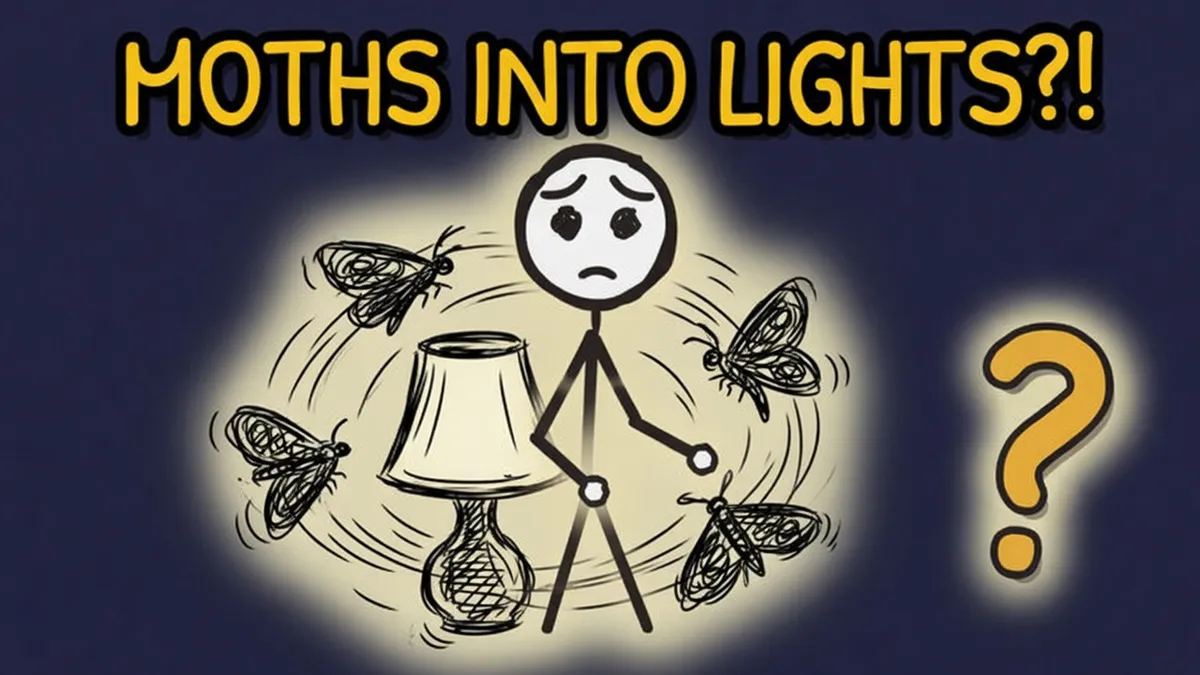
Everyone knows the answer to this one, which is exactly the problem. A moth spirals into your porch light because it mistakes the bulb for the Moon and its ancient navigation goes haywire. It is one of those facts so neat, so often repeated, that it feels settled. It is also, on the best evidence we now have, almost certainly wrong. In 2024 a team finally did the obvious thing nobody had managed before, they filmed the insects in full 3D, and what they found rewrites the whole story.
01 · The old storyThe Moon, the bulb, and the death spiral
The textbook explanation is genuinely elegant, which is part of why it stuck. It goes like this. Night-flying insects, the story says, navigate by holding a fixed angle to the Moon. Because the Moon is so far away that its light arrives in effectively parallel rays, keeping a constant angle to it keeps you flying in a straight line. Then along comes a candle, or a street lamp, a light source that is near. Try to hold a constant angle to a nearby point of light and the geometry betrays you: to keep the angle fixed you have to keep turning, tighter and tighter, until you spiral helplessly into the flame. The name for it is transverse orientation. It is tidy, it is intuitive, and it has been in nature documentaries for decades.
02 · The problemNobody had actually watched them do it
Here is the awkward part. For all its fame, that explanation was never really backed by evidence. It was a plausible geometric story that everyone repeated because it sounded right. The one thing that could have tested it, a careful three-dimensional reconstruction of how insects actually move around a light, had never been done well, because insects are small, fast, and annoying to track in the dark. So the myth sat there for the better part of a century, unfalsified mostly because no one had looked closely enough to falsify it.
03 · The experimentFilming insects in 3D
In 2024, a group led by Samuel Fabian and Yash Sondhi, publishing in Nature Communications, went and looked closely enough. They used high-resolution motion capture in the lab, the same kind of multi-camera rig that animates video-game characters, and stereo-videography out in the field in Costa Rica, and reconstructed the exact flight paths of moths, dragonflies, butterflies and other insects around artificial lights. And the very first thing the data said was that the insects were not flying toward the light at all. They mostly flew at right angles to it. Whatever they were doing, it was not steering in for the kill.
04 · The real answerThey point their backs at the light
What the insects were actually doing is both simpler and stranger. Every insect kept turning its dorsum, its back, toward the brightest light. This is a deep, ancient reflex called the dorsal light response, and out in the natural world it is brilliant. The brightest thing in an insect’s visual field is normally the sky, straight up. So a rule as dumb as “keep your back to the brightest light” is a rock-solid way of knowing which way is up, and staying level in flight. It has worked for hundreds of millions of years, because until about a century ago there was no bright light at night that wasn’t the sky.
Then we invented one. Put a bright point of light at eye level, or below, and the reflex does its job faithfully and disastrously: the insect banks to keep its back turned toward the bulb, and a permanent bank turns straight flight into a circle. It is not being drawn in. It is being held at the wrong angle, unable to work out which way is up.
The insect isn't attracted to your porch light. It is trapped beside it, attitude-locked, its "which way is up" reflex hijacked by the brightest false sky it has ever seen.
05 · Three ways to crashOrbit, stall, invert
Once you know it is a tilt reflex and not a homing instinct, the chaos around a lamp resolves into three clean patterns, all of which the study measured. In orbiting, the insect circles the light at a steady bank, backs turned inward, sometimes for minutes. In stalling, an insect passing under the light pitches up steeply to keep its back to it, climbs until it runs out of airspeed, and simply stops flying. In inverting, an insect that crosses directly over the light rolls upside down, still dutifully aiming its back at the source, and drops out of the air into a dive. Three different-looking catastrophes, one underlying cause.
06 · The other suspectsWhy the rival theories fall short
The Moon story is not the only one people have floated, but the dorsal light response outperforms all of them. The idea that insects flee toward brightness to escape a predator does not fit flight that circles rather than bolts. The dark-zone or Mach-band idea, that a bright light makes the surrounding sky look darker and insects veer away from the apparent gloom, does not match the measured paths either. And the old notion that insects home in on a candle’s infrared warmth, perhaps mistaking it for wavelengths reflected by the Moon or by a mate, runs straight into an inconvenient fact: cool LED lights that give off virtually no heat trap insects just as well. It is the light’s direction that snares them, not its temperature. These older ideas are best treated as contested, plausible fragments that the 3D data leaves behind.
07 · Why it mattersBlue light, warm light, and vanishing insects
This is not just a trivia correction, because artificial light at night is a real pressure on insect populations, and the trap is worse for some colours than others. Insects are especially sensitive to short wavelengths, so ultraviolet and blue-rich light pulls in and disorients far more of them than warm light does. It is why moth surveyors bait their traps with UV lamps, and why filtered amber bulbs catch dramatically fewer insects than cool white LEDs. And the cost is measurable: a 2021 study found moth caterpillar numbers in street-lit hedgerows running roughly 47% below unlit ones, with white LEDs doing the most damage. Every trapped, stalled, exhausted adult is one that is not feeding, mating or laying eggs.
08 · The payoffSo why do moths fly into lights?
The honest answer is that, on the best evidence we have, they mostly don’t. They fly around lights, and above them, and upside down over them, because a bright artificial source stands in for the sky and jams the oldest orientation reflex in the insect toolkit. They are not seduced, they are stranded, held at a broken angle they can’t correct while the light dominates their world. The good news is that this makes the fix concrete rather than mystical. Warm, low-blue bulbs, aimed down, shielded from spilling upward, switched off when nobody needs them. You are not resisting some irresistible lure. You are simply declining to hang a second, fake sky in the dark.
Quick questions
So moths aren't actually attracted to light?
Not in the way we assumed. The 2024 motion-capture study found insects rarely fly straight at a light. Instead they turn their backs toward it and end up circling, climbing or crashing nearby. The best current reading is that artificial light traps insects that pass close by, rather than reaching out and pulling them in from a distance.
What is the dorsal light response?
It is an ancient reflex for staying the right way up. In the natural world the brightest part of the visual scene is the sky, straight above, so keeping your dorsum (your back) pointed at the brightest light is a reliable way to know which way is up. It works beautifully outdoors. It fails badly around a bright point of light sitting at eye level or below.
Why do they orbit the light instead of flying straight in?
Because the reflex controls their tilt, not their heading. To keep its back angled toward a light off to one side, an insect has to bank, and a constant bank turns a straight path into a circle. The 2024 study measured exactly this: insects banked toward the light and looped around it, flying roughly at right angles to it rather than toward it.
What actually happens to a moth near a bulb?
The study catalogued three failure modes. In orbiting, the insect circles the light at a steady bank. In stalling, it climbs steeply with its back to the light until it loses airspeed and stops flying. In inverting, it passes over the light, flips upside down trying to keep its back to it, and dives. All three come from the same tilt reflex misfiring.
What was the old 'Moon navigation' theory?
The classic idea, sometimes called transverse orientation, held that moths navigate by keeping a fixed angle to the Moon. Because the Moon is effectively infinitely far away, that angle stays constant along a straight path. Mistake a nearby bulb for the Moon, the theory said, and holding a constant angle to it forces you into a tightening spiral. It is a lovely idea. It was never backed by strong flight data, and the 2024 study found the behaviour does not match it.
Why doesn't the Moon theory hold up?
A few reasons. The predicted inward spiral is not what the 3D flight tracks actually show. When researchers switched the light's position, insects readily switched their orbit direction, which a fixed-compass strategy should not do. And many insects do not appear to use the Moon as a compass in the first place. The angle-to-the-Moon story is best treated as a myth that outlived its evidence.
What are the other hypotheses people mention?
A handful, all weaker than the dorsal-light explanation. One is that insects flee toward brightness to escape (the escape-to-light idea). Another is the Mach band or dark-zone escape idea, that a bright light makes the surrounding sky look darker and insects steer away from the apparent darkness. Another proposed that a candle's infrared glow resembles the wavelengths reflected by female moths or by the Moon. None explains the measured 3D flight as cleanly as the dorsal light response, and the 2024 study argued against several of them directly.
Does the heat of a flame attract them?
It does not seem to be the main driver. Insects are trapped just as effectively by cool LED lights that give off almost no infrared, which is strong evidence against the idea that they home in on a flame's warmth. The trap is about light direction, not temperature.
Why are some lights worse than others?
Colour matters a lot. Moths and many insects are far more sensitive to short wavelengths, so ultraviolet and blue-rich light pulls in and disrupts far more of them than warm light does. Studies find warm amber or filtered LEDs attract dramatically fewer insects than cool white ones. It is why entomologists trap moths with UV lamps, and why 'bug-friendly' bulbs are amber.
Do all moths fly to light?
No. Plenty of species show little or no attraction, some are actively repelled, and day-flying moths largely ignore it. Even among night-fliers the response varies by species, sex and state. In the 2024 study some hawkmoths seemed to ignore the lights entirely. 'Moths love light' is a rough generalisation, not a rule.
Does light pollution actually harm moths?
Yes, and the evidence is getting hard to argue with. A 2021 study by Douglas Boyes and colleagues found moth caterpillar numbers in hedgerows under street lights were roughly 47% lower than in nearby unlit hedgerows, with white LEDs the worst offenders. Trapping and disorienting adults, disrupting feeding and mating, and cutting caterpillar numbers all point the same way: artificial light at night is one pressure behind insect declines.
What can I do to help moths at home?
Use warm-coloured (low blue) bulbs outdoors, keep outdoor lights off when you don't need them, put them on motion sensors or timers, aim them downward and shield them so light doesn't spill upward or sideways, and close curtains so indoor light doesn't leak out. Reducing the blue content and the total spill is the single most effective thing, because blue-rich, upward-spilling light traps the most insects.
Why do moths sit still once they reach the light?
Once trapped in the light's field, an insect often can't re-establish level flight, so it stalls, lands on or near the surface, and stays. With the bright source still dominating its visual world, the same reflex that trapped it keeps it there, which is why moths seem to 'rest' on a lit wall for hours.
Is this settled science now?
The dorsal-light-response finding is the best-supported explanation we have and it comes from direct 3D flight data, which earlier theories never had. But it is recent (2024) and describes behaviour close to the light rather than every aspect of long-range attraction, so treat it as the leading answer, strongly evidenced, rather than the final word.
Take the quiz on this
A quick 4-question check on what you just read. Get them right to earn XP: no points for just scrolling.
Our sources 9 checked
// every claim on this page was checked before it went up