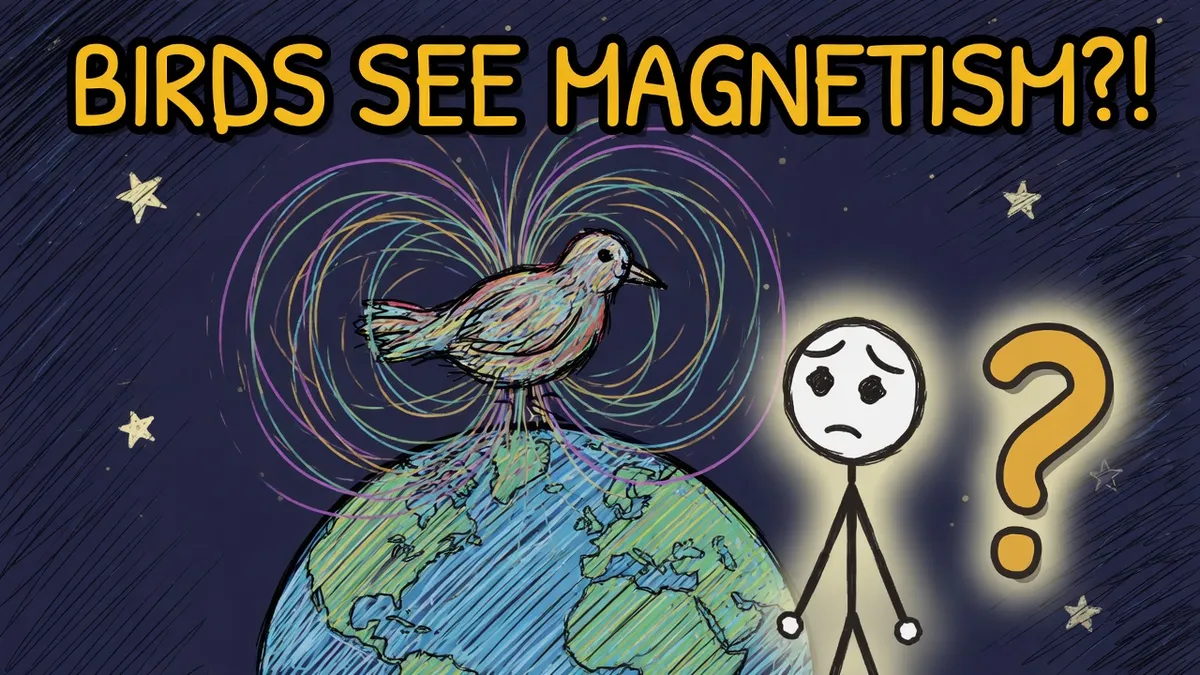
Every autumn, a European robin barely heavier than a couple of coins launches itself into the dark and flies hundreds of miles to a place it may have visited exactly once, and finds it. No map, no landmarks it can see in the black, no one to follow. It steers, in part, by Earth's magnetic field: a force so faint you'd never feel it, roughly a hundred times weaker than the magnet holding a photo to your fridge. Somehow the bird reads it anyway. And here is the genuinely humbling part: after more than fifty years of clever experiments, we still can't say for certain how.
01 · The proofYes, the sense is real
Start with the thing we are sure of. Birds really do have a magnetic compass, and we’ve known it since 1966, when Wolfgang Wiltschko and Fritz Merkel put migratory robins in a cage ringed with electromagnetic coils. The birds, restless to migrate, kept trying to hop in their natural travel direction. Then the researchers rotated the magnetic field around the cage, and the birds rotated their headings to match. Turn the field, turn the bird. It was the first hard proof that any animal could navigate by the geomagnetic field, and it turned a folk hunch into a science.
02 · The compassIt reads the tilt, not the direction
Here’s the first surprise: a bird’s compass doesn’t work like the one in your pocket. Yours has a needle that points along the field toward magnetic north. A bird’s compass ignores that entirely. Instead it reads the inclination, the angle at which the field lines dive into the ground. Near the poles they plunge in steeply; near the equator they run almost flat. So the bird senses “toward the pole” versus “toward the equator” rather than “north” versus “south.” You can prove it in a lab: flip only the vertical part of the field, leaving the horizontal part alone, and the bird cheerfully reverses direction. It isn’t chasing a pole. It’s reading a slope.
03 · The eyeA compass that needs light to work
Now it gets strange. The compass is fussy about light. Robins orient perfectly well under blue and green light, but switch the room to pure red and the sense simply switches off. The birds wander, disoriented. A compass that cares what colour the light is can’t be a lump of iron. It has to be plugged into the chemistry of vision itself. That single clue is why most researchers now look for the primary compass not in the beak, but in the eye, in a light-sensing molecule that only wakes up when the right wavelength hits it.
04 · The quantum bitTwo electrons, spinning in step
The leading explanation is one of the few genuinely quantum tricks anyone has found in biology. In the retina sits a protein called cryptochrome. When blue light strikes it, an electron leaps from one part of the molecule to another, leaving behind two unpaired electrons, a so-called “radical pair.” The spins of those two electrons flip between two arrangements, singlet and triplet, millions of times a second. Earth’s feeble magnetic field is just strong enough to tip the odds between those two states, and it does so by an amount that depends on how the molecule is angled to the field. Multiply that across a whole retina of molecules and, in principle, the bird gets a direction. It’s a compass built from quantum spin, running at body temperature, which physicists find slightly outrageous.
If this is right, the bird isn't feeling the field at all. It's seeing it, a faint shadow or glow laid over its ordinary vision, shifting as the bird turns its head, brightest or darkest in a particular direction.
05 · Seeing northA shadow drawn over the world
That’s not a poetic flourish; it’s where the anatomy points. Because the compass lives in the retina, the magnetic signal would ride the same wiring as sight, and it does travel from the eye up the visual pathway to a specific patch of the forebrain nicknamed Cluster N, part of the bird’s visual processing system. Knock Cluster N out chemically and the magnetic compass fails, while the bird’s star compass and sun compass keep working fine. So the field seems to be handled as visual information. Nobody can climb inside a robin’s skull to check, but the best guess is that a migrating bird looks out at the night and sees, layered faintly over the stars, the shape of the planet’s field.
06 · The beakThe other sensor, and a cautionary tale
There’s probably a second system, and its story is a lesson in scientific humility. Birds have iron-rich structures in the skin of the upper beak, wired to the brain by the trigeminal nerve, and the natural guess was that these little iron particles act like microscopic compass needles, reading the field’s strength to help build a mental “map” of where the bird is. A tidy division of labour: the eye gives you the direction, the beak tells you your position. But in 2012 a team looked closely at those famous iron cells and found that many of them weren’t nerve cells at all: they were macrophages, ordinary immune cells stuffed with iron. Years of assumption, quietly undone. Some evidence still supports a beak-based, trigeminal magnetic sense, so the idea isn’t dead. It’s just genuinely unresolved.
07 · The payoffSo how do they do it?
Honestly? We don’t fully know, and it would be dishonest to pretend otherwise. Everything above is real and hard-won: birds have the sense, it reads inclination, it depends on light, it can be jammed by weak radio-frequency noise (itself a strong hint the quantum idea is right), and a 2021 study showed robin cryptochrome really is magnetically sensitive in a test tube. But showing a molecule twitches to magnetism in a dish is not the same as catching a living bird using it to fly home. The actual receptor has never been pinned down. Researchers have a wry name for the whole puzzle: a sense without a receptor. So the next time a small brown bird crosses a continent in the dark and lands in the exact hedge it left, sit with the fact that it’s steering by something we can measure, disrupt, and model, and still can’t quite explain. That’s not a gap in the story. That’s the good part.
Quick questions
How do birds sense Earth's magnetic field?
They have a magnetic compass, and the leading explanation is a light-triggered chemical reaction in the eye. Blue light hits a protein called cryptochrome and creates a short-lived pair of molecules, a 'radical pair', whose electron spins are subtly steered by the magnetic field. That changes how the reaction ends, which the brain may read as a pattern of light. A second, separate system using tiny iron particles near the beak probably measures field strength. Both are strongly supported but neither has been proven in a living bird.
Do birds actually see Earth's magnetic field?
Possibly, that's the leading hypothesis, not settled fact. Because the compass is built into the eye and needs light to work, many researchers think the field appears to the bird as a faint pattern of light or shading laid over its vision, brightest or darkest in certain directions. Signals from the retina travel to a forebrain region called Cluster N that is part of the visual system, which fits the idea. But no one can climb inside a robin's head, so 'seeing' the field remains an inference.
What is the radical-pair mechanism?
It's the quantum idea at the heart of the eye-based compass. When cryptochrome absorbs blue light, an electron jumps between two parts of the molecule, leaving two unpaired electrons, a 'radical pair'. Those two electrons' spins flip between two arrangements (called singlet and triplet) millions of times a second, and Earth's weak magnetic field tips the balance between them. That changes the chemical outcome depending on the bird's heading. It's one of the few places in biology where a quantum effect may do something useful.
Which protein lets birds sense magnetism?
The leading candidate is cryptochrome, specifically a version called Cry4 (or Cry4a), found in the light-sensing cells of the retina. A 2021 study in Nature showed that cryptochrome 4 taken from a night-migrating European robin is magnetically sensitive in a test tube, and more sensitive than the same protein from non-migratory chickens and pigeons. That's a strong hint, but showing a molecule reacts to magnetism in a lab dish is not the same as proving the bird uses it to navigate.
Is bird navigation really quantum?
The leading hypothesis is genuinely quantum, it depends on the spin states of entangled electrons, which is quantum mechanics, not a metaphor. If it's correct, a robin's eye would be exploiting a subtle quantum effect at body temperature, something physicists find remarkable. But 'quantum biology' here is still a hypothesis with strong lab support and no direct proof inside a living bird, so it should be described as promising, not proven.
What is an inclination compass?
It's a compass that reads the tilt of the field, not its direction of flow. Earth's field lines dip into the ground at an angle that gets steeper toward the poles and flattens out at the equator. A bird's compass senses that dip angle, so it tells 'poleward' from 'equatorward' rather than 'north' from 'south'. One neat consequence: if you flip the vertical part of the field in a lab, the bird reverses course, proof, from 1966 onward, that it's reading inclination.
Why does red light switch off a bird's magnetic compass?
Because the compass is light-dependent and appears to be driven by a blue-light-absorbing molecule. In experiments, European robins orient normally under blue and green light but become disoriented under pure red light (around 630 nm), which cryptochrome doesn't absorb well. That wavelength dependence is one of the strongest reasons scientists locate the compass in the light-sensing chemistry of the eye rather than the beak.
Do birds have magnetite in their beaks?
Birds do have iron-rich structures in the upper beak, connected to the brain by the trigeminal nerve, and for years these were thought to be magnetic sensors reading field strength. But it's contested: a 2012 study found that many of the iron-rich cells were actually macrophages, immune cells, not sensory neurons. Some evidence still points to a beak-and-trigeminal magnetic sense, so the magnetite idea isn't dead, just unresolved.
Do birds use one magnetic sense or two?
The best guess is two complementary systems. The light-dependent eye compass appears to give direction (which way is poleward), while an iron-based sense near the beak may read field intensity as part of a 'map' telling the bird roughly where it is. Direction plus position would let a bird both hold a heading and know when it has arrived. This division of labour is a leading interpretation, not a proven fact.
Which birds can sense magnetic fields?
Many, and not only migratory ones. The classic subject is the European robin, but a magnetic compass has been shown in species from garden warblers to domestic chickens, and iron-rich beak structures turn up across many birds. Homing pigeons are famous for it too. Magnetoreception is thought to be widespread in birds, and in other animals, from sea turtles to some fish and insects, rather than a rare specialisation.
Can Wi-Fi or electronic noise disrupt a bird's compass?
Weak radio-frequency electromagnetic noise can, at least in the lab. A double-blind 2014 study found that European robins lost their magnetic orientation when exposed to the kind of broadband electromagnetic noise given off by everyday electronics, even at strengths far below official human safety limits, and regained it when the birds were screened from it. That the compass is jammed by radio-frequency fields is itself a strong clue that it works through the radical-pair (quantum) mechanism.
Do humans have a magnetic sense?
There's a hint, but it's early and unconfirmed. A 2019 study reported that rotating a magnetic field around volunteers produced a repeatable dip in their brain's alpha waves, a signature the brain uses when it processes a sensory signal, suggesting the human brain can at least detect the field unconsciously. It's intriguing but a single line of evidence, with no sense of direction that people can actually use. Treat 'humans have a magnetic sense' as an open question, not a fact.
How accurate is a bird's magnetic compass?
Very, when combined with the bird's other senses. Migratory birds also use the sun, the pattern of polarised skylight, and the rotation of the stars, and they cross-check all of these. Over a lifetime a bird can build a mental map precise enough to return to the same small patch of ground across thousands of kilometres. The magnetic compass is one instrument in a whole navigation kit, not a lone GPS.
Has the mechanism actually been proven?
No, and that's the honest headline. It's often called 'a sense without a receptor': everyone agrees birds have a magnetic compass, but the actual sensory molecule has never been conclusively identified in a living bird. The radical-pair/cryptochrome idea is the front-runner and has impressive lab support; the magnetite idea is contested. After more than half a century of work, exactly how a bird feels the field is still one of biology's great open questions.
Take the quiz on this
A quick 4-question check on what you just read. Get them right to earn XP: no points for just scrolling.
Our sources 14 checked
// every claim on this page was checked before it went up