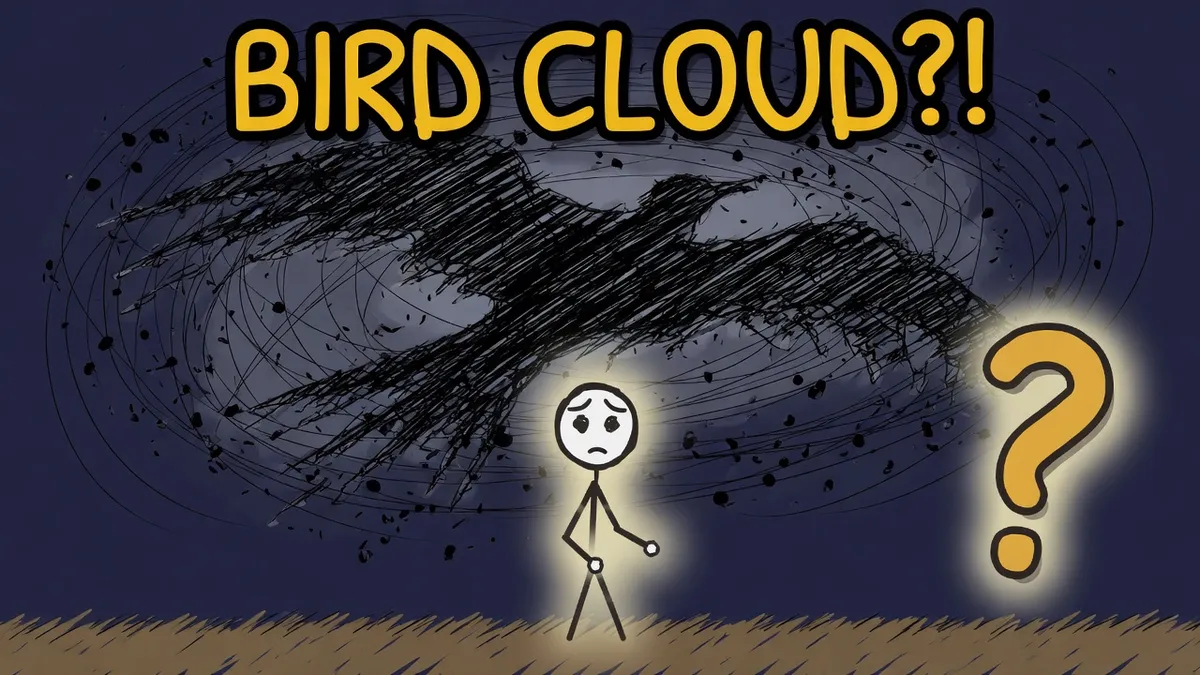
At dusk, over a reed bed or a city rooftop, tens of thousands of starlings pour into the sky and start to dance, swooping, swirling, folding into one vast, breathing shape that pours across the evening like liquid. It never stops moving, and it never seems to crash. Your first instinct is that somewhere in there, a leader bird is calling the moves. There isn't one. No leader, no plan, not a single bird in charge of anything. And that's the strange, beautiful part.
01 · The instinctSurely someone's in charge?
It’s the obvious assumption, and it’s completely wrong. A murmuration has no leader, no head bird, no rehearsal, no shared blueprint. Nobody is looking at the whole shape and deciding where it should go next. In fact, no single starling can even see the whole shape; each one only ever perceives the birds immediately around it. So the coordinated cloud you’re watching isn’t being steered from anywhere. It’s being built, moment to moment, from the bottom up.
02 · The rulesThree absurdly simple instructions
Instead of a leader, every starling runs the same tiny rulebook, and it only pays attention to the handful of birds nearest it. The classic version comes from a 1987 computer model by Craig Reynolds, who built flocking “boids” out of just three local rules. Rule one, cohesion: drift toward the birds near you. Rule two, alignment: point the same way and fly the same speed as your neighbours. Rule three, separation: never let anyone get too close. Stay close, match, don’t crash. That is genuinely the entire recipe.
03 · The emergenceHow a shape appears from nothing
Now, here’s the thing about those three rules: no single one of them describes a murmuration. There’s nothing in “don’t crash” about giant swirling ribbons in the sky. But run all three, in every bird, at the same time, and the enormous shape simply appears, with nobody having designed it. That’s called emergence: complex, coordinated behaviour arising out of simple parts following simple rules, with no central controller anywhere. The whole is doing something none of the pieces know anything about.
04 · The sevenThe detail that makes it work
Here’s the finding that turned this from a nice idea into hard science. In the mid-2000s, a project called STARFLAG photographed real starling flocks over Rome with synchronised cameras and reconstructed the position of every bird in three dimensions. What they found was surprising: each starling doesn’t respond to whatever birds happen to be within a certain distance. It responds to a fixed number of nearest neighbours, on average about six or seven, no matter how far apart the flock spreads. When the whole cloud stretches thin or bunches tight, each bird keeps watching the same headcount. That “topological” rule is what lets the flock expand, contract and turn without ever falling apart.
Because every bird is locked to its seven, a single starling's turn doesn't stay local, it ripples outward across the entire flock in a fraction of a second, like a wave travelling through water.
05 · The waveOne bird, felt across the sky
That rippling turn isn’t a metaphor. When researchers measured how the flock’s movements correlate, they found something physicists call scale-free correlation: the birds are coordinated across distances far larger than any one bird could sense directly. In practice, information about one individual changing course propagates across the whole flock fast and efficiently, so a hundred thousand birds can react as if they share a single nervous system. One bird flinches, and the shudder crosses the sky almost before you can blink. It’s not telepathy; it’s just seven neighbours, passing the message on, over and over, at speed.
And researchers have actually clocked it. Tracking flocks turning over Rome, physicists found that a bird’s turn doesn’t fade or smear as it spreads: it travels as a clean wave that crosses a flock of hundreds of birds in around half a second, faster than the birds themselves fly. Any single starling’s reaction time is only 20 to 100 milliseconds, but stacked bird-to-bird, those tiny delays add up to a signal that outruns the flock and sweeps the whole cloud almost before your eye can follow it.
06 · The reasonThere's a killer in the sky
All of this beauty has a grim engine behind it. Roosting starlings are hunted by fast, agile raptors, above all the peregrine falcon, the fastest animal on Earth, which can hit around 320 km/h in a diving stoop. Against a lone bird, that’s a death sentence. But against a churning mass of thousands, all shifting together, a predator struggles to lock onto any single target, the “confusion effect.” A large citizen-science study backs this up: the presence of predators is positively linked to how big and how long murmurations get. There may be a bit of “warmer together” at communal roosts too, but the evidence points hardest at safety. It’s the leading explanation, not a closed case, but the pattern is clear: more danger, bigger dance.
07 · The payoffSo how do thousands move as one?
They don’t, really, not as a “one.” A murmuration isn’t choreographed and it isn’t led. It’s thousands of small, selfish, near-identical decisions, stay close, match, don’t crash, watch your seven, adding up to something far bigger and more beautiful than any single bird could ever picture. And the very same hidden maths runs schooling fish, swarming insects, even moving human crowds: simple parts, simple rules, an astonishing whole. So that breathtaking shape rolling across the evening in flawless unison? It’s a hundred thousand birds, each one just frantically trying not to bump into the seven strangers nearest it.
The animated version
Same answer, told as a little animated story with the strange little stickman acting it out. Dry, quick, and, obviously, correct.
Quick questions
Do starlings have a leader in a murmuration?
No. There's no leader and no plan: not a single bird is in charge. The coordinated shape is emergent: it appears from every bird independently following the same few local rules at the same time.
How do starlings avoid crashing into each other?
Each bird follows a 'separation' rule, never let a neighbour get too close, while also matching everyone's direction and speed. Because they're all steering by the same handful of nearby birds, the flock stays spaced out and moves coherently even at high speed.
How many neighbours does each starling watch?
Research on wild flocks over Rome found each bird interacts with a fixed number of nearest neighbours, on average about six or seven, regardless of how far apart the flock spreads. It's the number, not the distance, that stays constant.
Why do starlings form murmurations at all?
The leading explanation is anti-predator safety. A dense, shifting cloud makes it hard for a hunter like a peregrine falcon to lock onto one target. Warmth at communal roosts may play a role too, but studies find murmurations are most strongly tied to the presence of predators.
Do other animals move like this?
Yes. The same principle, simple local rules producing complex group motion, is seen in schooling fish, swarming insects, and even human crowds. Scientists call it collective motion or self-organisation.
What is a murmuration, and where does the word come from?
A murmuration is the collective noun for a flock of starlings, used especially for the huge, shape-shifting clouds they pour into at dusk. The word traces back through Middle English to the Latin murmuratio, 'a murmuring', almost certainly named for the soft, rushing hum that thousands of beating wings make overhead. It's been in English since around 1390, centuries before anyone could explain the physics underneath it.
When and where can you see starling murmurations?
In the UK the season runs roughly October to March, peaking in the depths of winter, often December to February, when migrant starlings swell the resident flocks. They gather in the last half-hour or so before dusk, just above a communal roost: classic spots are reed beds and wetland nature reserves, and famously a few seaside piers like Brighton and Aberystwyth. Arrive before sunset and be ready to wait, because on some nights the display lasts only a few minutes.
How many starlings are in a murmuration?
Anywhere from a few hundred to well over a million. A typical winter roost runs into the tens of thousands, but the biggest gatherings are staggering: a roost on the Somerset Levels has been estimated at several million birds. These giant figures are eyeballed estimates rather than head counts, so hold the exact numbers loosely; even so, a 'small' murmuration is still thousands of birds moving in near-perfect coordination.
Do other birds form murmurations besides starlings?
Yes, starlings are just the most famous. Similar coordinated, shape-shifting flocking turns up in waders like red knots and dunlins, and in some flocks of blackbirds, geese, swallows and finches. Starlings get the spotlight mainly because their flocks are so large, so tightly packed, and so easy for people to watch wheeling over towns and reed beds at dusk.
How do starlings react fast enough not to crash?
Partly reflexes, partly a relay. A single starling's reaction time is on the order of 20 to 100 milliseconds, but the real trick is how a turn spreads: when one edge of the flock banks, the change travels through the group as a coherent wave, measured crossing a flock of hundreds of birds in about half a second, faster than the birds themselves fly. Because each bird only has to track its handful of neighbours, the message outruns any single wingbeat.
Is a murmuration safer for each bird, or just prettier for us?
Safer is the leading explanation. A dense, shape-shifting flock confuses predators and dilutes each bird's chance of being the one caught. Peregrine falcons and other hunters still take starlings, but the collective display is mainly anti-predator defence, with the beauty as a side effect for human watchers.
Do fish and insects use the same rules as a starling murmuration?
Broadly, yes. Schooling fish, swarming insects and even human crowds can be modelled with the same local rules: stay near neighbours, match their heading, and do not collide. Starlings are the showpiece, but the self-organising pattern is common across animals.
Take the quiz on this
A quick 4-question check on what you just read. Get them right to earn XP: no points for just scrolling.
Our sources 12 checked
// every claim on this page was checked before it went up