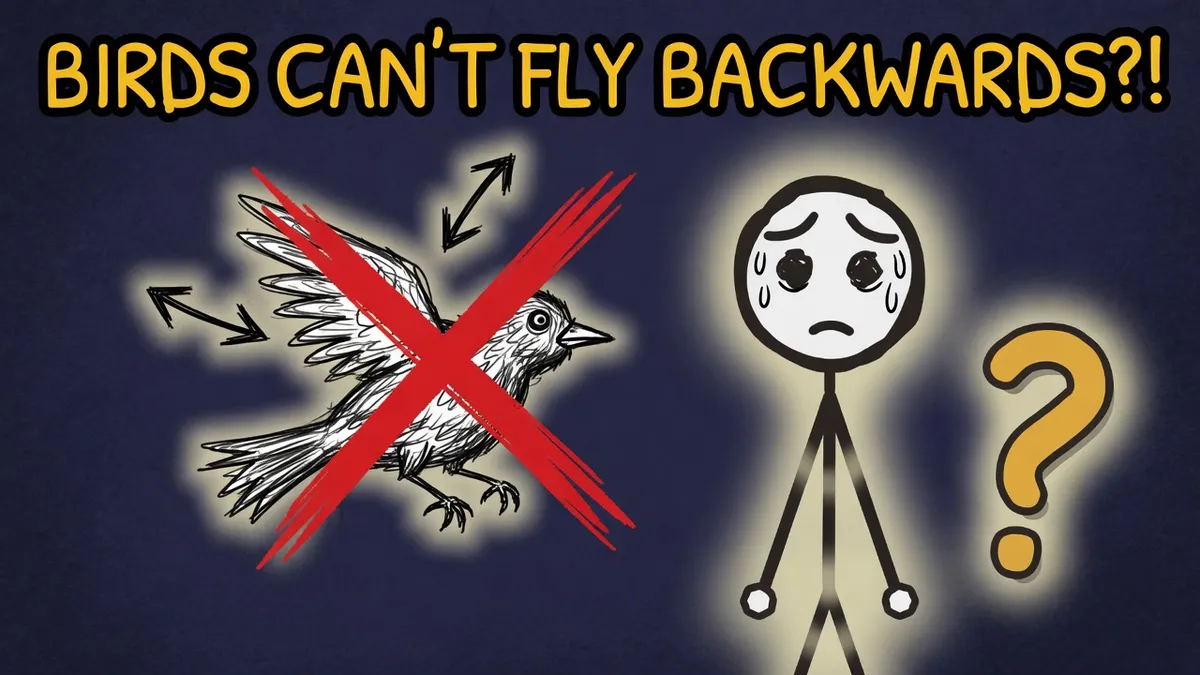
Watch a bird for long enough and you will see it do almost anything: bank, stall, dive, hang on a gust, drop onto a wire from a dead climb. But there is one move you will never see a crow or a gull or a sparrow pull off. It cannot reverse. It cannot back up in mid-air the way it goes forward. Nearly every bird on Earth flies in exactly one direction, and the reason is a piece of engineering hidden in the shoulder.
01 · The engineA normal wing only works one way
Here is the thing most people get wrong about flapping: a bird’s wing is not an oar it pushes evenly in both directions. It is a one-way engine. On the downstroke, the wing is fully spread, angled to bite the air, and it does nearly all the work, generating the lift that holds the bird up and the forward thrust that drives it on. Then, on the upstroke, the wing mostly gives up. It partly folds, the feathers twist to let air slip through, and it flicks back up with as little resistance as possible, resetting for the next power stroke.
That design is brilliant for going forward and hopeless for going back. Every cycle, the useful push points the same way. There is simply no stroke in the sequence built to shove the bird in reverse. Ask a pigeon to fly backwards and you are asking a rowing boat to move by feathering both oars: the machinery just does not point that way.
02 · The near missesThe birds that cheat for a second
Now, “can’t fly backwards” needs one honest asterisk. A few birds can lurch backwards for a beat or two. A heron or an egret coming in to land will sometimes back-pedal in the air to fine-tune its footing. Some small warblers flick backwards off a branch. And any bird startled deep in a bush will occasionally burst out backwards in a panic of wingbeats.
But watch closely and it is never real flight. It is a shove, a controlled fall, a bit of clumsy back-pedalling that lasts a wingbeat and then stops. None of these birds can hold it. They cannot cruise in reverse, hover in place, and pick their way backwards through the air with any control. For that you need a completely different kind of wing, and only one family of birds ever grew one.
03 · The exceptionThe bird that broke the rule
The hummingbird does not flap the way other birds flap. It barely folds its wing at all. Instead of a down-then-recover flap hinging at the shoulder, the whole wing sweeps back and forth in a flattened figure-of-eight, almost like treading water in the air. And the trick that makes it possible sits right at the shoulder: where your average bird has a joint built to hinge the wing up and down, the hummingbird has a rotating ball-and-socket joint.
That joint lets the wing turn over. On the forward sweep the underside of the wing faces down; then the wing inverts and, on the backward sweep, the top of the wing faces down. So the wing is angled to make lift going both ways. Popular accounts often describe the wing rotating up to roughly 180 degrees, and while the exact figure is a bit of a simplification, the core point holds: the hummingbird wing does something no other bird’s wing can, it flips over mid-stroke.
04 · The measurementHow much lift comes on the way up
For a long time people assumed that if hummingbirds hover like insects, they must generate lift equally on both strokes, the way insects do. In 2005, a team led by Douglas Warrick, with Bret Tobalske and Donald Powers, actually measured it, filming hovering hummingbirds through a cloud of illuminated mist to trace the swirls of air their wings left behind. Published in Nature, the result was a beautifully specific number.
A hovering hummingbird gets about 75% of its weight support on the downstroke and about 25% on the upstroke. Not the even 50-50 split of a true insect, but nowhere near the near-zero upstroke of an ordinary bird either. The hummingbird sits exactly in between: a bird that evolved partway toward flying like a bug. That 25% is the whole story. It is the lift that no other bird makes, and it is what turns a forward-only flyer into something that can hover, strafe, and reverse.
The thing that lets a hummingbird fly backwards is not a stronger muscle or a faster wing. It is a single joint that lets the wing turn upside down, so the "recovery" stroke every other bird wastes becomes a second engine.
05 · The steeringTilt the eight and you go anywhere
Once the wing makes lift on both sweeps, backward flight is almost a formality. To hover, the hummingbird holds its figure-of-eight flat and level, and the forward and backward sweeps cancel out into pure lift: it hangs dead still in the air. To go forward, it tilts the pattern one way. And to go backwards, it simply tilts it the other way, angling the wingbeats so the net push points behind it.
That is why a hummingbird at a feeder looks less like a bird and more like a tiny helicopter. It can rise straight up, slide sideways, hold a perfect hover while it drinks, and then peel off backwards to clear the flower before turning. The same rotating shoulder that made backward flight possible made the hummingbird the most manoeuvrable flyer with feathers, capable of briefly flying upside down and pivoting on the spot.
06 · The billWhy this trick nearly kills them
None of this is free. Hovering is one of the most metabolically expensive things any animal does, and hummingbirds do it more or less constantly. They run among the highest metabolic rates of any vertebrate, with hearts that can beat well over a thousand times a minute and wings that never really rest. A hummingbird can burn through roughly half its body weight in sugar in a single day, which is why it spends its life chained to the next flower.
The cost is steepest at night, when it cannot feed. At its daytime burn rate, a hummingbird would starve to death in its sleep. So it does something drastic: it enters torpor, a nightly near-hibernation in which its body temperature crashes, its heart rate falls to a fraction of normal, and its metabolism drops so low the bird looks almost dead until dawn. The exotic flight comes bundled with an exotic, knife-edge kind of life.
07 · The payoffSo why can't birds fly backwards?
Because a wing is not neutral machinery: it is a tool shaped for one job. Almost every bird’s wing is built as a forward-only engine, all the work on the downstroke, a wasted recovery on the way up, brilliant for covering distance and useless in reverse. The occasional heron back-pedalling to land is just borrowing a wingbeat, not truly flying backwards.
Only the hummingbird rebuilt the joint. Swap the hinge for a ball-and-socket, let the wing flip over, and suddenly the wasted upstroke becomes a second source of lift, worth that measured 25%. Everything else, the hover, the figure-of-eight, the ferocious appetite, the near-death sleep, follows from that one change. Birds can’t fly backwards because their shoulders won’t let them. A hummingbird’s will, and it pays for the privilege every minute it is awake.
Quick questions
Can any bird fly backwards?
Hummingbirds are the only birds that can fly backwards in a sustained, controlled way. A handful of others, herons, egrets, some warblers, or any bird startled out of a bush, can shove themselves backwards for a wingbeat or two, but it is a lurch, not real flight, and they cannot keep it up.
Why can't most birds fly backwards?
Because a normal bird wing is a one-way engine. It makes lift and forward thrust on the downstroke, then largely folds and feathers on the upstroke to cut drag. That design pushes the bird forward every cycle, so there is nothing to drive it in reverse.
How do hummingbirds fly backwards?
Their shoulder is a rotating ball-and-socket joint that lets the whole wing flip over, or invert. Instead of a down-then-recover flap, the wing sweeps a flat figure-of-eight and makes lift on both the forward and the backward sweep. Tilt that figure-of-eight and the bird can push itself backwards, sideways, even briefly upside down.
Are hummingbirds the only birds that can hover?
They are the only birds that can hover for long stretches in still air, staying dead still at a flower. Kestrels, kingfishers and terns can appear to hover, but they are mostly hanging on a headwind or beating hard against a breeze, not holding a true stationary hover the way a hummingbird does.
What is the figure-of-eight wing motion?
Seen from the side, a hovering hummingbird's wingtip traces a flattened figure-of-eight rather than an up-and-down flap. The wing sweeps forward, inverts, sweeps back, and inverts again, so the underside faces down on the forward stroke and the top faces down on the backstroke. That is what lets it make lift going both ways.
Do hummingbirds make lift on the upstroke?
Yes, and that is what sets them apart. A 2005 study in Nature found a hovering hummingbird gets about 75% of its weight support from the downstroke and about 25% from the upstroke. Insects tend to split it evenly, so the hummingbird sits partway between an ordinary bird and a bug.
How fast do hummingbirds beat their wings?
Very fast. Most species beat their wings on the order of 50 times a second, and the smallest can hit 80 or more, which is what produces the humming sound they are named for. The wings move too fast to see as anything but a blur.
Why do hummingbirds eat so much?
Hovering is one of the most expensive things any animal does, and hummingbirds do it constantly. They run among the highest mass-specific metabolic rates of any vertebrate, with heart rates that can top 1,000 beats a minute, so they may eat around half their body weight in sugar a day just to keep the engine running.
What is torpor in hummingbirds?
Torpor is a nightly mini-hibernation. A hummingbird cannot feed in the dark, and at its normal burn rate it would starve before morning, so it lets its body temperature and heart rate plunge, dropping its metabolism dramatically to save fuel until the sun comes back and it can eat again.
Can hummingbirds fly upside down?
Briefly, yes. Because the wing can invert and the bird can pivot on the spot, a hummingbird can flip through a short backwards somersault or hold a brief inverted position, usually as an escape or courtship move, before righting itself. No other bird has that range of control.
Can penguins or other birds fly backwards underwater?
Penguins do not fly in air at all, they use their wings as flippers to 'fly' through water, and can indeed manoeuvre in reverse there. But that is swimming, not flight. In the air, sustained backward flight is a hummingbird-only skill.
Do bats or insects fly backwards?
Many insects, dragonflies especially, are superb backward and hovering fliers, because their wings work very differently from a bird's and make lift on multiple strokes. Some bats can reverse briefly too. Among birds, though, only hummingbirds manage sustained backward flight, and they do it by borrowing an insect-like trick.
Why can hummingbirds do it and no other bird can?
It comes down to one joint. Other birds have a shoulder built to hinge the wing up and down; the hummingbird's shoulder is a rotating ball-and-socket that lets the wing turn over. Change the joint and you change what the wing can do, and only hummingbirds got this particular upgrade.
Take the quiz on this
A quick 4-question check on what you just read. Get them right to earn XP: no points for just scrolling.
Our sources 7 checked
// every claim on this page was checked before it went up