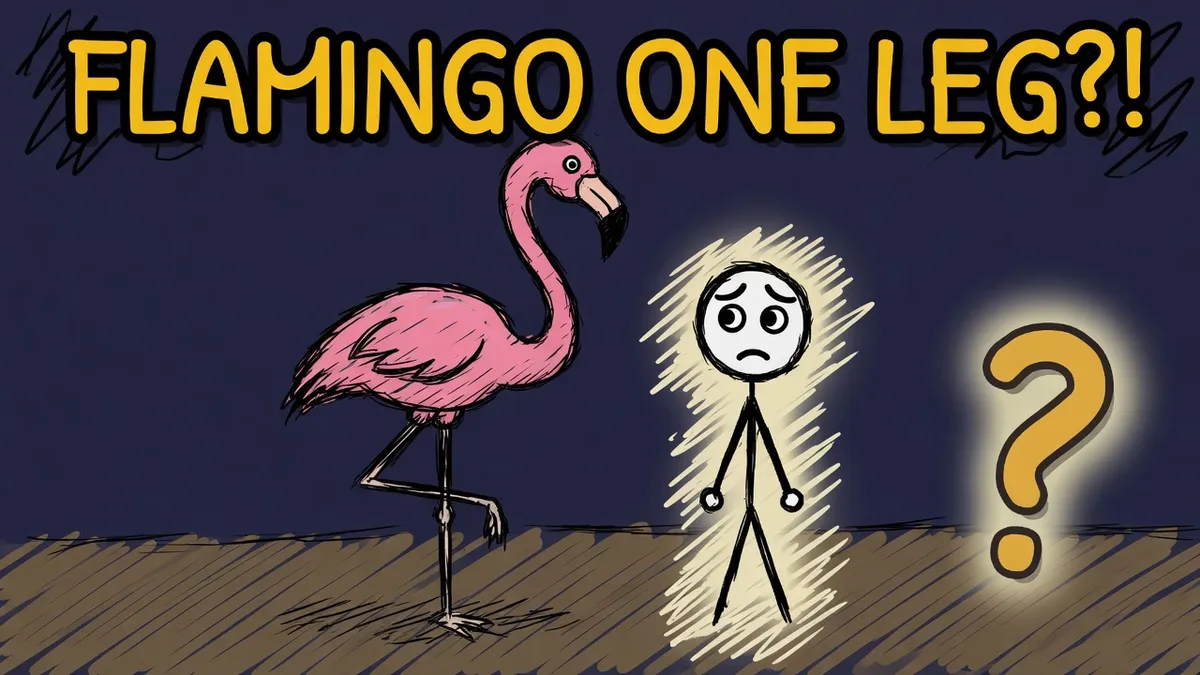
Look at a flamingo standing in a lagoon and your instinct is to feel the effort. One impossibly thin leg, a whole pink body balanced on top, the other leg folded away like a party trick. It looks precarious, exhausting, the kind of pose you could hold for maybe ten seconds before wobbling. So here is the fact that flips the whole thing on its head: for a flamingo, standing on one leg is not the hard version. It is the easy one. The bird is barely trying, and it is actually steadier than it would be on two.
01 · The puzzleThe pose that should be tiring, but isn't
Our intuition comes from being human. Ask a person to stand on one leg and their muscles start a frantic, invisible negotiation: tiny corrections, a wobble here, a clench there, all to keep the body’s weight balanced over one small base. Do it for a few minutes and you feel it. So we assume a flamingo must be doing the same thing, only heroically, for hours, sometimes while asleep. The real question isn’t why they bother. It is how they get away with it so cheaply.
02 · The anatomyThat "knee" is actually its ankle
First, clear up the most common misreading of the flamingo leg. That joint partway up, the one that seems to bend backwards like a knee put on upside down, is not a knee at all. It is the ankle. The flamingo’s real knee is tucked up high against its body, hidden under the feathers, so the long stretch you think of as the shin is really the equivalent of a very elongated foot and lower leg. The bird is essentially standing on tiptoe, on a foot that has been stretched out into a stilt. That matters, because the way those joints stack changes everything about how the weight is held.
03 · The mechanismThe leg that locks itself
In 2017, Young-Hui Chang and Lena Ting set out to measure the effort directly, and found there was almost none to measure. When a flamingo shifts its weight onto one leg and leans very slightly forward, its centre of mass settles in front of the joints, and the leg passively locks into a straight, stable column. Gravity does the balancing. The muscles barely have to fire. They called it a passive gravitational stay: a stance held up by skeleton and gravity, not by constant muscular work. It is closer to a folding deckchair snapping into position than to an athlete holding a pose.
To test it, the researchers took a flamingo cadaver, a bird with no working muscles at all, and stood it on one leg. It held the pose by itself, perfectly stable. Then they tried it on two legs, and it toppled over.
04 · The proofA dead bird that balanced better than a live one
Sit with that for a second, because it is the cleanest evidence you could ask for. A body with zero muscle activity should collapse the instant you let go. Instead the cadaver stood one-legged unassisted, the joints locking under gravity exactly as the living bird’s do, and it stayed put even when tilted through wide angles. Yet the same cadaver would not hold a one-legged stance on two legs. That is the counterintuitive heart of it: one leg is the stable configuration and two is the unstable one, at least for resting. The pose isn’t a feat of balance. It is a feature of the flamingo’s frame.
The live birds backed it up. Chang and Ting measured how much resting flamingos swayed, and found that when a bird tucked its head onto its back and dozed off, it swayed less than when it was alert and fidgeting. A sleepy flamingo is a steadier flamingo. If staying upright took real muscular work, drowsiness should make it worse, not better. Instead the numbers point the other way, which is what you would expect from a stance the body holds on autopilot.
05 · The other storyTucking a leg away to stay warm
The mechanics explain how the pose costs so little. They don’t fully explain when a flamingo chooses it, and that is where the older idea comes back in. A bird’s legs are bare, thin and poorly insulated, so a lot of body heat leaks out through them, especially when they are planted in cold water. Pull one leg up into the warm plumage and you roughly halve the surface losing all that heat.
This isn’t just a tidy story. In 2009, Matthew Anderson and Sarah Williams watched a captive flock and found the pattern you would predict if warmth mattered: the birds rested on one leg more often in water than on land, and more as the temperature dropped. They also checked and rejected the obvious rival, muscle fatigue, since the birds were actually quicker to move off from a two-legged rest than a one-legged one. Heat loss, not tired legs, tracked the behaviour.
06 · The honest answerBoth, probably, and nobody has fully settled it
So which is it, clever engineering or a warm coat? The most honest answer is that it does not have to be a contest, and the science has not conclusively crowned one winner. The passive-stay mechanics explain why the pose is nearly free to hold. The thermoregulation data explain a good part of when birds bother to strike it. A stance that costs almost nothing and saves heat is simply a good deal from two directions at once, and evolution rarely turns down a two-for-one. The two ideas coexist far more comfortably than headlines pretending one “debunked” the other would suggest.
07 · The company they keepFlamingos aren't even unusual
For all the mystique, the one-legged stand is not a flamingo party trick. Ducks, geese, gulls, herons and storks do it too, standing on a single leg to rest and to keep warm, for exactly the same reasons. Flamingos just do it on longer legs, in prettier water, in a more photogenic colour, so they became the poster bird for a habit half the wading world shares. The pose is common precisely because it is such a bargain: cheap to hold, and warm into the deal.
08 · The payoffSo why does a flamingo stand on one leg?
Because it is the lazy option, and lazy, in nature, usually means smart. The leg locks itself into a stable pillar under gravity, so the bird can hold the pose for hours on next to no muscle, steady enough to sleep on, a cadaver could do it. Fold the other leg up into the feathers and the same pose that costs nothing also stops precious heat pouring out into the cold water. It looks like the hardest thing in the marsh. It is, quietly, the easiest, which is the most flamingo answer imaginable: make the effortless thing look impossible, and stand there being pink about it.
Quick questions
Why do flamingos stand on one leg?
The leading answer is effort. A flamingo's leg locks into a passive stance that holds its body up with little or no muscle work, and it is actually steadier on one leg than two. Tucking the other leg against the body also conserves heat, so warmth is very likely a second reason the pose pays off.
Is it really easier for a flamingo to stand on one leg than two?
Yes, and that is the surprising part. In a 2017 study a flamingo cadaver held a stable one-legged pose on its own, with no muscle activity at all, but fell over when set on two legs. When the weight is centred over a single locked leg, gravity does the balancing for free.
Does standing on one leg keep flamingos warm?
Almost certainly it helps. Birds lose a lot of heat through their bare legs, especially in cold water, and pulling one leg up into the feathers roughly halves the exposed surface. A 2009 study found flamingos rested one-legged more often in water than on land, and more as the temperature dropped, which is exactly what you would expect if warmth mattered.
So is it about balance or about warmth?
Probably both, and the science has not fully settled which matters more. The mechanics explain how the pose costs so little, and thermoregulation explains a chunk of when birds choose it. The two ideas do not exclude each other, and the honest answer is that a cheap stance that also saves heat is a good deal on every count.
Don't their legs get tired standing on one leg all day?
That seems to be the whole point: they don't. Because the joints lock passively, the muscles barely have to fire, so there is little to fatigue. One study even found the birds were slower to start moving from a two-legged rest than a one-legged one, the opposite of what you would see if one leg were the tiring option.
Do flamingos swap legs?
Yes. They regularly switch which leg they stand on, which is part of why muscle fatigue alone does not explain the pose. If one leg were straining, you would expect frequent, uneven swapping, but the behaviour looks more like comfortable resting than relief from effort.
Why does a flamingo's knee bend backwards?
It doesn't, because that joint is not the knee. The backward-bending joint halfway up a flamingo's leg is its ankle. The real knee is tucked up high against the body, hidden under the feathers, so the long lower section you see is effectively a very stretched foot and lower leg.
Do flamingos sleep standing on one leg?
Often, yes. They tuck the head back onto the body and rest on a single leg, and brain-wave studies of birds suggest they can sleep with half the brain at a time. The 2017 work found sleepy birds actually swayed less than alert ones, so the locked one-legged stance is stable enough to doze on.
Do other birds stand on one leg too?
Plenty do. Ducks, geese, gulls, herons, storks and many wading birds all rest one-legged, and the same two explanations apply: it is a low-effort resting posture and it cuts heat loss through the legs. Flamingos are just the most photogenic example.
Do flamingos fall over when they sleep on one leg?
Very rarely. The passive locking of the joints keeps the body poised over the standing leg, so it takes a real disturbance, a gust or a shove, to topple them. Left undisturbed, a resting flamingo can hold the pose for long stretches, including while asleep.
Why are flamingos pink, while we're here?
Their diet. Flamingos eat algae and small crustaceans such as brine shrimp that are rich in pigments called carotenoids, and their bodies deposit those pigments in the feathers. A flamingo raised without carotenoids in its food would grow up white, and captive birds are often fed supplements to keep them vivid.
Do flamingos stand on one leg in the wild or just in zoos?
Both. The behaviour is seen in wild flocks and captive ones alike, which is one reason it is unlikely to be an artefact of captivity. Wild flamingos standing in cold, shallow lagoons have exactly the conditions where a low-effort, heat-saving pose would earn its keep.
Take the quiz on this
A quick 4-question check on what you just read. Get them right to earn XP: no points for just scrolling.
Our sources 8 checked
// every claim on this page was checked before it went up