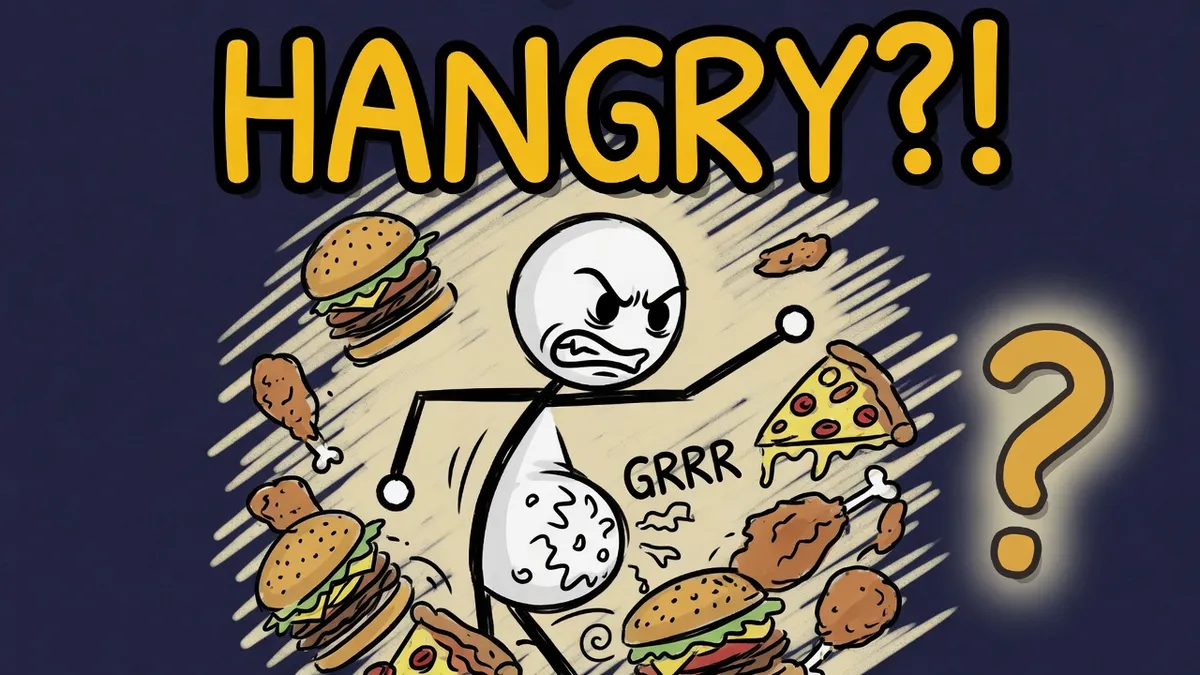
Here is the tell that gives the whole thing away. You are, by any fair account, a reasonable person. Then you skip lunch, and by three o'clock a colleague's chewing has become an act of open aggression, an email's tone is a personal insult, and you are one small provocation from saying something you'll regret. You eat a sandwich. Within minutes the grievance simply dissolves, as if it were never there. Nothing changed except your blood sugar. That is the strangest part of being hangry: the anger feels completely real and completely justified, right up until food reveals it was never really about the world at all.
01 · The organYour brain is an expensive, badly-stocked engine
Start with the demanding customer at the centre of all this. Your brain is about 2% of your body weight but burns roughly a fifth of your total energy, and it is fussy about what it will accept: it runs almost entirely on glucose. Worse, it keeps almost no reserves of its own. Muscles and liver can stockpile fuel; the brain lives more or less hand to mouth, dependent on a steady trickle delivered by the blood. So when blood sugar starts to slide, the organ that pays your bills is the first to notice, and it does not take the news calmly.
02 · The alarmLow fuel trips a stress response
When glucose dips too low, the body does not politely suggest a snack. It launches what physiologists call the counter-regulatory response: a coordinated push to drag blood sugar back up, and to make you go find food right now. Part of that push is a surge of stress hormones, adrenaline and cortisol, the same chemicals that flood you when you’re startled or under threat. This is why hunger can feel oddly urgent and jittery rather than just empty. Your body has decided a fuel shortage is a kind of emergency, and it reaches for the emergency kit: the machinery of fight-or-flight.
03 · The moleculeThe chemical that says "eat" also says "fight"
There is a specific culprit worth naming: neuropeptide Y. It is one of the most powerful hunger signals your brain has, cranking up when fuel runs low and practically shouting at you to eat. But here is the awkward overlap. Neuropeptide Y also acts in the amygdala, the brain’s emotional switchboard, and higher levels of it have been linked to anger and aggression. So the very molecule tasked with driving you toward the fridge is, at the same time, quietly filing down your patience. The signal for hunger and a primer for a short fuse turn out to share a chemical address.
04 · The self-control taxWhy the small stuff suddenly gets you
Now layer on a second effect. Holding your temper, biting your tongue, letting a petty annoyance slide: all of that is self-control, and self-control appears to be metabolically expensive. When glucose is scarce, the evidence suggests impulse regulation weakens, so the reaction you would normally suppress slips out instead. This is the important subtlety. Hunger does not necessarily make the world more annoying. It makes you worse at not reacting to it. The provocation was always there. Your brakes just got softer. (Worth a small caveat: some of the classic glucose-and-willpower research has been debated in psychology’s replication reckoning, so treat this as a real tendency rather than an iron law.)
Falling blood sugar builds the raw bad feeling, but it doesn't come pre-labelled "anger." Your brain has to decide what the feeling means, and it usually blames whatever is standing nearby.
05 · The misattributionHanger is partly a story you tell yourself
Here is where hanger stops being pure chemistry and becomes psychology. In 2018, researchers Jennifer MacCormack and Kristen Muscatell ran a set of studies on exactly this. They found that hunger, on its own, did not simply make people angry. It made people more likely to read ambiguous things negatively, but only when there was already a negative context to hang the feeling on. Prime a hungry person with something unpleasant and the crankiness found a target; give them a neutral or pleasant setting and it largely didn’t. In other words, your empty stomach generates a vague, uncomfortable arousal, and your brain, hunting for an explanation, staples it onto the nearest available grievance. The chewing colleague isn’t the cause. They’re just the coat hook.
06 · The evidenceIt's real, and awareness is the off-switch
None of this means hanger is imaginary. A 2022 field study followed 64 people for three weeks, pinging them five times a day for over nine thousand snapshots of real life, and the pattern was clear: the hungrier people were, the more anger and irritability and the less pleasure they reported, even after accounting for age, sex, body weight and how quick-tempered they were to begin with. So the effect is genuine and it shows up in ordinary days, not just the lab. But the MacCormack work also handed us the antidote. People who recognised that their bad mood might just be hunger were less likely to actually feel hangry. Naming the state loosens its grip. The feeling loses its power the moment you refuse to believe its story about the world.
07 · The payoffSo why do we get hangry?
Because a glucose-hungry brain, sensing its fuel run low, pulls the fire alarm: a stress-hormone surge and a chemical hunger signal that together leave you rushed, edgy and low on self-control. That’s the body’s half. The mind’s half is a misreading, taking a formless bad feeling and deciding, wrongly, that it is anger at something out there. Which is oddly good news. It means the cure is not just a sandwich, though a sandwich helps enormously, but a small act of honesty: catching yourself mid-snap and asking whether you’re actually furious, or just overdue for lunch. Most of the time, it’s lunch.
Quick questions
Is being hangry a real thing?
Yes. A 2022 field study tracked 64 people over 21 days, more than 9,000 check-ins, and found that the hungrier people reported being, the more anger and irritability they felt and the less pleasure, even out in ordinary daily life. It held up after controlling for age, sex, BMI and even trait anger. Hangry is not just a word.
What actually causes hanger, low blood sugar or something else?
Both, working together. Falling glucose sets off a hormonal stress response (cortisol and adrenaline) and involves neuropeptide Y, all of which push you toward a shorter temper. But whether that raw bad feeling becomes anger depends heavily on context and how you interpret it.
Why does the brain react so strongly to low blood sugar?
Because the brain runs almost entirely on glucose and can barely store any. It's about 2% of your body weight but burns roughly 20% of your energy. If blood sugar drops too far, the brain is genuinely at risk, so the body treats a fuel shortage as something close to an emergency.
What is neuropeptide Y and what does it have to do with anger?
Neuropeptide Y is one of the most powerful appetite signals in the brain: it screams eat when fuel is low. It also acts in the amygdala, a region tied to emotion, and higher levels are linked to anger and aggression. So the same molecule that drives hunger can also prime irritability.
Why does low blood sugar make me lose my temper over small things?
Self-control is metabolically expensive, and low glucose appears to weaken impulse regulation. So the small annoyance you'd usually let slide is harder to suppress. You're not more provoked, you're just worse at holding the reaction in.
Does eating actually fix hanger?
Usually, yes, and often faster than the grievance deserves. Once glucose rises and the stress-hormone response settles, the edge comes off within minutes to a bit longer. The suddenness of the fix is a clue that the anger was driven by body chemistry, not by the thing you were annoyed at.
Why do some people get hangry and others don't?
Partly interpretation. A 2018 study found people who were aware their bad mood might just be hunger were less likely to feel hangry. Blood-sugar sensitivity, personality, sleep, stress and habit all vary too, so the same dip lands differently in different people.
Is hanger the same as a fight-or-flight response?
It borrows the same machinery. When glucose falls, the body launches a counter-regulatory response that releases adrenaline and cortisol, the classic stress hormones. That surge makes you feel rushed and on edge, which is easy to experience as anger even though nothing is threatening you.
Does low blood sugar make you more aggressive?
There's evidence pointing that way. Studies have linked lower glucose to more aggressive impulses, and neuropeptide Y is tied to aggression. It's an active area of research rather than a settled law, so it's best read as a real tendency, not a guarantee.
Can being hangry affect your decisions and relationships?
It can. Low self-control plus a short fuse is a poor state for negotiation, arguments or careful choices. One well-known (and debated) study even found judges gave harsher rulings before meal breaks. The safe takeaway: don't make big or heated decisions on an empty stomach.
How do I stop getting hangry?
Prevention beats cure: eat regularly, favour foods that release glucose slowly, and don't skip meals when you know a stressful stretch is coming. In the moment, the single most useful move is simply naming it, 'I might just be hungry,' which loosens hanger's grip before you act on it.
Is hanger dangerous or a sign of a problem?
Ordinary hanger is harmless and passes with food. But frequent, severe symptoms when you go without eating, shakiness, sweating, confusion, can point to reactive hypoglycaemia or another condition and are worth a doctor's look, especially if you have diabetes.
Why do I feel fine one minute and furious the next when hungry?
Because the switch is partly chemical and partly contextual. The glucose dip and hormone surge build a bad, high-alert state quietly in the background. Then some small negative trigger arrives, and your brain fastens the whole feeling onto it as anger, all at once.
Take the quiz on this
A quick 4-question check on what you just read. Get them right to earn XP: no points for just scrolling.
Our sources 6 checked
// every claim on this page was checked before it went up