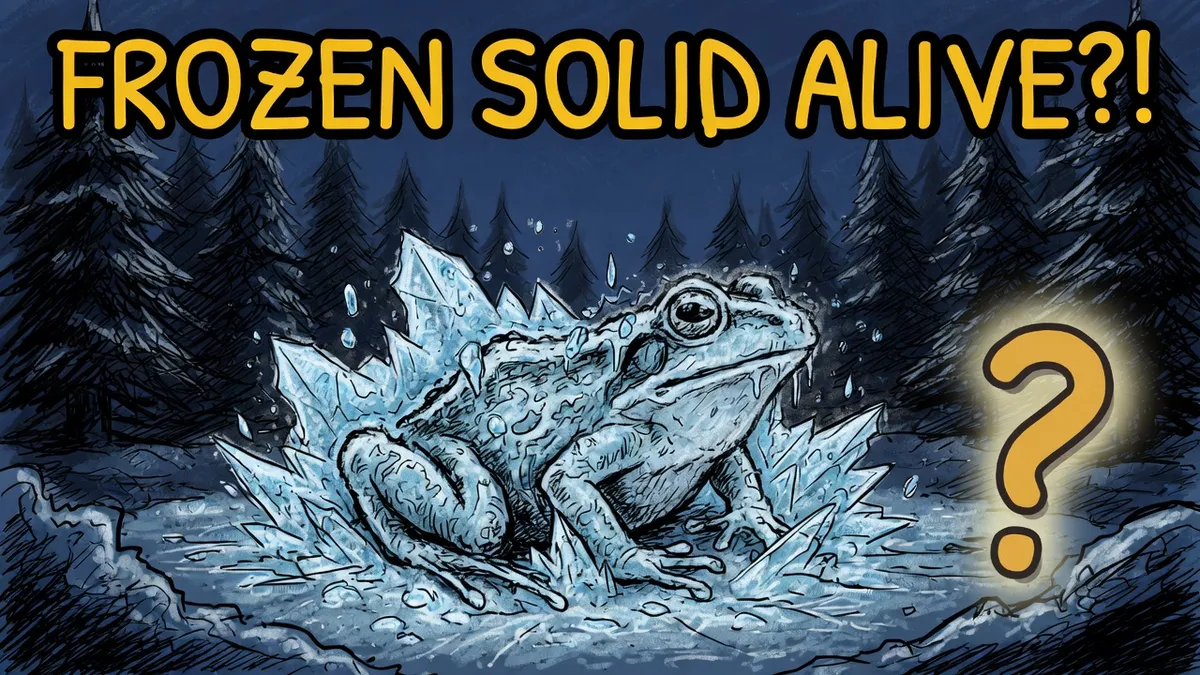
Most animals treat ice inside the body as the end of the story. The wood frog treats it like a seasonal habit. Winter closes in, the frog stiffens, the heart falls silent, and for months the forest floor holds what looks for all the world like a small frozen death. Then the thaw comes, the ice turns back to water, and the corpse clocks in for another spring of croaking. It is not a trick of the light. It is one of the strangest survival routines in nature, and it runs on sugar.
01 · The problemA frog that sleeps too close to the cold
Wood frogs live further north than an amphibian has any right to, right across the boreal forest and up into Alaska. And unlike animals that dig deep to escape the frost, the wood frog spends winter tucked just under the leaf litter, barely below the surface. That shallow bed freezes right through. So the frog faced a simple, brutal choice: find a way to escape the ice, or find a way to survive it. It chose the second, and became one of the very few backboned animals on Earth that can freeze and live.
02 · What "frozen" really meansNo pulse, and that's the plan
This is not a light chill with a slow heartbeat. In a full freeze, a wood frog has no detectable heartbeat, no breathing, no blood flow and no brain activity. Hook it up to a monitor and every line is flat. Up to two-thirds of the water in its body has turned to ice. By every test a doctor would run, the animal is dead. It simply has a plan to stop being dead later.
03 · The alarmIce on the skin, sugar in the blood
Here is the elegant part. The moment ice crystals form on its skin, the frog does not panic, it responds. A signal races inward, and the liver starts breaking down its stored glycogen into glucose, pouring it into the bloodstream within minutes, while the circulation still works. The surge is enormous: blood sugar can climb to hundreds of times its normal level. Any doctor would call those numbers a lethal diabetic emergency. For the wood frog, they are the whole survival strategy.
04 · The antifreezeWhy the sugar saves the cells
That glucose is a natural cryoprotectant, a biological antifreeze, and it is joined by urea the frog has been quietly stockpiling all autumn. Together they change the physics of the freeze. The goal is not to stop ice, that is impossible out on the cold ground. The goal is to control where the ice forms. The protectants keep crystals growing in the safe spaces between the cells, never inside them, because ice inside a cell is a demolition charge. As the outside freezes, water is drawn out of each cell and the cell shrinks and dehydrates hard, which would be fatal on its own. The sugar is what lets it survive that too, riding out the winter as a tough little raisin that plumps back up on thaw.
The same molecule that would put a human in a hospital, sky-high blood sugar, is the exact thing keeping the frog alive. Its cure is our emergency.
05 · The Alaskan extremeMonths in the deep freeze
Not every wood frog lives the same winter. A frog in the southern part of the range might freeze for a few days at a couple of degrees below zero. A wood frog in interior Alaska is playing a far harder game: field studies have tracked them frozen for the better part of a year, with body temperatures plunging to around minus 18 C. These northern frogs load up on even more glucose, and researchers think the repeated freeze-and-thaw cycles of autumn actually help them stockpile it, training for the big freeze ahead. Same species, wildly tougher winter.
06 · Why we careThe frog that might save your transplant
Biologists watch this trick the way engineers watch a rival’s blueprint. If nature can pause a complex, backboned animal for months and then restart it cleanly, medicine wants to know how. The dream is longer organ storage: a donor kidney or heart that could travel further and wait longer before transplant. A human is not a wood frog, and our tissues throw a much bigger tantrum at ice, so this is inspiration rather than a technique that works on us yet. But every mechanism decoded in a frozen frog is a genuine clue with a very long shelf life.
07 · The payoffSo how does a wood frog survive being frozen?
It freezes on purpose, and it cheats with chemistry. Ice is allowed in, but only into the spaces where it cannot kill. A flood of sugar and urea keeps the damage bill payable, the heart goes so quiet it disappears from the instruments, and the animal spends the dark months as something almost indistinguishable from a small frozen death. Then the warmth returns, the ice becomes water, the heart shudders back to life, and a little brown frog that was, by every measure, dead an hour ago hops off to find a pond. Life, it turns out, sometimes survives by learning to imitate death perfectly, and then politely declining it.

The animated version
Same answer, told as a little animated story with the strange little stickman acting it out. Dry, quick, and, obviously, correct.
Quick questions
Do wood frogs really freeze solid?
They freeze a large share of their body water, up to about two-thirds, and go stiff and cold with no detectable vital signs. Scientists avoid the phrase 'solid' because a core of protected fluid remains inside the cells, but to the touch it is a frog-shaped block of ice.
Does the frog's heart actually stop?
Yes. In the fully frozen state there is no measurable heartbeat, no breathing, no blood flow and no brain activity. The heart simply stops, sometimes for weeks, and starts again on thaw.
What stops the ice from destroying its cells?
A natural antifreeze, mostly glucose made from the liver's glycogen stores, joined by urea built up over autumn. These cryoprotectants keep ice forming outside the cells and stop the cells from collapsing as water is drawn out of them.
How does the frog know to make the antifreeze?
The trigger is the ice itself. The moment ice crystals touch the skin, a signal races inward and the liver starts converting glycogen to glucose within minutes, pumping it out through the blood while the circulation still works.
How cold can a wood frog survive?
It depends on where it lives. Southern frogs handle mild freezes of a few degrees below zero. Wood frogs in interior Alaska are far tougher, surviving body temperatures down to around minus 18 C in the wild.
How long can they stay frozen?
Southern frogs manage short freezes of days to weeks. Alaskan wood frogs can stay frozen for the better part of the winter, on the order of several months continuously, thawing only when spring arrives.
Is the glucose really like antifreeze in a car?
It is the same basic idea, lowering the freezing point and protecting against ice, but the details differ. The sugar does not stop ice entirely. It manages where ice forms and shields the cells as water leaves them, which is cleverer than the stuff in your radiator.
Why don't its organs die without oxygen for months?
Frozen, the frog has no circulation, so its tissues must ride out months with almost no oxygen and almost no energy use. Freeze-tolerant animals have biochemical tricks for surviving that near-total shutdown that would quickly kill a human. The full story is still being worked out.
Do other animals freeze and survive too?
Yes, a small club. Some other frogs, turtles hatchlings, insects and other cold-climate creatures tolerate freezing. The wood frog is simply the most famous vertebrate example in North America, not a lone miracle.
Does it freeze and thaw more than once each winter?
It can. In autumn and spring, weather swings mean a frog may partly freeze and thaw several times. Some research suggests these repeated cycles actually help northern frogs stockpile more protective glucose for the deep freeze ahead.
Could humans ever copy this to store organs or freeze people?
Researchers study freeze tolerance hoping to preserve human organs for transplant longer. But a person is not a wood frog: our tissues cannot yet survive that much ice. It is inspiration, not a technique that works on us today.
Where does a wood frog spend the winter?
Usually just under the leaf litter and shallow soil, not deep underground like many hibernators. That shallow bed is exactly why it needs the trick: its winter bedroom freezes right through.
Take the quiz on this
A quick 4-question check on what you just read. Get them right to earn XP: no points for just scrolling.
Our sources 6 checked
// every claim on this page was checked before it went up