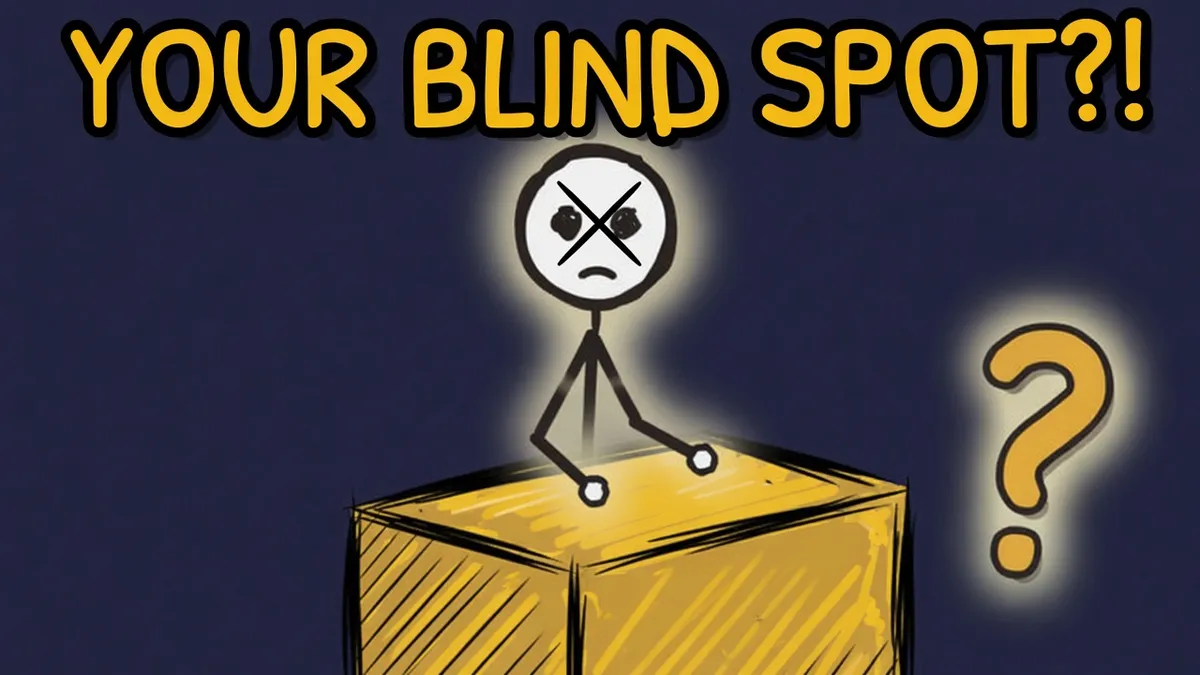
Right now, in each of your eyes, there's a spot where you see quite literally nothing. Not blurry. Not dim. Nothing at all, a real hole in your sight, and not a small one. It's there this second, and it was there yesterday, and it has been there every waking moment of your life. And you have never once noticed it. That's the genuinely unsettling part: not the hole, but how thoroughly it's been hidden from you.
01 · The gapA blank patch in the sensor
The hole exists because of a bit of clumsy wiring at the back of the eye. Your retina is carpeted with millions of photoreceptors, the light detectors that turn the world into signals. But all the cabling that carries those signals has to escape somehow, and at one point it all bundles together into the optic nerve and punches straight through the retina to head for the brain. Right at that exit hole, the optic disc, there’s simply no room left for detectors. It’s a blank patch in the sensor. Light lands there, and nothing reports it.
02 · The sizeBigger than the moon, several times over
You might picture a pinprick. It isn’t. Your blind spot spans something like 5 to 7 degrees of your visual field, roughly 7.5° tall by 5.5° wide in one standard estimate. To put that in perspective: the full moon, up in the night sky, is only about half a degree across. Which means your blind spot could comfortably swallow several full moons at once and still have room. A common shorthand is that it’s about the width of your fist held at arm’s length. That’s a touch generous, since a fist is closer to ten degrees, but it makes the point. This is not a rounding error in your vision. It’s a hole you could park the moon in.
03 · The first trickTwo eyes, two different holes
So why isn’t the world riddled with holes? The first defence is almost embarrassingly simple: you have two eyes, and the blind spot sits in a different place in each one. Whatever your left eye misses, your right eye is looking straight at, and vice versa. Between the two of them, the gaps are covered. For the way you normally move through the world, both eyes open, that alone is nearly enough to keep the hole permanently plastered over.
04 · The second trickCover one eye and it still isn't there
Now cover one eye. You’d expect a black hole to yawn open somewhere off to the side. And yet, it doesn’t. Everything still looks whole and seamless. Which means the two-eyes explanation can’t be the whole story, and your brain must be doing something sneakier. It is. It fills the hole in. It looks at whatever surrounds the gap, the colour, the texture, the pattern, and simply paints more of it straight across the blank. Brick wall, and it gives you bricks. Grass, and it gives you grass. It fabricates the missing piece to match, so smoothly you never catch it in the act.
You can catch it in the act. A dot placed inside your blind spot doesn't go black, it vanishes, and the background colour flows in to replace it. Draw a line straight through the gap and you'll see one solid, unbroken line, even though its middle is landing on precisely nothing. Your brain invents the join and hands it to you as fact.
05 · The demoHow to find your own
This is easy to prove on yourself. Close your left eye and fix your right eye on a single point straight ahead. Hold a small object out to the right and slide it slowly inward toward your nose. At one particular spot it will simply disappear, swallowed whole, and then pop back into existence as you keep going. You’ve just slid it into your blind spot and back out. The vanishing isn’t a black smudge; it’s a clean edit, the background quietly stitched over the top. That seamless replacement is the fill-in, happening in real time, right where you can watch it fail to leave a mark.
06 · The historyMaking heads disappear at court
None of this is new knowledge. In the 1660s, a French physicist named Edme Mariotte worked out that the optic nerve’s exit point must be blind, which flatly contradicted the belief of the time that it should be the most sensitive part of the eye. He presented it to the Royal Society and, the story goes, delighted the court of Louis XIV by positioning courtiers just so and making their heads appear to pop out of existence, an early, faintly mischievous parlour trick built on a hole nobody knew they had.
07 · The payoffYou're watching a reconstruction
So here’s the quietly unsettling truth the blind spot leaves you with. A part of what you are looking at, right now, is not arriving from your eyes at all. It’s your brain’s best guess, painted in to cover a hole it would rather you didn’t see. That reflex of filling-in isn’t a bug; it’s what lets vision feel whole. But it means you are never watching reality quite directly. You’re watching a very confident reconstruction of it, gaps and all, and the next time you’re certain you can see something with your own two eyes, remember that some of it is real, some of it your brain is smoothly making up, and it will never once tell you which.
The animated version
Same answer, told as a little animated story with the strange little stickman acting it out. Dry, quick, and, obviously, correct.
Quick questions
What causes the blind spot in your eye?
It's the optic disc, the spot where the optic nerve leaves the retina and heads to the brain. All the nerve fibres bundle together and pass through the retina there, leaving no room for the photoreceptors that detect light. So that patch is simply blank.
How big is the blind spot?
Bigger than most people expect. It's roughly 5 to 7° of your visual field, around 7.5° tall by 5.5° wide in one common estimate. Since the full moon is only about half a degree across, your blind spot could hide several full moons at once.
Why can't I see my blind spot?
Two reasons. First, your eyes' blind spots don't line up, so whatever one eye misses, the other catches. Second, even with one eye closed, your brain fills the gap in: it copies the surrounding colour and texture across the hole so smoothly you never notice.
How do I find my own blind spot?
Close your left eye and stare at a fixed point with your right. Hold a small object out to the right and slowly slide it inward, at one spot it will simply vanish, then reappear as you keep moving. That's the hole, and your brain filling it back in.
Does the brain really 'make up' what's in the blind spot?
Yes, in a sense. It doesn't leave a black void, it interpolates, copying the surrounding pattern across the gap. A dot placed inside the blind spot disappears and is replaced by the background; a line drawn through it looks unbroken. So part of what you perceive there is fabricated, not detected.
Who discovered the blind spot?
The French physicist Edme Mariotte, in the 1660s. He worked out that the optic nerve's exit point is blind, overturning the assumption that it should be the most sensitive part of the eye, and reportedly amused the court of Louis XIV by making people's heads appear to vanish.
Where is the blind spot located?
Off to the outer side of each eye's vision, roughly 15° to the side of wherever you're looking directly, and a touch below the horizontal line of your gaze. That's because the optic disc that creates it sits on the nasal (nose) side of the retina, and the eye flips the image left-to-right, so the gap lands in your outer field. Both blind spots point outward, in opposite directions, which is part of why one eye so easily covers for the other.
What is the optic disc?
It's the small, roughly circular spot at the back of your eye where the optic nerve gathers up all the retina's wiring and leaves for the brain, and where the main blood vessels enter. Because every nerve fibre and vessel has to squeeze through that one exit, there's no room left for light detectors, which is exactly why the optic disc is your blind spot. Eye doctors can see it directly when they shine a light in; it's also called the optic nerve head.
Why is the eye wired backwards?
It's one of biology's odder choices: the light-detecting cells in your retina face away from the light, sitting behind a layer of nerves and blood vessels that the light must pass through first. That's the 'inverted' retina, and it's what forces the wiring to bundle up and punch a hole through the retina to escape, creating the blind spot. It sounds like bad engineering, but it lets the detectors sit against the tissue that feeds them blood and soaks up stray light. There's even evidence that special glial cells (Müller cells) act like living fibre-optic cables, funnelling light cleanly through the clutter to the detectors. So the layout costs you a blind spot but buys real advantages.
Do animals have blind spots?
Vertebrates do, every animal with a backwards-wired eye like ours (mammals, birds, reptiles, fish) has a blind spot for exactly the same reason we do. But octopuses, squid and other cephalopods don't. Their eyes evolved separately, with the light detectors facing the right way and the nerve wiring running out the back of the retina instead of punching through it. No hole in the retina, no blind spot. So the octopus, of all creatures, has the more sensibly wired eye.
Can you get rid of your blind spot?
Not entirely. The optic disc is a permanent gap, so the blind spot itself is here to stay. But you can apparently shrink how much it costs you. In a 2015 University of Queensland study, twenty days of training on a demanding visual task shrank the functional blind spot by around 10%, seemingly by sharpening the detectors sitting right at its edge. It's a modest effect from a small study, and it doesn't fill the hole in, but researchers were interested because the same trick might one day help people with disease-related blind patches. For everyday life you don't need to fix it: your two eyes and your brain already hide it completely.
Is an enlarged blind spot a sign of an eye problem?
It can be, which is why eye doctors measure it. A normal blind spot is stable and something you never notice. But if it grows, it can signal that the optic nerve head is swelling, as in papilledema, caused by raised pressure around the brain, where an enlarged blind spot is the most common early sign on a visual-field test. Enlarged blind spots also turn up in some cases of glaucoma and other optic-nerve conditions. So a blind spot you can't detect is completely normal; a blind spot that seems to be growing, or new gaps in your vision, are worth an eye exam.
Take the quiz on this
A quick 4-question check on what you just read. Get them right to earn XP: no points for just scrolling.
Our sources 13 checked
// every claim on this page was checked before it went up