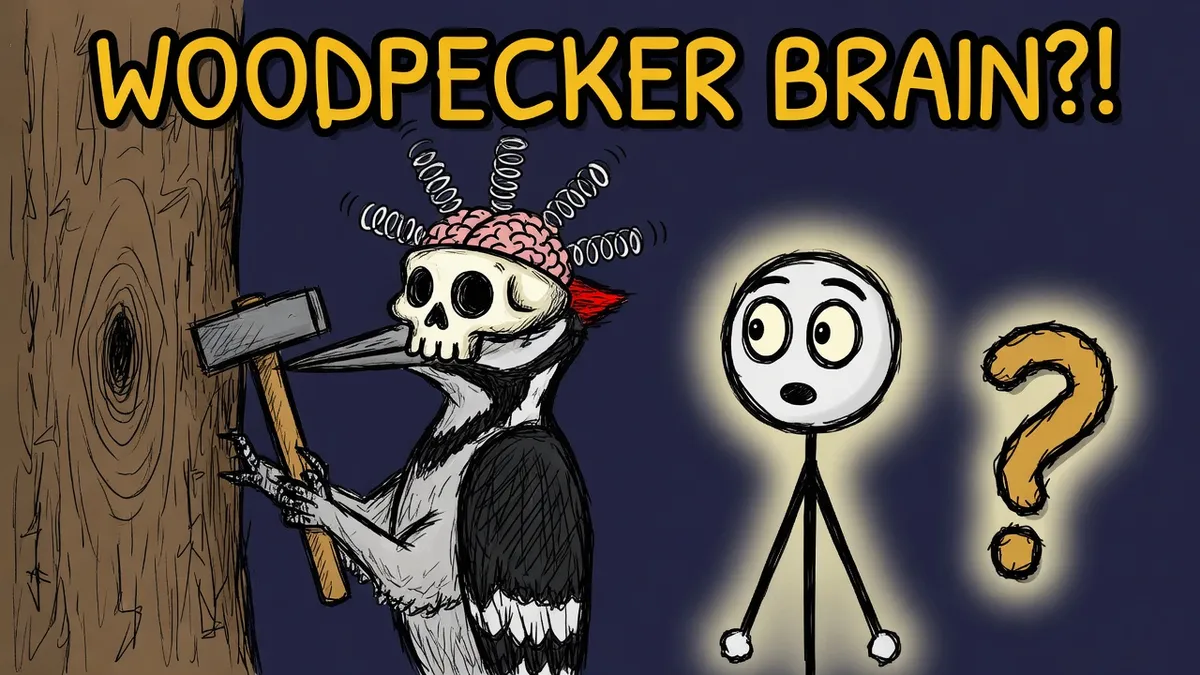
Here is the thing everyone learned, and it is a beautiful story: a woodpecker can hammer its face into solid oak thousands of times a day because its skull is a marvel of natural engineering. A spongy, shock-absorbing braincase. A tongue bone that wraps around the head like a built-in seatbelt. Tiny cushions that soak up the blow before it reaches the brain. Engineers spent years reverse-engineering that skull into helmets and crash casings. There is only one problem with the story. In 2022 somebody finally filmed it happening, and none of it was true.
01 · The puzzleAn impact that should scramble a brain
Start with the sheer violence of it. A woodpecker drives its beak into wood at around 20 strikes a second, the tip moving at roughly 6 to 7 metres per second, and does it up to about 12,000 times a day. Each impact decelerates the head at something like 1,200 times the force of gravity. To put that in human terms: a knock of somewhere between 80 and 135 g is enough to give a footballer a concussion. The woodpecker is casually taking ten times that, over and over, and going back for more.
So for as long as anyone thought about it, the question wrote itself. What is protecting the brain? And the search for an answer produced one of the most repeated facts in popular biology.
02 · The textbook answerThe skull that supposedly saves it
The classic explanation had several parts, and they all sounded convincing. The braincase contains patches of spongy bone, which was described as a natural crumple zone. The hyoid, the long bone that supports the tongue, loops all the way up and around the back of the skull, and was cast as a shock-absorbing strap. The beak was said to be slightly springy, the brain small and snug. Put together, the woodpecker became nature’s crash helmet: a system built, feature by feature, to absorb the shock before it could injure anything.
It was such a tidy idea that it escaped biology entirely. Papers on protective packaging, sports helmets and electronic-device casings routinely opened by invoking the woodpecker skull. It was a textbook case of biomimicry, the design world borrowing a trick from evolution. The trouble is that nobody had actually measured whether the trick existed.
03 · The cameraWhat high-speed filming actually showed
In 2022, a team led by Sam Van Wassenbergh at the University of Antwerp did the obvious thing that somehow had not been done properly before. They filmed real woodpeckers, three different species, pecking, with high-speed cameras fast enough to track the beak tip and the skull frame by frame. Then they measured how each one decelerated on impact.
Here is the logic. If the skull were a shock absorber, it would have to slow down more gently than the beak: the whole point of a cushion is that the thing behind it decelerates less harshly than the thing in front. So the team looked for exactly that gap between beak and skull. They found none. The skull decelerated in lockstep with the beak, as if the two were a single rigid tool. There was no measurable cushioning anywhere in the head. The woodpecker was not wearing a helmet. It was swinging a hammer.
Not only is there no shock absorption, there had better not be. Any cushioning would sabotage the bird, and once you see why, the whole helmet story flips inside out.
04 · The reasonWhy a woodpecker must not absorb shock
Think about what a shock absorber does: it takes the energy of an impact and soaks it up, turning it into heat and squish instead of forward motion. That is wonderful if your goal is to protect a fragile passenger. It is a disaster if your goal is to dig a hole in a tree.
Every joule of energy the woodpecker’s skull absorbed as cushioning would be a joule that did not go into the wood. A cushioned head would mean weaker pecks, which would mean pecking harder and longer to excavate the same cavity, for a bird whose entire livelihood is excavating wood. Van Wassenbergh’s team modelled it and the numbers were blunt: adding shock absorption makes the woodpecker worse at being a woodpecker. Evolution did not build a crash helmet and forget to mention it. It built the most efficient wood chisel it could, and efficiency here means transmitting the blow, not swallowing it.
05 · The real answerIt is safe because it is small
So if nothing is protecting the brain, why is the brain fine? The answer turns out to be almost anticlimactic, and it is all in the physics of scale. What actually injures a brain is not raw g-force but the pressure that builds up inside the skull when the head stops suddenly. And that pressure, for the same deceleration, depends on how big the brain is. A smaller brain generates less internal pressure from the same jolt, so it can survive a far harder stop before crossing the line into injury.
A woodpecker’s brain is roughly one-seventh the length of a human’s, which is a large part of why it can shrug off decelerations several times higher than we could. It helps, too, that the brain is small, smooth and tightly packed, held snug with very little cerebrospinal fluid around it to slosh back and forth. Run the calculation and the pressure inside a pecking woodpecker’s skull comes out two to three times below the level that concusses a human or a monkey. The bird is not surviving a concussive blow. At its size, the blow never becomes concussive in the first place.
06 · The honest caveatWhat the old idea still might explain
Now, science is rarely a clean knockout, and it is worth being careful here. The 2022 work demolished the claim that the skull protects the brain by absorbing shock. It did not prove that every feature of the skull is pointless. The spongy bone at the front and back of the braincase, for instance, may well help the skull itself resist cracking under the enormous repeated load. That is a real job, but it is a different one: resisting failure of the bone is not the same as cushioning the brain.
There is also the unresolved matter of tau. A 2018 study found that woodpecker brains accumulate tau protein, the same marker that piles up in humans after repeated head knocks. Nobody yet knows whether that is quiet damage the birds tolerate or a clever protective adaptation. So the fair summary is this: the shock-absorbing-helmet story is largely overturned, but the woodpecker’s biology is not a fully closed book, and the older absorption hypothesis has not been universally abandoned by everyone in the field.
07 · The payoffSo why don't they get concussion?
Because they do not need shock absorbers, and building any would only slow them down. The woodpecker is not protected by a spongy skull or a tongue-bone seatbelt or any hidden cushion. Its head is a deliberately stiff, efficient hammer that channels the full force of the blow into the wood, exactly as a good tool should. The brain rides along at 1,200 g, thousands of times a day, and stays safe for the least glamorous reason imaginable: it is small enough that the pressure never reaches the danger line. For a century we admired the woodpecker for its engineering. It turns out the real trick was never engineering at all. It was just being tiny, and getting on with the job.

The animated version
Same answer, told as a little animated story with the strange little stickman acting it out. Dry, quick, and, obviously, correct.
Quick questions
So do woodpeckers get concussion or not?
In normal pecking, no. A 2022 study calculated that the pressure inside a woodpecker's brain during a peck stays roughly two to three times below the threshold that concusses a human or monkey. They are not shrugging off a concussive blow, the blow never reaches concussive pressure inside their small skull in the first place.
Isn't the woodpecker skull a natural shock absorber?
That was the textbook answer for decades, and it now looks wrong. When Sam Van Wassenbergh's team filmed real woodpeckers with high-speed cameras in 2022, the skull decelerated in lockstep with the beak. If the skull were cushioning the blow, the head would slow more gently than the beak tip. It did not. The head works more like a stiff hammer than a helmet.
Why wouldn't shock absorption help the woodpecker?
Because it would waste the peck. Any energy the skull soaked up as cushioning is energy that does not go into the wood, so the bird would have to peck harder to dig the same hole. For an animal that lives by excavating wood, a shock-absorbing head would be a serious handicap. Evolution optimised the head as an efficient tool, not as a crumple zone.
Then why don't their brains get injured?
Size. A smaller brain can withstand a much higher deceleration before the internal pressure reaches an injuring level. A woodpecker brain is roughly a seventh the length of a human brain, which is why it can tolerate forces several times higher. It also helps that the brain is small, smooth and tightly packed, with very little cerebrospinal fluid around it to slosh.
How many g's does a woodpecker experience?
Estimates centre on about 1,200 times the force of gravity at each impact, with some measurements higher. For comparison, a hit of roughly 80 to 135 g is enough to concuss a human. The woodpecker takes an order of magnitude more and walks away, purely because of how the physics scales down at its size.
How many times a day does a woodpecker peck?
A lot. Common estimates run up to around 12,000 pecks a day, and some species and situations push higher, especially when a bird is excavating a nest cavity. Over a lifetime that adds up to tens of millions of impacts, which is exactly why people assumed there had to be some clever protective mechanism.
What is the tongue bone (hyoid) that people mention?
Woodpeckers have an unusually long hyoid, the tongue-support bone, that loops up and around the back of the skull. It was often described as a built-in seatbelt or spring that dampens the blow. Its main job is anchoring and projecting a very long tongue. Whether it meaningfully cushions the brain is now doubted, since the 2022 filming found little sign of damping anywhere in the head.
What did the 2022 study actually do?
Sam Van Wassenbergh and colleagues, publishing in Current Biology, filmed three woodpecker species pecking with high-speed cameras and tracked how the beak and skull moved frame by frame. They combined that with CT scans and mechanical modelling. The result: no measurable shock absorption between beak and skull, and a model showing that adding cushioning would only hurt the bird.
Does the spongy bone in the skull do anything, then?
Possibly, but not what we thought. The plates of spongy bone at the front and back of the braincase may help the skull resist cracking under the load, rather than absorbing energy to protect the brain. That is a subtle but important difference: resisting failure is not the same as cushioning a blow.
Do woodpeckers show any brain damage at all?
There is a genuinely open question here. A 2018 study found that woodpecker brains contain build-ups of tau protein, which in humans is a marker of repeated head trauma. Nobody yet knows whether that is harmful damage or a protective adaptation. It is one reason scientists still say the woodpecker's biology is not fully settled.
Did the old theory really inspire safety gear?
Yes. For years, engineers cited the supposed woodpecker shock-absorbing skull in designs for helmets, black-box casings and packaging. The 2022 finding does not make those devices fail, but it does undercut the woodpecker as the inspiration: the bird was never absorbing shock to begin with.
Could a bigger bird peck the same way safely?
No, and that is the whole point. Because the danger scales with brain size, a much larger animal doing the same thing would generate injuring pressures inside its bigger brain. The woodpecker's strategy only works precisely because it is small. You cannot simply scale a woodpecker up into a safe head-banger.
Take the quiz on this
A quick 4-question check on what you just read. Get them right to earn XP: no points for just scrolling.
Our sources 9 checked
// every claim on this page was checked before it went up