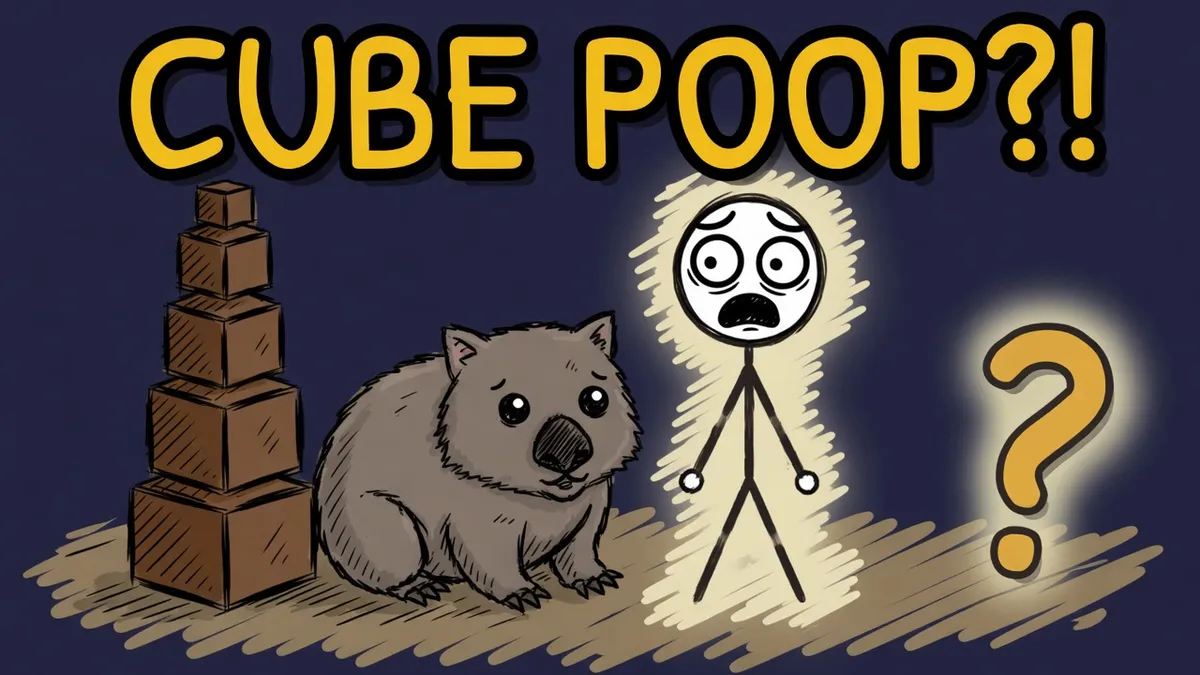
Somewhere in Australia, right now, a soft, round, tube-shaped animal is quietly producing a neat little pile of cubes. Not roughly cube-ish. Cubes: flat faces, rounded corners, stacked like tiny dice. The wombat is the only creature on Earth that does this, and for years it read like a magic trick with no explanation. A round animal, a round exit, and out come squares. The answer, when scientists finally cornered it, turned out to be even stranger than the question.
01 · The oddityThe only square poop in nature
Start with just how unusual this is. Across the entire animal kingdom, droppings come in tubes, ropes, pellets and blobs, all variations on round, because that is what a soft tube pushing soft material naturally makes. Exactly one animal breaks the pattern. A bare-nosed wombat leaves behind 80 to 100 little cubes a night, each about two centimetres across, and it does it every night of its life. This is not a rare deformity or a one-off. It is the wombat’s standard-issue output, and it is genuinely unique in nature.
02 · The wrong guessIt's not the exit that does it
The intuitive explanation, the one almost everyone reaches for first, is that the wombat must have some kind of square nozzle. Push soft material through a cube-shaped opening and you get a cube, the way a pasta machine stamps out shapes. It is a lovely idea, and it is completely wrong. A wombat’s rear opening is round and unremarkable, like any other mammal’s. Whatever is making the corners is not at the end of the line. It is happening much earlier, deep inside the animal, and that is the clue that cracked the whole mystery.
03 · The mechanismAn intestine of uneven stiffness
In 2018 and 2019, a team led by Patricia Yang and David Hu got hold of wombat intestines and went looking. What they found, and published in full in the journal Soft Matter in 2021, is that the last stretch of the gut, roughly the final 17 percent, has a wall that is not the same all the way around. Running along its length are two stiffer bands and two stretchier ones. The stiff zones are about twice as thick, and several times harder, than the soft ones. So when the intestine contracts, it does not squeeze evenly like a closing fist. The stiff parts barely give while the soft parts stretch, and that lopsided squeezing is what presses flat faces and sharp corners into the passing feces.
The cube is finished before it ever reaches the exit. By the time a wombat's dropping arrives at that ordinary round opening, it is already a fully formed cube, moulded metres upstream by muscle, and simply passes through.
04 · The drynessWhy it holds its shape at all
None of this would work on a normal, sloppy dropping. Corners moulded into wet material would just slump back into a blob. The reason a wombat’s cubes hold their edges is that they are extraordinarily dry by the time they are shaped. A wombat lives on poor, dry grasses and roots, and to survive on such thin fare it runs one of the slowest, most thorough guts of any mammal. The food inches through for a very long time, so long that estimates range from several days up to around two weeks, and along the way almost every drop of water is reabsorbed. What is left is a stiff, near-solid material, dry enough to take an edge and keep it. Round animal, dry contents, uneven muscle, and out comes a cube.
05 · The whyCubes that stay where you put them
So the how is settled. The why a cube is useful is the part still open to argument, and the leading idea is delightfully practical: cubes don’t roll. Wombats are territorial and nearly blind, and they communicate largely by smell, stacking their droppings on top of rocks, logs and other raised landmarks so the scent carries. A round pellet perched on a rock would roll off and vanish into the grass. A flat-sided cube stays put, holding its scent up where rivals will find it. It is a satisfying story, and it fits the wombat’s behaviour neatly. It is worth being honest, though: this is a plausible hypothesis, not a proven fact. The cube shape might have evolved for exactly this, or it might mostly be a by-product of that very dry, very muscular gut, with the anti-roll perk a happy accident.
06 · The spin-offWhy engineers are taking notes
Here is the twist nobody expected: the wombat may have solved a manufacturing problem. Almost every cube humans make, an ice cube, a sugar cube, a die, is produced by cutting, pouring into a rigid mould, or extruding through a shaped die. The wombat makes cubes with none of that. It uses a soft, flexible tube and nothing but differences in wall stiffness and rhythmic squeezing. To an engineer, that is a genuinely new method: a way to shape soft materials into precise forms without any hard mould at all. Patricia Yang’s team pointed this out directly, and it is a real reason a study about wombat droppings ended up interesting people who make things for a living.
07 · The payoffSo why do wombats poop cubes?
Because a wombat is an animal built to waste nothing, and the cube is what falls out the far end of that thrift. Its gut runs so slow and pulls out so much water that the droppings arrive nearly solid, and the last stretch of intestine, stiff on two sides and soft on the other two, quietly presses that dry material into corners long before it reaches the perfectly round exit. Whether the shape is a clever adaptation for scent-marking or just a lucky quirk of the plumbing is still, honestly, an open question. But the mechanism is real, it is beautiful, and it is the only place in nature where a soft, round animal reliably produces a perfect little box.
The animated version
Same answer, told as a little animated story with the strange little stickman acting it out. Dry, quick, and, obviously, correct.
Quick questions
Why do wombats poop cubes?
Because the last section of a wombat's intestine has walls of uneven stiffness: two stiffer bands and two more flexible ones running lengthways. As near-dry droppings are pushed through by muscle contractions, the stiff parts and stretchy parts squeeze at different rates and press flat faces and corners into the feces. The shape is formed in the gut, well before it reaches the exit.
Do wombats really make cube-shaped poop?
Yes, genuinely. Wombat droppings come out as rounded cubes, roughly two centimetres across, with recognisable flat sides. They are the only animal known to produce cube-shaped feces, and it is not a rare fluke: a healthy wombat does it routinely, many times a night.
How does a round anus make a square poop?
It doesn't, and that is the twist most people get wrong. The corners are not stamped out at the exit like pasta through a die. They are formed earlier, along the last stretch of the intestine, by muscles of uneven stiffness working on feces that are already almost solid. By the time the cube reaches the round opening, it is fully shaped and just passes through.
Who worked out how wombats make cubes?
A team led by Patricia Yang and David Hu at Georgia Tech, working with Scott Carver in Australia and colleagues. Their first findings won an Ig Nobel Prize in Physics in 2019, and a fuller study was published in the journal Soft Matter in 2021, tracing the shaping to variations in stiffness around the intestinal wall.
What part of the gut actually makes the cube?
The last stretch, roughly the final 17 percent of the intestine. Across that section the wall is not uniform: two zones are markedly thicker and stiffer, and two are thinner and more flexible. As the gut contracts, the stiff and soft zones move the drying feces at different speeds, and that mismatch is what forms the flat faces and corners.
Why is wombat poop so dry?
Because wombats live on poor, dry grasses and roots and have to squeeze every drop of value out of them. Their gut is very long and very slow, so by the end almost all the water has been reabsorbed. Wombat droppings are drier than most mammals', which is exactly why they hold a moulded shape instead of slumping.
How long does a wombat take to digest its food?
A very long time, among the slowest of any mammal. Estimates vary quite a lot between sources and studies, from several days up to around two weeks, but the theme is consistent: extremely slow transit that maximises how much water and nutrition the wombat pulls from tough, low-quality food.
How many cubes does a wombat produce?
Roughly 80 to 100 separate pellets in a single night. Each is about two centimetres across. That is a lot of building blocks, which fits the idea that the droppings are being used deliberately, as scent markers scattered around the wombat's home range.
Why would a cube shape be useful to a wombat?
The leading, and pleasingly practical, idea is that cubes don't roll. Wombats stack their droppings on top of rocks, logs and other raised spots to mark territory by scent, and a flat-sided pellet is far more likely to stay put on a perch than a round one that would roll off. It is a plausible advantage, but treat it as a good hypothesis rather than a proven fact.
Is the 'so they don't roll away' explanation actually proven?
Not conclusively. It is a reasonable and popular idea, backed by the fact that wombats really do place droppings on raised markers, but nobody has definitively shown that the cube shape evolved for that reason rather than being mainly a by-product of how a very dry gut works. It is best described as plausible, not settled.
Do baby wombats poop cubes?
The cube shape depends on dry feces and a mature, muscular gut, so it becomes clear once a wombat is eating solid grass and its digestive system is working like an adult's. Young joeys still nursing do not produce the same firm cubes, because the shaping needs the dryness and the gut mechanics that come with a grown-up diet.
Why do engineers care about wombat poop?
Because it is a genuinely new way to manufacture cubes. We usually make cube shapes by cutting, moulding or extruding through a die. The wombat makes them from a soft, flexible tube using only differences in wall stiffness and rhythmic squeezing, which hints at fresh methods for shaping soft materials in manufacturing without a rigid mould.
Take the quiz on this
A quick 4-question check on what you just read. Get them right to earn XP: no points for just scrolling.
Our sources 7 checked
// every claim on this page was checked before it went up