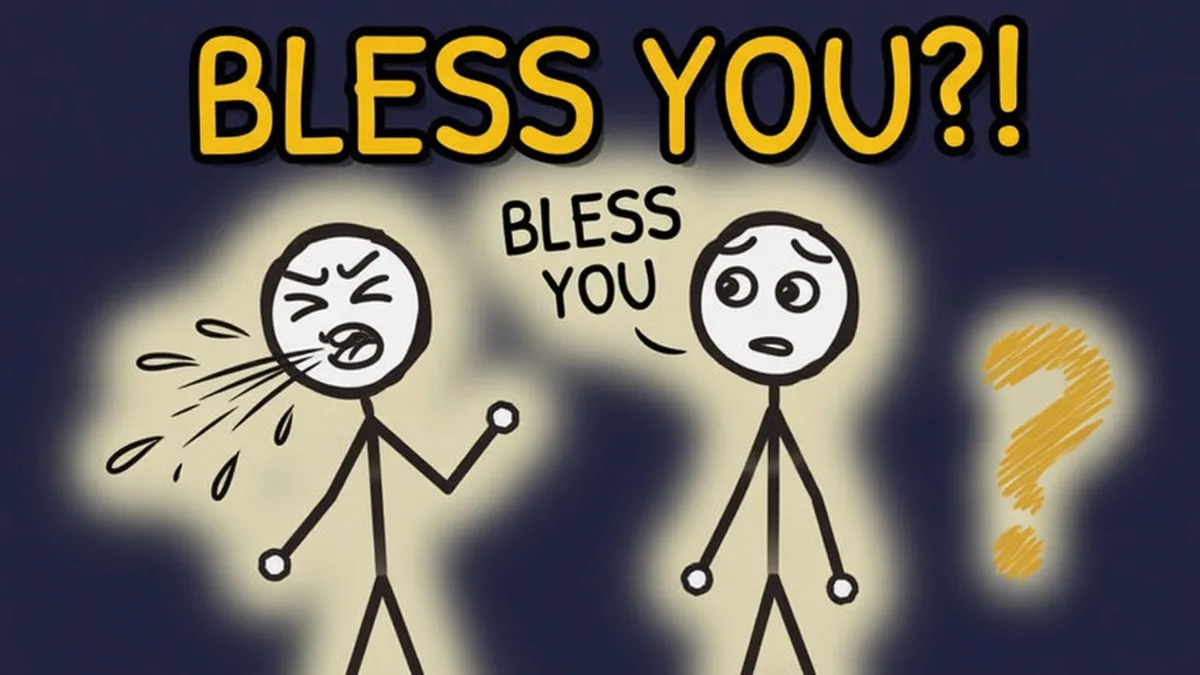
Someone across the room sneezes, and a small miracle of social programming fires: total strangers, mid-conversation, mid-email, instantly murmur "bless you", and then carry on as if nothing happened. You do it without deciding to. You'd feel faintly rude not to. It's one of the most reflexive phrases in the language, aimed at a bodily noise no one can control. And almost everyone who says it is carrying around the same neat explanation: a pope, a plague, a decree. There's just one problem with that story: it's almost certainly not true.
01 · The famous storyA pope, a plague, and a tidy legend
Here’s the version you’ve probably heard. In 590 AD, a brutal plague was sweeping through Rome, and one of its early warning signs was a fit of sneezing. So the newly installed Pope Gregory I supposedly ordered that anyone who sneezed be blessed on the spot, “God bless you”, a quick prayer to shield them from what looked like a death sentence. It’s a wonderful story. It has a date, a named authority, a grim disease, and a moral. It gets repeated everywhere. And that’s roughly where its virtues end.
02 · The problemThere's no evidence he ever said it
Dig for the source and it evaporates. Gregory did call Rome to prayer during the plague (that part is real), but there is no record of him ordering a blessing for sneezes, or coining the phrase, or telling anyone else to. Historians generally file the tale under apocryphal: a good story that attached itself to an existing custom centuries later. And it must have been existing, because, and this is the quiet bombshell, people were already answering sneezes long, long before Gregory was born.
The Greeks and Romans were responding to sneezes centuries before the plague of 590. The pope didn't start the habit. He arrived a thousand years too late to.
03 · The ancient habitWhen a sneeze was a message from the gods
Rewind to the ancient world and a sneeze wasn’t a symptom: it was an omen. The Greeks read one as a sign from the gods, sometimes good, sometimes ill, depending on the moment. Around 401 BC the soldier-writer Xenophon described giving a rallying speech to stranded, terrified troops when a man in the ranks sneezed, and the whole army took it as divine approval and bowed in thanks. Aristotle mulled over why sneezes seemed “prophetic and sacred.” The Romans, ever practical, answered a sneeze out loud: “Salve”, be well, or “may Jupiter preserve you.” The instinct to say something when someone sneezes is thousands of years old and predates the blessing we use by a very wide margin.
04 · The soulThe belief that did the real work
So if not a papal decree, then what? The likeliest engine is superstition, specifically, an old and widespread dread about what a sneeze does to you. A sneeze is sudden and violent, and one persistent folk belief held that it could momentarily jolt the soul loose from the body, or crack the body open just wide enough for an evil spirit to slip in. Say “God bless you” fast enough, and you’d seal the gap, a verbal shield thrown up in the half-second of vulnerability. It’s pure folklore, with nothing physical behind it. But folklore like this, repeated across generations, is exactly the kind of thing that hardens into a reflex nobody questions.
05 · The heart mythNo, a sneeze doesn't stop your heart
One cousin of that old fear still floats around today: the idea that your heart briefly stops when you sneeze, and that the blessing was meant to jump-start it again. It’s a myth. Your heart does not stop. What actually happens is more modest: a big sneeze spikes the pressure in your chest, which can briefly tug on your blood flow and heart rhythm, enough that you sometimes feel a “skipped beat”, with the vagus nerve nudging your pulse in the moment. But the heart’s electrical drumbeat never pauses. It’s a neat example of how a real, faint bodily sensation gets inflated into a dramatic-sounding “fact.”
06 · Around the worldHealth, silence, and a different rulebook
Strip out the religion and you find much of the world simply wishes you well. The German Gesundheit, now common in English too, just means “health,” with no blessing attached. Spanish “salud,” Italian “salute,” Polish “na zdrowie” all say the same thing: be healthy. Arabic custom runs the exchange the other way, with the sneezer saying “praise God” and a companion answering “God have mercy on you.” And then there’s the plot twist for anyone who assumes the response is universal: across much of East Asia. Japan, China, Korea, the polite move is to say nothing at all. A sneeze is a private little event, and pointing it out is the mildly awkward thing to do. The person who sneezed is the one more likely to apologise.
07 · The payoffSo why do we say it?
Because a great many small forces piled up and left a habit behind. There was no single founding moment, no pope, no decree, no clean origin to point at. Instead: ancient omens, a fear for the soul, a dread of evil slipping in, a wrong guess about the heart, all reinforcing each other across centuries until “God bless you” wore down into the automatic little courtesy it is today. The beliefs that built it have almost entirely evaporated. The reflex outlived every one of them. That’s the honest answer to why you bless a stranger for sneezing: not because you believe any of the old reasons, but because enough people did, for long enough, that your mouth now does it before your brain gets a vote.
Quick questions
Why do we say 'bless you' when someone sneezes?
There's no single proven reason: it's a habit assembled from centuries of overlapping superstition. The most repeated story credits Pope Gregory I during a 590 AD plague, but that's legend, not documented fact. Older and better-supported roots include folk beliefs that a sneeze could expel the soul or let evil spirits in, so a blessing acted as protection. Ancient Greeks and Romans were already answering sneezes long before any of this, which is why historians think the custom grew by slow reinforcement rather than a single decree.
Did Pope Gregory really start saying 'bless you'?
Probably not. The popular tale is that during a plague in Rome in 590 AD, Pope Gregory I ordered people to say 'God bless you' to anyone who sneezed, because sneezing was an early plague symptom. But there's no historical evidence he issued such an instruction or used the phrase, and the custom of responding to sneezes already existed in the ancient world. Historians generally treat the Gregory story as apocryphal, a good story that got attached to the custom later.
How old is the custom of responding to a sneeze?
Older than Christianity by centuries. The ancient Greeks treated a sneeze as a sign or message from the gods. Xenophon, around 401 BC, recorded soldiers taking a sneeze during a speech as a good omen. Romans responded too, with phrases like 'Salve' (be well) or 'Jupiter preserve you'. So people were reacting to sneezes with blessings and omens long before the plague-and-pope story is supposed to have begun.
Does your soul leave your body when you sneeze?
No, that's an old superstition, not a fact. One widespread folk belief held that a sneeze was so violent it could momentarily push the soul out of the body, or open you up to evil spirits sneaking in, and that a quick 'bless you' guarded against it. It's charming folklore and it genuinely helped shape the custom, but there's no physiological reality to it: nothing leaves your body when you sneeze except air and droplets.
Does your heart stop when you sneeze?
No. This is a persistent myth. Your heart does not stop when you sneeze. What can happen is that the pressure changes in your chest during a big sneeze briefly affect blood flow and can nudge your heart rhythm, sometimes felt as a 'skipped beat', via the vagus nerve. But the heart's electrical activity keeps going the whole time. The old idea that a sneeze stops the heart, and that a blessing restarts it, is folklore.
What does 'gesundheit' mean?
It's German for 'health', literally 'gesund' (healthy) plus '-heit' (a suffix like '-hood'), so roughly 'health-hood'. Unlike 'bless you', it carries no religious meaning; it's simply a wish for the sneezer's wellbeing. It spread into American English through German-speaking immigrants and is now a common secular alternative to 'bless you'.
Why do some people say 'gesundheit' instead of 'bless you'?
Usually to keep the wish secular, or out of habit inherited from German-speaking families. 'Bless you' is short for 'God bless you' and has religious roots, while 'gesundheit' simply means 'health'. Many languages take the same non-religious route. Spanish 'salud', Italian 'salute', Polish 'na zdrowie' and Russian 'bud' zdorov' all literally mean 'health' or 'be healthy'.
What do people say after a sneeze in other countries?
It varies a lot. Many languages wish health: German 'Gesundheit', Spanish 'salud', Italian 'salute', Polish 'na zdrowie'. Arabic speakers often have the sneezer say 'alhamdulillah' (praise God) and the responder reply 'yarhamuk Allah' (God have mercy on you). And in much of East Asia. Japan, China, Korea, it's simply not customary to say anything; the sneezer may even apologise instead.
Why is it rude to acknowledge a sneeze in some cultures?
In several East Asian cultures, a sneeze is treated as a private, faintly embarrassing bodily event, so drawing attention to it can feel awkward rather than kind. In Japan, for example, it isn't customary to respond to someone else's sneeze, and the person who sneezed is more likely to say 'excuse me'. It's not coldness, just a different social rule about which bodily noises get publicly noticed.
Did people once think sneezing was a good sign?
Yes, in the ancient world a sneeze was often read as a positive omen, a nudge from the gods that you were on the right track. Greek writers including Aristotle discussed sneezing as something 'prophetic and sacred', and there's the famous moment recorded by Xenophon around 401 BC when a soldier's sneeze during a rallying speech was taken as divine approval. The idea that a sneeze meant good luck, not danger, was common long before it became linked to illness.
Is 'bless you' religious?
By origin, yes, it's a shortened form of 'God bless you', a request for divine protection. In everyday modern use, though, most people say it as a reflexive politeness with no real religious intent, the same way 'goodbye' began as 'God be with ye'. That's exactly why secular alternatives like 'gesundheit' exist for people who'd rather not invoke a blessing.
Why do we say it automatically, even to strangers?
Because it has become a piece of social ritual, an almost involuntary courtesy, like saying 'thank you'. Its original superstitions have faded, but the reflex to acknowledge a sneeze with a small kindness persists, and skipping it can feel oddly rude. In that sense 'bless you' survives less as a belief than as a tiny, automatic gesture of goodwill toward whoever just sneezed.
Take the quiz on this
A quick 4-question check on what you just read. Get them right to earn XP: no points for just scrolling.
Our sources 11 checked
// every claim on this page was checked before it went up