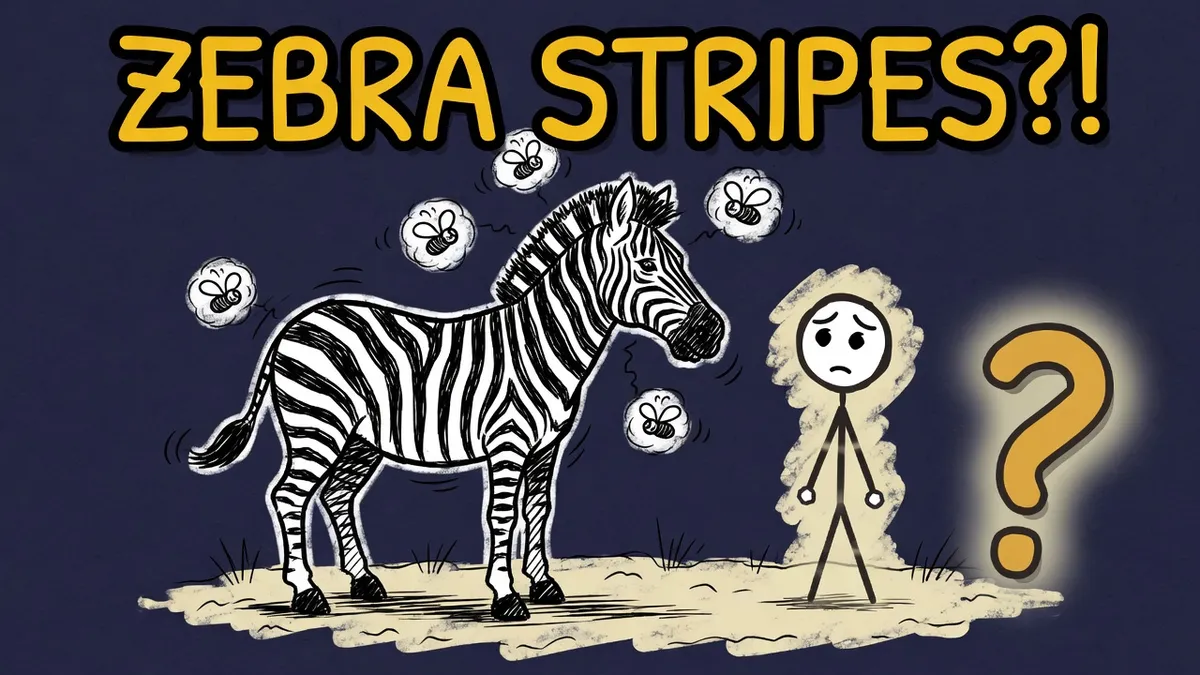
Here is a question that sounds like it should have been answered in a Victorian textbook: why is a zebra stripy? It is one of the most recognisable animals alive, and for more than 150 years absolutely nobody could agree on what the stripes were for. Darwin had an opinion. His rival Wallace had a different one. Generation after generation of naturalists lined up behind camouflage, or dazzle, or cooling, and none of them could win the argument. The pattern was obvious. The reason was a genuine mystery. And when the answer finally arrived, it was almost comically small.
01 · A question older than DarwinThe stripe that stumped everyone
The trouble with zebra stripes is that they are so bold they seem to demand a bold explanation, and the naturalists duly supplied several. Maybe the stripes were camouflage, breaking up the animal’s outline in tall grass. Maybe a galloping striped herd created a confusing blur that spoiled a lion’s aim. Maybe the black and white bands set up cooling air currents in the African heat. Maybe they helped zebras recognise one another. Four tidy theories, each plausible, and for over a century no way to tell which, if any, was right.
02 · The theories that fellNot hiding, not dazzling, not cooling
The awkward thing is that the popular answers do not survive close inspection. Zebras are strikingly conspicuous in daylight, and lions and hyenas catch them perfectly well, which is hard to square with camouflage. The “motion dazzle” idea, that stripes scramble a predator’s targeting, has surprisingly weak support when you look at where zebras are actually killed. The cooling theory has been tested and keeps coming up short. And individual recognition does not explain why stripes appear exactly where they do on the map. One by one, the grand explanations quietly ran out of evidence.
03 · Follow the fliesThe map that gave it away
The breakthrough came from asking a duller question: not “what could stripes do?” but “where, precisely, do striped equids live?” In 2014, a team led by Tim Caro mapped seven species of wild horses, asses and zebras against everything that might matter: predators, temperature, forest, grassland. Only one factor lined up cleanly with striping, and it was not lions or heat. It was overlap with biting flies. Wherever equids shared ground with disease-carrying horseflies and tsetse flies, they tended to be stripy. Where the flies were absent, the stripes faded away. The evolutionary driver was not a predator at all. It was a bug.
04 · The coat experimentDressing a horse to prove it
A map shows a pattern, but it cannot show cause, so the researchers ran the experiment. They put coats on ordinary horses: some striped, some solid black, some solid white, on the same animals. Then they counted the flies. The result was clean. Horseflies landed on the plain coats readily, and mostly refused the striped ones. Crucially, the flies still circled the striped horses just as much: the stripes were not repelling them from afar. The failure happened at the last second. Slow-motion video showed the flies coming in too fast and not braking, so instead of settling they overshot, bumped into the animal, or peeled away. A zebra is, in effect, wearing a landing strip that no fly can land on.
After 150 years of grand theories about lions and heat and hiding, the boldest coat in nature turned out to be insect repellent, worn by an animal too big to swat.
05 · How the trick worksThe part still being solved
Knowing that stripes beat flies is not the same as knowing how, and this is where honest science admits it is not finished. An early favourite was that dark coats reflect polarised light that flies steer toward, and stripes break it up, but newer experiments have not backed that. Another idea, that the bands scramble the fly’s sense of its own motion (an “aperture effect”), has also largely been rejected. The current front-runner is simpler: horseflies are drawn to big blocks of dark colour up close, and thin, sharply outlined stripes leave no dark block to aim at. It is a good explanation. It is not yet the final word, and researchers are still picking at the details.
06 · Why flies, of all thingsA small enemy with deadly friends
It can feel absurd that evolution would redesign an entire animal to dodge an insect, until you meet the insect. Africa’s biting flies are not just an itch. Tabanids and tsetse flies carry diseases like trypanosomiasis that can sicken or kill a horse or zebra, and equids have thin coats that leave a lot of skin exposed to a probing bite. For an animal standing out on the plains all day, cutting the number of successful bites is not cosmetic, it is survival. A pattern that keeps the flies from landing is worth evolving even if it makes you the most visible thing on the savanna.
07 · The payoffThe boldest pattern in nature is anti-fly wear
So why does a zebra have stripes? Not to vanish, not to bewilder lions, and not to keep cool. The best evidence we have says it is dressed to defeat a fly: a coat so hard to land on that the insects carrying deadly disease mostly give up and drift away. It is a beautifully deflating answer to a question that captivated biology for a century and a half. The grandest, most photographed pattern in the animal kingdom, the one Darwin argued over, appears to be, at heart, the world’s most elegant piece of pest control.
The animated version
Same answer, told as a little animated story with the strange little stickman acting it out. Dry, quick, and, obviously, correct.
Quick questions
Why do zebras have stripes, in simple terms?
The best current evidence says the stripes evolved to stop biting flies from landing on them. Zebras live in regions full of horseflies and tsetse flies that spread dangerous diseases, and striped coats are strikingly bad at letting those flies make a controlled landing.
Are zebra stripes for camouflage?
Probably not, at least not mainly. Zebras are conspicuous in daylight and are hunted successfully by lions and hyenas, and modelling suggests the stripes do little to hide them at the distances predators actually detect them. Camouflage is one of the theories the evidence has moved away from.
Do stripes confuse predators like lions?
This 'motion dazzle' idea (that a moving striped herd scrambles a predator's aim) is popular, but it has weak support. Studies of where zebras are hunted and how lions catch them do not show the protection you would expect if that were the main function.
How do stripes actually stop flies?
Flies still circle zebras as much as other animals, so the stripes do not repel them from a distance. The difference is at the last moment: horseflies fail to decelerate properly as they close in on stripes, so instead of a controlled landing they overshoot, collide, or swerve away. Far fewer complete a successful landing.
Which flies are the problem?
Mainly tabanids (horseflies) and glossinids (tsetse flies). In Africa these biting flies can transmit diseases such as trypanosomiasis and equine influenza that are dangerous or fatal to horses and zebras, so avoiding their bites has real survival value.
Is the fly explanation proven?
It is the best-supported explanation and comes from both large-scale mapping and controlled experiments, but the fine details of how the stripes defeat the flies are still being studied and debated. The 'why' looks solid, the exact optical 'how' is not fully settled.
Did the stripes evolve to keep zebras cool?
The cooling idea (that black and white stripes set up tiny air currents) has been proposed and tested, but the evidence is weak and inconsistent, and it does not explain the geographic pattern nearly as well as the biting-fly explanation does.
Do zebra stripes work by polarised light?
An earlier idea was that flies are drawn to the polarised light reflected off dark coats, and stripes disrupt it. More recent experiments have not supported polarised light as the mechanism, so it has largely been set aside.
Is every zebra's stripe pattern unique?
Yes. Like a fingerprint, each zebra's exact stripe arrangement is individual, which also lets researchers (and other zebras) tell them apart. Individual recognition may be a side benefit, but it is not thought to be the main reason stripes evolved.
Are zebras black with white stripes or white with black stripes?
Black with white stripes. Zebras have dark skin underneath, and the white is where pigment is switched off, so the 'default' animal is dark and the stripes are added on top.
Why don't horses have stripes if stripes stop flies?
Most domestic horses evolved outside the range of Africa's worst biting-fly and disease pressure, so there was less advantage to striping. The experiments that put striped coats on ordinary horses were testing the effect directly, and the flies avoided the stripes just the same.
Do other striped animals use stripes against flies too?
It is an active question. The fly-deterrence finding in zebras has prompted researchers to look at whether painted stripes could protect livestock, and some trials suggest stripe-like markings do reduce fly landings on cattle. The broader story is still being worked out.
Take the quiz on this
A quick 4-question check on what you just read. Get them right to earn XP: no points for just scrolling.
Our sources 6 checked
// every claim on this page was checked before it went up