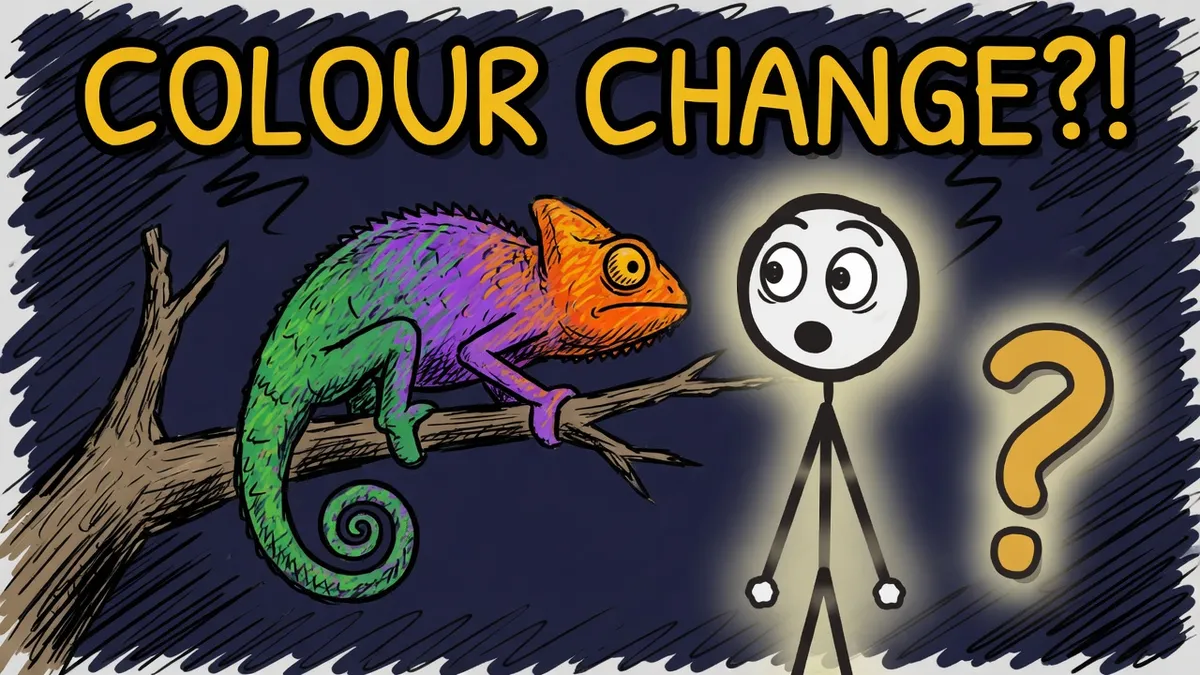
Everyone knows what a chameleon does: it sits on a red cushion and turns red, sits on a chessboard and turns into a chessboard, a living paint-chip that melts into any background to hide. It's one of the most famous facts in all of nature. It's also, delightfully, wrong on nearly every count. Chameleons don't change colour with pigment, they don't do it mainly to camouflage, and when one flushes electric orange, it isn't trying to disappear. It's doing the exact opposite. The truth involves nanotechnology, and a lizard throwing a very public tantrum.
01 · Not paintA crystal, not a pigment
Start with the biggest surprise: a chameleon changing colour is not moving coloured dye around under its skin, the way an octopus does. In 2015, scientists at the University of Geneva worked out what’s really happening, and it’s stranger and cleverer. A chameleon’s skin contains cells called iridophores, packed with a neat, three-dimensional lattice of tiny crystals made of guanine. This lattice reflects light, and crucially, the animal can change its spacing. It’s not painting itself. It’s re-tuning a microscopic mirror.
02 · The physics of a stretchHow spacing becomes colour
Here’s the beautiful part. When the crystals are packed tightly together, the lattice reflects short wavelengths of light, blue. When the chameleon gets excited and actively loosens the lattice, spreading the crystals apart, it shifts to reflecting longer wavelengths, yellows, oranges, reds. So the colour you see isn’t a pigment at all; it’s geometry. This is called structural colour, and it’s the same trick that makes an opal shimmer or a butterfly’s wing flash blue. The chameleon is playing with the spacing of a crystal grid to choose which colour of light bounces back at you. Add in a base layer of yellow pigment and that blue reflection reads as calm green, until the animal decides to light up.
03 · Not for hidingThe camouflage myth
Now the second myth, and it’s the bigger one. Chameleons do not change colour mainly to camouflage. Think about it: the dramatic transformations everyone loves are into bright, vivid, screaming colours, blazing yellow, hot orange, electric red. Those are the worst possible colours for hiding in green leaves. That’s the clue. The showy changes aren’t camouflage at all; they’re the opposite. A chameleon going bright is making itself as visible as possible, on purpose, because the colour change is a form of communication. It’s a billboard, not a cloak.
Watch two male chameleons meet and the whole thing clicks into place. They don't try to blend in, they try to out-dazzle each other. Each flushes brilliant, aggressive colours in a stand-off, a silent shouting match conducted entirely in light. And there's a wonderful tell: the loser is the one who switches his bright display off first, dimming down to signal "I give up." A chameleon's colours aren't a disguise. They're a mood made visible, fury, dominance, desire, broadcast on its skin. When a chameleon goes technicolour, it isn't hiding from the world. It's yelling at it.
04 · The built-in thermostatColour as temperature control
The other real reason chameleons change colour has nothing to do with other chameleons at all. It’s about heat. Being cold-blooded, a chameleon has to manage its temperature using the environment, and colour is one of its tools. On a chilly morning it can turn darker to soak up more sunlight and warm quickly; when it’s too hot, it can go paler to reflect the sun away. The Geneva team even found a second, deeper layer of crystals in the skin, tuned not to visible light but to reflect heat-carrying infrared, a passive sunshade built right into the animal. Part light-show, part solar panel, part parasol.
05 · What it actually can't doThe limits of the trick
So where did the “matches anything” myth come from? Chameleons can shift within a limited range to blend a bit better with their surroundings, and a few species genuinely use this for modest camouflage. But it’s a bounded repertoire, not magic. A chameleon cannot turn plaid, cannot copy a photograph, cannot become a chessboard, no matter how many faked videos suggest otherwise. Each species has its own palette and works within it. The cartoon of a lizard perfectly mimicking any pattern isn’t just an exaggeration; it points at the wrong ability entirely. The real skill isn’t disappearing. It’s expressing.
06 · The payoffSo how do chameleons change colour?
By re-tuning a lattice of nanocrystals in their skin, squeezing them together for blue, spreading them apart for red, choosing a colour the way you’d tune a radio, all through structural physics rather than pigment. And they mostly do it not to vanish, but to speak: to threaten rivals, to court mates, to manage the sun’s heat on their backs. The famous image of the chameleon as nature’s master of disguise gets it almost exactly backwards. It’s not a shy creature melting into the background. It’s a tiny, crystalline mood-lamp with a temper, and when it lights up, the whole point is that you’re supposed to look.
Quick questions
How do chameleons change colour?
They change colour by rearranging a lattice of microscopic guanine crystals inside skin cells called iridophores. When the crystals are packed tightly the skin reflects blue light; when the chameleon spreads them apart, the skin reflects yellows and reds instead. This is structural colour, a light trick, working alongside pigment cells.
Do chameleons change colour to camouflage?
Mostly no. This is the big myth. Their most dramatic colour changes are for communication and temperature control, not blending in. They can match their surroundings within a limited range, and some species do use it for camouflage, but they cannot turn into any colour or pattern like a cartoon.
Why do chameleons change colour?
The main reasons are social signalling and body temperature. Bright colours flash aggression, dominance or a readiness to mate, while darkening or lightening the skin helps them absorb or reflect the sun's heat. Camouflage is a minor, limited part of the picture.
What colours can a chameleon turn?
It depends on the species, but showy ones like the panther chameleon can move through greens, blues, yellows, oranges and reds, plus paler and darker shades. The range is a repertoire, not unlimited. A calm animal often sits in green or greenish-brown and lights up when excited.
Do chameleons change colour based on mood?
Yes, in effect. Their colour reflects their state: calm animals stay muted greens, while an agitated, threatened or courting chameleon flushes bright yellows, oranges and reds. It is less a conscious mood ring and more an automatic display tied to social situations and stress.
Is chameleon colour from pigment or structure?
Both, but the fast dramatic change is mainly structural. The rapid switch comes from tuning nanocrystals that reflect specific wavelengths of light, while pigment cells add yellows and reds and a dark melanin wash that controls brightness. The 2015 Geneva study showed the crystal tuning drives the quick colour flips.
What is the 2015 chameleon colour study?
It is a paper in Nature Communications by researchers at the University of Geneva (Teyssier, Saenko, van der Marel and Milinkovitch). Studying panther chameleons, they showed the animals actively tune a lattice of guanine nanocrystals to shift colour, and found a second deeper crystal layer that reflects heat-carrying infrared light.
How fast can a chameleon change colour?
Quite fast. In the panther chameleon studied in 2015, a full colour transition takes roughly one to two minutes. Brightness changes from melanin can happen even more quickly. It is not instant, but it is dramatic to watch.
Do chameleons change colour with temperature?
Yes. Colour is part of how they manage heat. On a cool morning a chameleon may darken to soak up sunlight and warm faster, then pale later to reflect heat and avoid overheating. A deep layer of crystals in the skin also reflects infrared light for passive heat protection.
Why do male chameleons turn bright colours?
Bright colours are a signal to other chameleons, usually during territorial disputes or courtship. An excited male flashes vivid yellows, oranges and reds to intimidate a rival or attract a mate. The loser of a stand-off typically switches his bright display off first to signal he is backing down.
Can a chameleon match any colour or pattern?
No. Despite viral videos suggesting otherwise, they cannot copy a chessboard or any arbitrary pattern. Each species has a bounded palette, and they shift within it. The flashy transformations people love are for being seen, not for perfectly disappearing into the background.
What are iridophores?
Iridophores are specialised skin cells containing an orderly, three-dimensional lattice of guanine crystals. By changing the spacing of that lattice, the cell changes which wavelengths of light it reflects, producing structural colour. Chameleons have two layers of them: a top layer for visible colour change and a deeper one that reflects heat.
Our sources 8 checked
// every claim on this page was checked before it went up