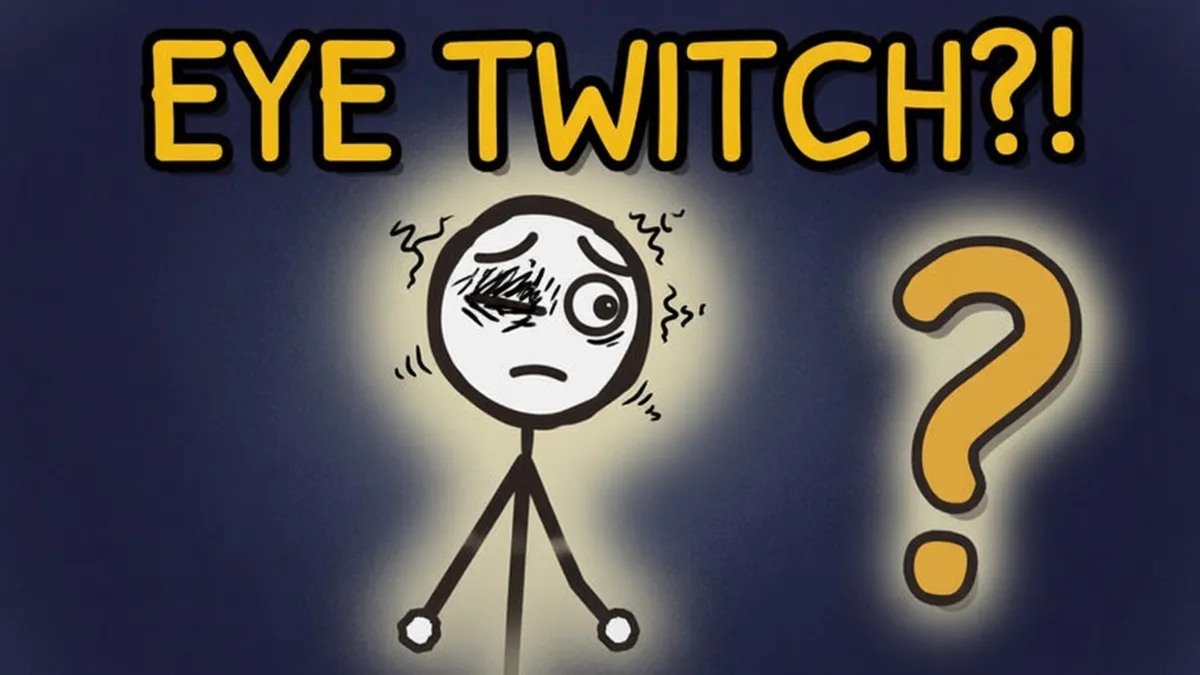
It arrives without warning and drives you slightly mad. A tiny, fluttering pulse in your eyelid, buzzing away like an insect trapped under the skin. You're certain everyone can see it. So you check a mirror, and there's nothing there. The twitch you can feel so vividly is completely invisible. That strange gap, between how huge it feels and how little actually shows, is the first clue to what's really going on.
01 · It has a nameEyelid myokymia
That everyday flutter is a specific, harmless thing called eyelid myokymia. It’s a fine, rippling, wave-like quiver of the orbicularis oculi, the thin ring of muscle that circles your eye and snaps the lid shut. Unlike a hard blink or a full clench, myokymia is gentle: a soft buzzing you feel far more than anyone can see. It almost always shows up in just one eye, usually the lower lid, and it comes and goes over seconds, minutes, or occasionally an infuriating hour.
02 · A wiring hiccup, not a muscle problem
The twitch isn’t your muscle being weak or damaged. It’s a signalling glitch. Your eyelid muscles take orders from the facial nerve, and in myokymia, a few individual motor units, single nerve fibres and the small bundle of muscle fibres they control, start firing on their own, in little rhythmic bursts, without any command from your brain to blink. And here’s the honest bit: exactly why those fibres suddenly discharge is not fully known. The medical literature calls the mechanism incompletely understood. It’s a genuine small mystery buzzing away in your eyelid.
The reason nobody else can see your twitch: only a handful of tiny motor units misfire, out of sync with each other, at roughly 3 to 8 pulses a second. So the muscle merely ripples instead of blinking. You can be intensely aware of the flutter while a friend staring right at your eye sees absolutely nothing.
03 · What sets it offThe story of a bad week
While the deep mechanism is fuzzy, the triggers are crystal clear, and suspiciously familiar. The classic culprits are stress, fatigue, lack of sleep, too much caffeine, alcohol, nicotine, and dry or strained eyes. Notice the theme: every one of those either ramps up your nervous system or irritates the eye’s surface, nudging those already-jumpy motor units into firing. Which is why the twitch so reliably coincides with a rough stretch, a deadline week, short nights, and one coffee too many, all stacking the deck at once. Your eyelid is essentially a small readout of your nervous system’s stress level.
04 · Why you can't just stop it
You’ve probably tried to consciously halt a twitch, and failed. That’s not a lack of willpower. You can’t switch it off because you never switched it on. Myokymia is a spontaneous, involuntary discharge, not a movement your brain is choosing to make, so there’s no voluntary control to override. The only levers you actually have are the indirect ones: more sleep, less caffeine, calming down, wetting a dry eye. Pull those, and the twitch tends to fade on its own. Fight it head-on, and you’re shouting at a machine that isn’t listening.
05 · The magnesium myth, and when to actually worry
You’ll see magnesium recommended everywhere for eye twitches. It’s worth being straight about this: the major eye-health authorities don’t list magnesium supplements as a proven fix for an ordinary twitch. Unless you have a diagnosed deficiency, sleep and less caffeine are far better bets. And while the common twitch is benign, there are red flags that mean a real check-up: if it lasts more than a few weeks, spreads across your face, forces the eyelid fully shut, or comes with pain or vision changes. Those point to different, more serious conditions (like blepharospasm or hemifacial spasm) that are not the everyday flutter.
06 · The payoffA tiny, honest messenger
So the next time your eyelid starts its private little dance, take it for what it almost always is: not a warning of anything sinister, but a small, honest messenger. A handful of overexcited nerve fibres, tipped over the edge by a stressful, sleep-short, over-caffeinated stretch, quietly reporting the state of your week to an audience of exactly one: you. Rest, ease off the coffee, and it will almost always pack up and leave as mysteriously as it arrived.
Quick questions
Why does my eye keep twitching?
The usual culprit is eyelid myokymia, a harmless flutter of the eyelid muscle set off by stress, tiredness, too much caffeine or dry eyes. It reflects a temporarily over-excited nerve, not a problem with your eye itself, and typically settles once you rest and cut back on triggers.
Is eye twitching a sign of something serious?
Almost always no. The common twitch (myokymia) is benign and does not affect your vision. It is only worth investigating if it lasts more than a few weeks, spreads to the rest of your face, forces the eyelid fully shut, or comes with pain or vision changes.
Why does only one eye twitch and not both?
Ordinary myokymia is typically one-sided because it is caused by a few motor units misfiring in a single eyelid muscle, most often the lower lid. If both eyes are being forced shut, that points to a different condition rather than a simple twitch.
Why does my lower eyelid twitch more than the upper?
Myokymia affects the lower eyelid more often than the upper, though it can occur in either. The medical literature notes this preference but does not fully explain why the lower lid is more prone to it.
How do I stop my eye from twitching?
Target the triggers: get more sleep, cut back on caffeine and alcohol, manage stress, and use lubricating drops if your eyes are dry. There is no instant off-switch, but reducing these factors usually lets the twitch fade on its own.
Can stress cause eye twitching?
Yes. Stress is one of the most common triggers, because it raises your nervous system's overall excitability, making the eyelid's motor units more likely to misfire. This is why twitches often flare during busy, high-pressure stretches.
Does caffeine make your eye twitch?
It can. Caffeine is a stimulant, and too much of it can provoke eyelid spasms. Eye specialists often suggest cutting back on coffee, tea and soda if you have a persistent twitch.
How long does an eye twitch last?
Individual twitches usually last only seconds to minutes, though they can come and go over hours or, for some people, days. Most cases resolve within days to a few weeks once the triggers ease.
When should I see a doctor about eye twitching?
See a doctor if the twitch lasts more than a few weeks, spreads to other parts of your face, closes the eyelid completely, or comes with redness, swelling, discharge, pain or vision changes. These features can signal something beyond simple myokymia.
Why can't I stop my eye from twitching consciously?
Because you are not the one starting it. Myokymia is an involuntary, spontaneous discharge from nerve and muscle fibres, not a movement your brain deliberately commands, so there is no voluntary control to switch it off. You can only reduce the triggers and wait.
Does magnesium stop eye twitching?
This is a popular claim, but major eye-health sources do not list magnesium supplements as a proven treatment for ordinary eyelid twitching. Unless you have a diagnosed deficiency, sleep, stress reduction and less caffeine are the better-supported fixes.
Can lack of sleep cause eye twitching?
Yes, tiredness and insufficient sleep are among the most common triggers. Eyelid twitches often show up precisely when people are run down, and catching up on rest is one of the most reliable ways to make them stop.
Can dry eyes cause eyelid twitching?
They can. Irritated or dry eyes are a recognised trigger for eyelid spasms, which is why lubricating drops sometimes help. Screen time and reduced blinking can worsen dryness and feed the cycle.
What is the difference between eye twitching and blepharospasm?
A simple twitch (myokymia) is a light, harmless flutter, usually in one lower eyelid. Blepharospasm is a rarer neurological condition that forces both eyes to blink hard or squeeze shut, can interfere with vision, and needs medical treatment.
Our sources 8 checked
// every claim on this page was checked before it went up