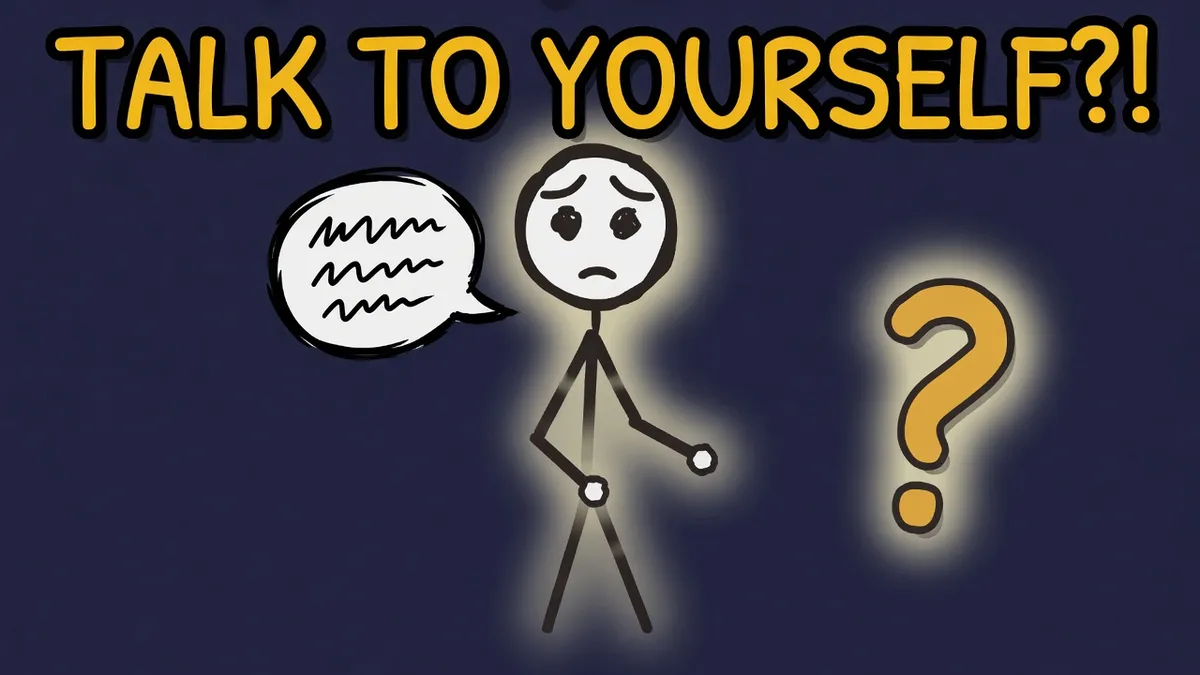
You have almost certainly done it today. Muttered a shopping list on the way to the fridge. Talked yourself through a fiddly moment: "okay, red wire first." Narrated your own hunt for the keys as if a small audience needed updates. We tend to treat all of this as a slightly embarrassing quirk, the kind of thing you hope nobody caught you doing. But it is not a glitch in the machine. It is the machine using its single most powerful tool, language, on the one person it can always reach: you.
01 · The originYour inner voice used to be out loud
The most durable account of where all this comes from belongs to the Soviet psychologist Lev Vygotsky, and it is one of those ideas that quietly reorganises how you see your own head. Watch a four-year-old build a tower and you will hear them narrate it: “put this one on top, no, the big one.” That running commentary is called private speech, and Vygotsky’s insight was that it is not babble. It is social speech, the kind adults use to guide the child, turned back on the self to guide their own behaviour.
Here is the part that lands. That out-loud self-talk does not disappear as the child grows. It goes underground. The words that used to be spoken get quieter, then become a mutter, then vanish from the air entirely and continue as silent inner speech. On this account, the voice in your head reading this sentence is private speech that simply learned to keep it down. This developmental story, external speech becoming internal, is the standard and well-supported view, and it is why the boundary between talking to yourself and thinking is far blurrier than it feels.
02 · The evidenceIt actually works, within limits
If self-talk were just a habit, it would not reliably change what you can do. It does. The cleanest evidence comes from sport psychology, where researchers can measure whether an athlete who talks to themselves performs better than one who does not. A 2011 meta-analysis pooled 32 studies and found a moderate positive effect, an average effect size of around 0.48, which in this field counts as a real and useful boost rather than a rounding error.
But the honest version comes with fine print. The benefit was not uniform. Self-talk helped most for fine, precise, and novel tasks, the ones where you are still figuring out the movement, and less for gross, well-practised ones where your body already knows the way. Researchers also split it into two flavours: instructional self-talk (“elbow up, follow through”) and motivational self-talk (“come on, you’ve got this”). Both helped, and across the board they were not statistically different, though instructional talk had the edge on the delicate, technical tasks. So the takeaway is not “talking to yourself makes you great.” It is narrower and more trustworthy: for the right kind of task, coaching yourself out loud measurably helps.
03 · The searchSay the name of the thing you lost
Here is a trick you can test on your own kitchen. In 2012, Gary Lupyan and Daniel Swingley ran a study where people searched a cluttered display for a named object, sometimes silently and sometimes while saying the target’s name out loud. Speaking the name sped the search up. Muttering “banana, banana” while your eyes swept the shelves genuinely helped find the banana faster.
The catch is elegant and worth knowing, because it stops this becoming a lazy life hack. The boost only appeared when the name matched the object well, when hearing “banana” reliably conjures a banana. When the label fit the thing poorly, saying it out loud could actually slow the search down, presumably by priming your visual system to look for the wrong sort of thing. The leading interpretation is that hearing a word sharpens the mental template your eyes are matching against. Name a thing clearly, and you tune your own vision to catch it.
04 · The pronounTalk to yourself as "you," not "I"
There is a strange, specific finding hiding in how you word your self-talk, and it comes mostly from Ethan Kross and colleagues. When you are stressed, addressing yourself in the first person (“why am I so nervous?”) keeps you locked inside the feeling. But swap the pronoun, use your own name or a second-person “you” (“okay, you’ve done harder things than this”), and something shifts. This is called distanced self-talk, and the idea is that the small linguistic move nudges you out of the immersed, drowning perspective and into a steadier, more observer-like one, the way you would coach a friend rather than spiral with them.
There is even brain-imaging support: one study reported that third-person self-talk dampened an electrical marker of emotional reactivity without ramping up the effortful, cognitive-control machinery, hinting it is a relatively cheap route to calming down. It is a genuinely appealing result. It is also one to hold loosely. The reported effects are modest in size, and the broader field of psychology has learned hard lessons about which tidy findings survive careful re-testing. So treat “talk to yourself as you” as a promising, low-cost thing to try, not a proven law.
The nagging fear is that talking to yourself is a sign something is wrong. It is closer to the opposite: it is your mind reaching for its best tool. The thing people actually worry about, hearing voices, is a different phenomenon entirely, and the line between them is not volume. It is control.
05 · The worryWhy it is not a sign of madness
Let us kill the anxiety directly, because it is the reason people hide something harmless. Talking to yourself, out loud and in public, is common and normal. Surveys suggest the large majority of adults carry on a running internal dialogue, and a solid minority talk to themselves aloud. It is not, on its own, a symptom of anything.
It is also not the same thing as an auditory verbal hallucination, and conflating the two is where the stigma comes from. The distinguishing feature is agency and control. Ordinary self-talk, even spoken aloud, is something you produce on purpose, can stop at will, and recognise as coming from your own perspective. A hallucinated voice is experienced as arriving from outside you, unbidden, and not under your command. One leading account of hallucination is precisely a failure of self-monitoring, the mind mistaking its own generated speech for someone else’s. The everyday muttering while you cook is the system working normally. It is your own voice, aimed at your own ear, and you are holding the microphone.
06 · The varietyNot everyone has a voice in there at all
One reason all of this feels universal is that we assume everyone’s inner life sounds like ours. It does not. When Russell Hurlburt’s team beeped people at random through the day and asked what was in their experience the instant before, they found staggering variety. For some people, inner speech showed up in almost every sampled moment. For others, in almost none. The proportion ran essentially the full range, from near zero to near one hundred percent.
Which means some people go through life with little or no inner voice, thinking instead in images, in feelings, or in wordless concepts that only get dressed in language when they need to say them out loud. If you are one of those people, talking to yourself out loud may not be a quirk so much as your primary way of thinking in words at all. (We have a whole piece on why some people have no inner voice, and it is stranger than you would guess.) The lesson is humility about your own head: the running commentary you take for granted is not the standard-issue human experience. It is one setting among several.
07 · The payoffSo why do you talk to yourself?
Because speech was never only for other people. It is a tool for thinking, and you are always within earshot. Said out loud, your own voice can sharpen what your eyes are looking for, hold a plan steady in working memory, coach you through the fine motor moment, and, worded carefully, talk you down off the ledge of your own panic. It is the same instrument a child uses to narrate a tower into being, grown up and mostly gone quiet, but always available to bring back into the air when a task or a feeling is hard enough to need it.
So the next time you catch yourself muttering directions to the fridge, do not wince. You are using the oldest cognitive technology you own, in the way it was built to be used. The only real mistake is the content: keep it kind, keep it instructive, and it is one of the most reliable free upgrades your mind has.
Quick questions
Is talking to yourself a sign of mental illness?
No. Talking to yourself, even out loud, is common and normal, and surveys suggest most adults have a running inner dialogue while a sizeable minority talk to themselves aloud. It is not the same as an auditory hallucination. The key difference is agency and control: self-talk is something you generate and can stop, and it comes from your own perspective, whereas a hallucinated voice feels like it arrives from outside you and beyond your control.
Why do I talk to myself out loud when I'm alone?
Usually to think better. Saying something aloud recruits your hearing and language systems as an extra channel, which can steady your attention, hold a plan in mind, or work through a problem. It is the grown-up version of the out-loud private speech children use to guide themselves, which never fully disappears: it just becomes quieter and mostly internal.
Does talking to yourself actually help you perform better?
Often, yes, but the effect is real rather than magic. A 2011 meta-analysis of sport studies found a moderate average benefit from self-talk, and it worked best for fine, precise, novel tasks rather than well-practised gross ones. So it is a genuine tool, with limits.
What is the difference between private speech and inner speech?
Private speech is the out-loud self-directed talk you can hear, most obvious in young children narrating their play. Inner speech is the silent internal version. In Vygotsky's account, the second grows out of the first: overt private speech gradually goes underground to become the covert inner voice.
Does saying what you're looking for out loud help you find it?
It can. In a 2012 study, people found target objects faster when they said the target's name aloud, at least when the name matched the object well. When the label fit the thing poorly, saying it could actually slow the search down. So naming what you are hunting for is a genuine, if modest, boost.
Is it better to say 'I can do this' or 'you can do this' to yourself?
There is evidence that addressing yourself by name or as you, called distanced self-talk, helps more than first-person I when you are stressed, because it nudges you into a calmer, more observer-like perspective. The effects reported are real but modest, and researchers are still mapping how reliable and general they are.
Why do children talk to themselves so much?
Because they are learning to steer their own behaviour with words. Self-directed speech peaks roughly between ages 4 and 7, when it is mostly out loud, and children use it to plan, focus, and calm down. As they get older it does not stop, it just moves inside and becomes the inner voice.
Do some people have no inner voice at all?
Yes. Sampling studies suggest inner experience varies enormously between people: some report inner speech in most sampled moments, others in almost none. Some people have little or no inner voice at all and think in other ways, such as images or wordless concepts. See our piece on why some people have no inner voice.
Does talking to yourself help with anxiety or emotion?
It can, depending on how you do it. Reframing a worry in the second or third person (you've got this, or using your own name) appears to help some people take a small step back from the feeling. It is a light-touch tool rather than a cure, and the measured effects are modest.
Why do I narrate my own actions?
Narrating, muttering a plan or listing your steps, is a way of loading your intentions into your working memory using sound. Hearing your own instruction can keep you on task and stop a plan slipping away, which is exactly the self-guiding job private speech evolved to do.
Is talking to yourself a sign of intelligence?
There is no good evidence that it marks you as more intelligent, despite the popular claim. What the research does support is more useful: self-talk is a functional thinking tool that can aid focus, memory, and performance. That is worth more than a flattering myth.
Can talking to yourself ever be a bad thing?
The content matters more than the act. Harsh, repetitive, self-critical talk (rumination) is linked to low mood, whereas encouraging or instructional self-talk tends to help. So the fix is rarely to stop talking to yourself: it is to change what you say.
Take the quiz on this
A quick 4-question check on what you just read. Get them right to earn XP: no points for just scrolling.
Our sources 8 checked
// every claim on this page was checked before it went up