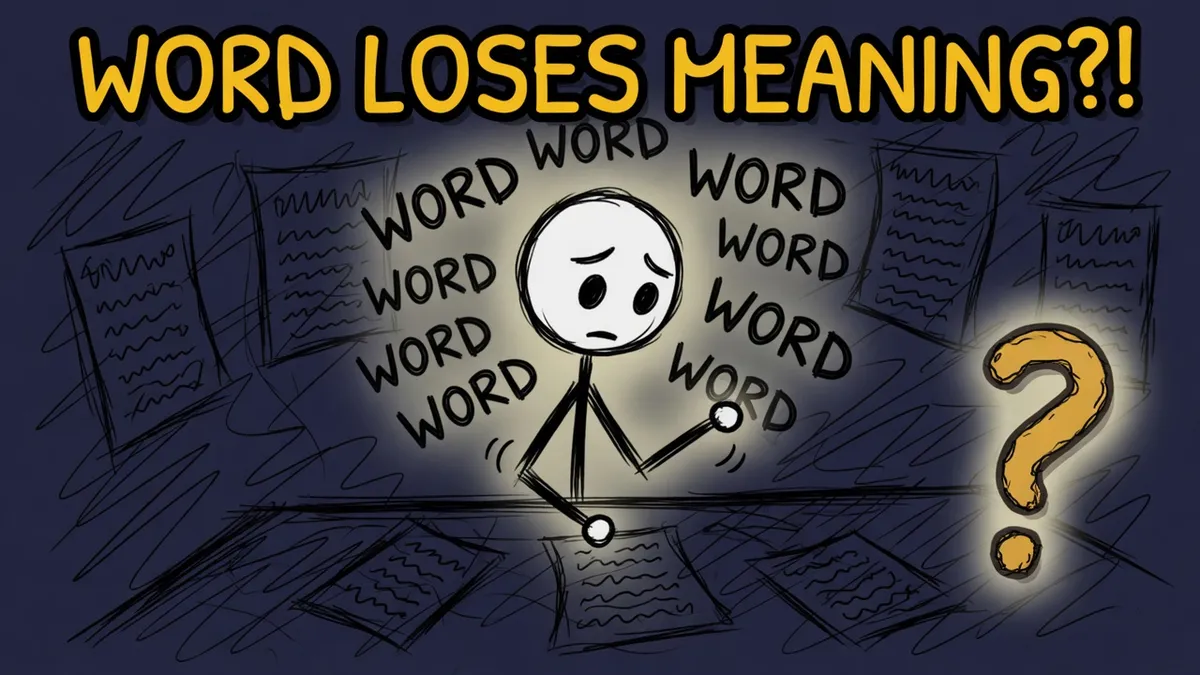
Pick a plain, everyday word: door is perfect. Say it out loud, steadily, thirty times. For the first few it's a door, the thing with a handle. Then something odd happens. Somewhere in the teens the word starts to come loose from what it means, and by the twenties you're just making a noise, dor, dor, dor, a silly little mouth-sound with no thing attached. The word hasn't changed. You haven't forgotten what a door is. So what, exactly, has drained out?
01 · The nameIt's called semantic satiation
The effect has a name, and a satisfyingly precise one: semantic satiation, literally, being “full up” on meaning. It was coined in 1962 by a psychologist named Leon Jakobovits James, in his doctoral thesis at McGill University. But he was naming something people had noticed for a very long time. Back in 1916, the psychologist Edward Titchener described how repeating a word until it turns “meaningless and blank” leaves you with just the bare sound. Researchers had even measured a “lapse of meaning” from staring at written words as far back as 1907. Jakobovits simply gave the ghost a name that stuck.
02 · The mechanismA circuit that tires like a muscle
Here’s what’s happening underneath. When you understand a word, you’re not just hearing a sound, you’re firing a specific pattern of neurons that is the meaning, the web of associations that turns dor into the-thing-with-a-handle. Say the word once and that pattern lights up cleanly. But say it again immediately, and again, and again, and you’re forcing the exact same circuit to fire over and over with no recovery time. And any circuit worked that hard starts to fatigue. Its response weakens with each repetition, a process called reactive inhibition. It’s the same principle as a muscle tiring, or your eyes going numb to a bright light, or your nose giving up on a smell after a minute. The meaning doesn’t vanish. It’s just been temporarily worn down.
03 · The proofIt's the meaning that tires, not your ears
You might reasonably suspect this is just your mouth or your ears getting bored, a plumbing problem, not a meaning problem. It isn’t, and there’s a clever way to show it. Researchers led by John Kounios wired people up to an EEG and watched a brain signal called the N400, which spikes whenever the brain processes meaning. As a word was repeated, that meaning-signal reliably faded. The trick was that they changed the word’s appearance between repeats, a different letter case, a different pitch of voice. If the fatigue were merely perceptual, changing the look or sound should refresh it. It didn’t. The meaning kept draining regardless, which tells us the tired part is the meaning system itself, not the eyes, not the ears.
Push the same trick a little further and you don't just get a hollow word, you manufacture jamais vu, the eerie opposite of déjà vu, where something you know perfectly well suddenly feels alien. Scientists did exactly that on purpose, and won an Ig Nobel Prize for it.
04 · The eerie cousinManufacturing jamais vu on demand
Everyone knows déjà vu, the sense that a brand-new moment is strangely familiar. Its mirror image is jamais vu: a genuinely familiar thing curdling into something foreign, wrong, unrecognisable. In 2021, a team led by Chris Moulin decided to summon it in the lab, and the simplest tool for the job was repetition. They had people write out a common word again and again, and about two-thirds of them hit a moment where the word stopped feeling like a word at all, becoming strange, doubtful, almost unreal. On average, the tipping point came at around 27 repetitions. The work was odd enough, and real enough, to win the 2023 Ig Nobel Prize for Literature. Semantic satiation, it turns out, is a reliable little machine for making the familiar go uncanny.
05 · The whole familyStare, and the letters fall apart too
It isn’t only the spoken word that fatigues. Fix your eyes on a single written word for long enough and a related thing happens on the visual side: the letters stop fusing into a familiar unit and start looking like arbitrary marks, so a perfectly correct word begins to read as a typo. There’s a name for that, too, Gestaltzerfall, roughly “shape decay”, and it’s especially vivid with dense written characters, where a whole logogram can crumble into a pile of unrelated strokes. Meaning, sound, and shape can each be satiated, because each is handled by a circuit that can be worn down. The word is a single object to you, but your brain is holding it up with several separate hands, and you can tire out any one of them.
06 · The payoffSo why does a word lose its meaning?
Because meaning isn’t stored in the word, it’s rebuilt, fresh, every time you use it, by a specific patch of brain that fires to summon it. Repeat the word fast enough and you exhaust that patch faster than it can recover, and for a few strange seconds you’re left holding the one part that doesn’t tire: the raw, meaningless sound. Nothing is broken and nothing is forgotten; give it a moment’s rest and door is a door again. It’s one of the only times you get to feel your own mind doing its work, the quiet, constant, invisible act of turning noise into meaning, precisely because you’ve briefly, harmlessly, run it out of fuel.
Quick questions
What is semantic satiation?
It's the temporary loss of a word's meaning after you repeat it many times in a row: the word decays into a bare, slightly absurd sound. The term was coined by psychologist Leon Jakobovits James in his 1962 doctoral dissertation at McGill University, though the phenomenon had been described for decades before under names like 'verbal satiation' and 'lapse of meaning.'
How many times do you have to say a word before it loses meaning?
Roughly 15 to 30 rapid repetitions for most people, though it varies with the word, the speed, and the person. Faster, uninterrupted repetition works best. In one lab study that had people write a word over and over, participants who reached the point of the word feeling strange did so at around 27 repetitions on average.
What causes semantic satiation?
The leading explanation is reactive inhibition. Each time you say the word, the same neural pattern that encodes its meaning fires. Fire any circuit fast enough and it fatigues, its response weakens with each repetition, a bit like a muscle tiring or your eyes adjusting to a bright light. The sound still reaches you, but the meaning it normally summons has temporarily dialled down.
Is it your brain getting tired, or your mouth and ears?
Chiefly the meaning, not the plumbing. Brain-wave experiments (Kounios and colleagues, 2000) found the neural signature of meaning, a response called the N400, fatigues with repetition even when the word's appearance or sound is changed between repeats, in a different letter case or a different pitch. That points to genuine fatigue in the meaning system itself, not just worn-out perception.
Does the meaning come back?
Yes, and quickly. Semantic satiation is temporary. After a short pause, seconds to minutes, the fatigued circuit recovers and the word snaps back to its ordinary, meaningful self. Nothing is damaged or forgotten; the meaning was only briefly suppressed.
Is semantic satiation the same as habituation?
It's a close cousin. Habituation is the general principle that a repeated stimulus gets a weaker and weaker response, you stop noticing a smell, a ticking clock, the feel of your clothes. Semantic satiation is habituation applied specifically to a word's meaning: repeat the meaning enough and the brain stops fully 'answering' it.
Does it happen with written words too, or only spoken?
Both. You can satiate a word by saying it aloud, by staring at it, or by writing it repeatedly: all three routes drain the meaning. Prolonged staring at a single written word (or character) can also trigger a related visual effect where the shapes themselves start to look wrong, sometimes called Gestaltzerfall, or 'form decay.'
What is jamais vu, and how is it related?
Jamais vu is the opposite of déjà vu: the unsettling sense that something genuinely familiar has become strange and unrecognisable. Semantic satiation is one of the most reliable ways to manufacture it in a lab: repeat a common word enough and it tips into feeling foreign. A 2021 study by Chris Moulin and colleagues did exactly this and won the 2023 Ig Nobel Prize for Literature.
Why does staring at a word make it look misspelled or wrong?
That's the visual side of the same coin, sometimes called wordnesia or, for the shape-level version, Gestaltzerfall. Fix your gaze on a word long enough and both its meaning and its visual 'wholeness' fatigue; the letters stop fusing into a familiar unit and start looking like arbitrary marks, so a perfectly correct word suddenly reads as an error.
Can semantic satiation be useful?
Possibly. Jakobovits himself suggested draining the emotional charge from a distressing word by repeating it could aid therapies like systematic desensitisation, and might ease the anxiety a stutterer feels around a feared word. These were exploratory ideas rather than established treatments, so treat them as plausible applications, not proven cures.
Does it work in any language?
Yes, semantic satiation is a general property of how brains process meaning, not a quirk of English, and it has been demonstrated across languages and writing systems, including experiments with bilingual speakers and with Chinese and Tibetan characters. Any word, in any language, will hollow out if you repeat it enough.
Who discovered semantic satiation?
The name is Leon Jakobovits James's (1962), but the observation is much older. Titchener described a repeated word turning 'meaningless and blank' in his 1916 textbook, and researchers had measured a 'lapse of meaning' from prolonged word fixation as far back as Severance and Washburn in 1907. Jakobovits and Wallace Lambert then studied it experimentally around 1960 to 62.
Take the quiz on this
A quick 4-question check on what you just read. Get them right to earn XP: no points for just scrolling.
Our sources 10 checked
// every claim on this page was checked before it went up