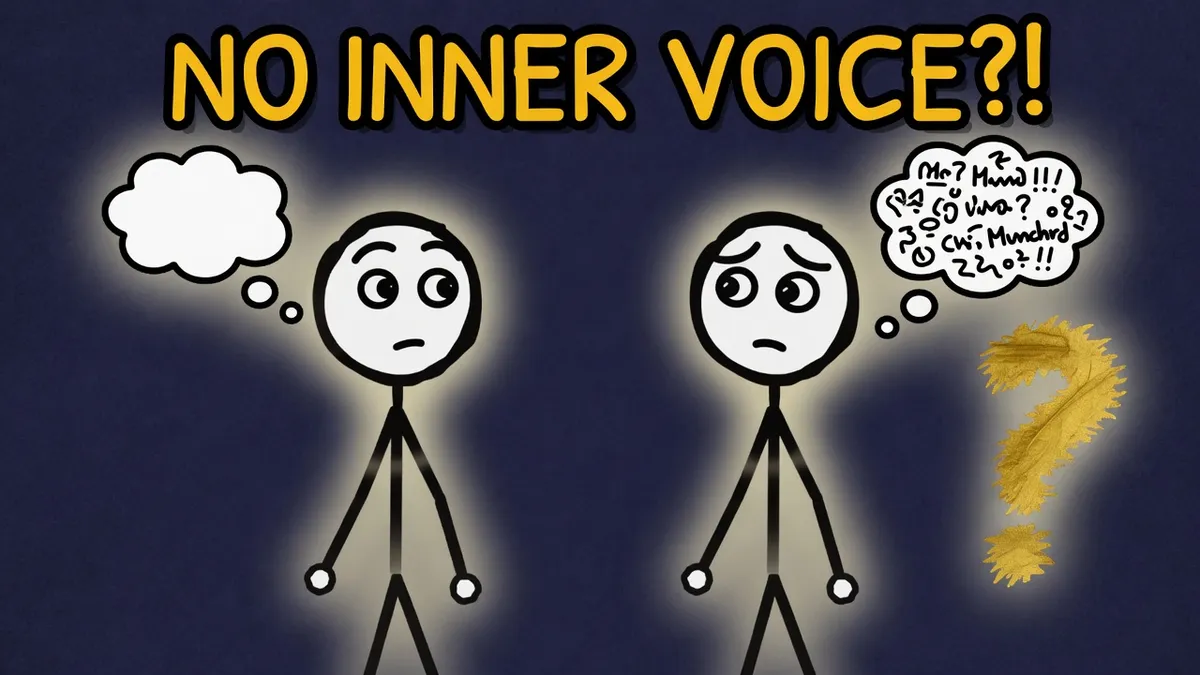
Read the next sentence, and listen closely. Right now, as your eyes move across these words, there's a good chance you can hear them, a little narrator, somewhere behind your face, quietly saying each one. That same voice talks you through your day, rehearses arguments in the shower, and reads your texts back to you. And you have always, quietly, assumed everyone has one. A lot of people simply don't.
01 · The spectrumIt was never a simple on or off
Here’s the first surprise: your inner voice isn’t a switch. It’s a whole spectrum. At one end sit people whose heads are a non-stop running commentary, narrating breakfast, drafting emails they’ll never send, replaying the conversation from four hours ago. At the other end sit people whose minds are almost completely silent. And the crucial part, the part that trips everyone up, is that neither of those is the “normal, correct” setting. They are just different ways of being a mind.
The reason this feels so shocking is that inner experience is invisible from the outside. You have exactly one head to look inside, and you’ve been looking inside it your whole life. So you naturally assume the inside of everyone else’s head sounds like yours. It very often doesn’t.
02 · The nameWhat we finally called the silence
For most of history the quiet end didn’t even have a name. Then, in 2024, researchers Johanne Nedergaard and Gary Lupyan gave it one: anendophasia, literally, no inner speech. They picked the word deliberately to echo aphantasia, the term for people who can’t picture things in their mind’s eye. And when they started actually testing people who live at that silent end, they found the difference is measurable. Across four studies, it genuinely changes how the mind does certain jobs.
03 · The testA way to feel it yourself
Here’s a demonstration you can run on your own head. Two written words: comb, and tomb. Do they rhyme?
If you have a strong inner voice, you just heard them, sounded them out, and instantly knew the answer is no. But those two words are a trap: they look like they should rhyme, so the only way to be sure is to play the sound back. In the studies, people low in inner speech found exactly this kind of judgment harder. They were also worse at holding a string of words in memory, the trick you use to keep a phone number alive until you can dial it. When your thinking doesn’t come pre-loaded as sound, sound-based puzzles get harder.
04 · Not a lesser mindSame destination, different vehicle
Now, this is important, because it’s the easiest thing to get wrong: a silent mind is not a lesser mind. The deficits the researchers found were narrow and specifically verbal: rhyming, holding words in memory. On other tests, like task-switching and categorical perception, low-inner-speech people were no different at all. People without a chattering narrator are every bit as sharp, as clever, and as capable as anyone else. They just get there by other means, thinking in pictures, in feelings, in fast wordless concepts that never need to be spelled out into sentences, closer to how some people bind colour to numbers than to a running monologue. Same destination, a completely different vehicle.
05 · Where it comes fromThe voice you used to use out loud
So where does this voice even come from? The leading idea traces back to the psychologist Lev Vygotsky. Watch a small child playing alone and they narrate constantly, no, no, the red block goes here, talking themselves through the task out loud. Vygotsky called this “private speech.” As the child grows, that running commentary doesn’t disappear. It goes quiet, drops to a mutter, and then turns fully inward. On this view, your inner voice is quite literally the voice you used to use out loud as a toddler, simply moved inside your head where nobody else can hear it.
Even if you're certain your narrator never shuts up, when scientists beep people at random and ask what was in their head that instant, inner speech shows up only about a quarter of the time.
06 · Even yours isn't constantTurn around fast enough and the room is quiet
This is the jolt for the confident narrators. There’s a method called Descriptive Experience Sampling: you carry a beeper that goes off at random moments, and the instant it does, you note exactly what was in your awareness. Do this across many people and many beeps, and inner speech turns up only about 26% of the time, a bit over a quarter, with enormous variation from one person to the next. Your voice only feels constant because it’s always there the moment you go looking for it. But looking for it is what summons it. Turn around fast enough, and the room is mostly silent.
07 · Still being arguedThe far quiet end, or a separate category?
I have to be honest here, because the science is genuinely new and not everyone agrees. In 2025, a commentary by Andreas Lind pushed back on the strongest reading of the anendophasia work. His argument: the evidence really shows big differences in how much people use an inner voice, not proof that any individual sits at exactly zero. So the truly silent mind might be the far, quiet end of one continuous spectrum, rather than a hard, separate category of person. It’s a live debate, and the honest answer is that we’re still measuring the edges of it.
08 · The payoffTwo ways of being a person, side by side
But sit with the strange part, whichever end you’re on. Your whole life, you’ve quietly assumed the inside of everyone’s head sounds like the inside of yours. The constant narrators can’t imagine the silence. The silent minds can’t imagine the chatter. Two utterly different ways of being a conscious person, sitting right next to each other on the bus, and neither one can see in. The next time that voice in your head reads a shop sign out loud for no reason at all, spare a thought for the people reading in total silence. And for the ones whose narrator just read this very line, in some borrowed voice: hello.
The animated version
Same answer, told as a little animated story with the strange little stickman acting it out. Dry, quick, and, obviously, correct.
Quick questions
Is it normal to have no inner monologue?
Yes. Inner speech varies from a near-constant narrator to almost none, and researchers stress that neither end of that spectrum is the "correct" or default setting. People with little or no inner voice simply think in other ways, in images, spatial relationships, or fast wordless concepts.
What is anendophasia?
It's the term coined in 2024 by Johanne Nedergaard and Gary Lupyan for a lack, or very low level, of inner speech. It deliberately echoes aphantasia, the word for a lack of visual mental imagery. Their studies found that people at this quiet end handle some verbal tasks differently, though whether anyone has literally zero inner speech is still debated.
Does having no inner voice mean you think worse?
No. In the 2024 studies, low-inner-speech adults did worse on a couple of specifically verbal tasks, holding word-strings in memory and rhyme judgments, but were no different on task-switching or categorical perception. They reach the same conclusions by different routes: visual, spatial and conceptual thinking rather than words.
Where does the inner voice come from?
The leading idea traces to psychologist Lev Vygotsky. Young children narrate their play out loud, "private speech." As they grow, that running commentary doesn't vanish; it goes quiet and turns inward. On this view, your inner voice is the voice you once used aloud as a toddler, simply moved inside.
How do I know if I have an inner voice?
Try a quick test: do the written words comb and tomb rhyme? If you instantly "heard" them and knew the answer is no, you sounded them out with an inner voice. If that felt oddly hard, you may sit nearer the quiet end of the spectrum.
What is an inner monologue?
Your inner monologue, or inner voice, is the experience of "hearing" language in your head without speaking aloud: narrating your day, rehearsing what you'll say, reading a sign to yourself. Psychologists call it inner speech. It's silent, self-generated, and you always know it's yours, which is exactly what separates it from actually hearing a voice.
Do most people have an inner voice?
Most report at least some inner speech, though far from constantly, and a minority have very little. The estimates are rough and depend heavily on method: surveys often land somewhere around 30 to 50% of people having a frequent verbal inner voice, with perhaps 5 to 10% reporting almost none. Because it all rests on self-report about a private experience, treat any single figure with caution.
Is having no inner voice linked to intelligence?
No. People with stronger verbal skills do tend to have a wordier inner voice, so inner speech loosely tracks verbal ability, but the absence of a narrator doesn't mean lower intelligence. Quiet-minded people reason, plan and solve problems just as well, using visual, spatial and conceptual thinking. IQ measures certain skills, not whether your thoughts arrive pre-loaded as sentences.
Can you develop an inner monologue?
Maybe, to a degree, but honestly, we don't really know. Inner speech is thought to form in childhood, and some argue that with deliberate practice (narrating, journaling, structured self-talk) an adult could build more of it, leaning on the brain's plasticity. But there's little hard evidence that a naturally silent mind can be turned chatty, so file this firmly under "plausible, unproven."
Do you think in words or pictures?
Most people do both, in shifting proportions: some lean heavily verbal, some heavily visual, and many switch depending on the task. Neither is "thinking properly"; they're different tools for the same job. People low in inner speech tend to report leaning on images, spatial layouts and fast wordless concepts instead of a running narration.
Is a lack of inner monologue linked to autism or ADHD?
The evidence is genuinely mixed and shouldn't be overstated. Some studies suggest autistic people use inner speech less during certain cognitive tasks; others find they use it just as much as anyone of a comparable level. Anendophasia itself was only named in 2024 and hasn't been cleanly tied to any diagnosis. So there's no reliable link established either way. Treat confident claims in either direction with scepticism.
Is having an inner voice the same as hearing voices?
No, and it's a common worry, so worth saying plainly. A normal inner voice is self-generated, and you know you're the one producing it. An auditory hallucination is experienced as coming from outside you, not made by you. One leading theory is that it's inner speech the brain has failed to recognise as its own. Having a chatty inner monologue is entirely ordinary and not a warning sign of anything.
Is anendophasia the same as aphantasia?
No, though the words were deliberately built to rhyme. Aphantasia is a lack (or near lack) of visual mental imagery: no mind's eye picture when you try to 'see' an apple. Anendophasia is a lack (or near lack) of inner speech: no running verbal narrator. Someone can have either, both, or neither. The 2024 researchers coined anendophasia to mirror aphantasia because both mark a quiet end of a private mental spectrum, not because they are the same condition.
Take the quiz on this
A quick 4-question check on what you just read. Get them right to earn XP: no points for just scrolling.
Our sources 14 checked
// every claim on this page was checked before it went up