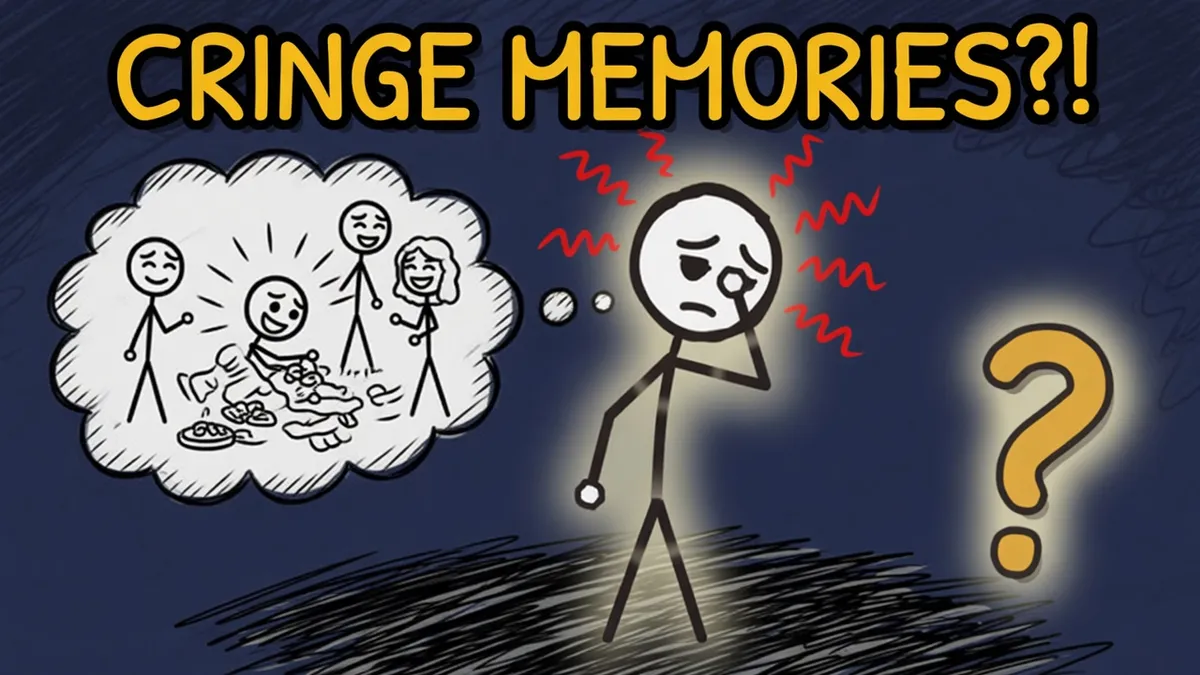
It's late. You're finally drifting off. And then, from absolutely nowhere, your brain leans over and whispers: hey, remember that incredibly stupid thing you said nine years ago? And your whole body physically curls up. Here's the strange part: it almost never does this while you're busy. It waits. It waits for the shower, the long train window, the quiet minute before sleep, and then it opens the folder of your worst moments. So why does your own brain ambush you like this, and always at the worst possible time?
01 · The ambushCringe attacks, and when they strike
These little ambushes are common enough to have a name: cringe attacks, involuntary autobiographical memories of embarrassing moments. They’re near-universal; you’ll often see them described as hitting around nine in ten of us, though that’s a popular figure rather than a hard-counted statistic. What’s genuinely striking is the timing. They almost never strike mid-task. They wait for the quiet: lying in bed, standing in the shower, staring out of a train window. That’s not a coincidence, it’s a clue about where they come from.
02 · The idle mindYour brain's default setting is you
The second you stop concentrating on the outside world, your brain doesn’t switch off, it flips into a kind of idle mode called the default mode network. And a wandering mind, left to its own devices, keeps returning to the same three topics: you, other people, and your past. So an unoccupied brain isn’t drifting randomly. It’s practically built to go rummaging through old social moments. The train window isn’t causing the cringe. It’s just removing the distraction that was holding it back.
03 · The filing systemWhy that memory got saved in HD
But why drag up that memory, the mortifying one, and not something pleasant? Because of how it was filed. When something socially charged happens, the amygdala slaps an urgent “important” label on it and tells the hippocampus to encode it in high definition. Emotionally charged moments end up stored far more vividly than ordinary ones, you’ll often see the figure quoted as roughly three times, which is more a rule of thumb than a precise constant. Then a negativity bias, inherited because remembering threats kept our ancestors alive, keeps the painful ones near the top of the stack. Your best memories fade to a blur; the cringe stays in 4K.
04 · The old alarmWhy your brain treats a faux pas like a predator
There’s a brutal old logic underneath all this. For most of human history, belonging to your group was survival. Being judged, mocked, or cast out could genuinely get you killed: no group meant no food, no shelter, no protection. So, on the leading account, the brain learned to treat a social slip-up much like it treats a physical threat: as something it must never forget. A misjudged joke isn’t a sabre-toothed tiger, of course. But the alarm system doesn’t always know the difference, and it would rather over-remember an embarrassment than let you repeat one that might once have cost you the tribe.
The replay feels like punishment. It isn't. Your brain thinks it's helping, it's reviewing the tape, like a coach, trying to work out what went wrong so you never do it again.
05 · The review, not the punishmentWhy it plays the tape at all
When your brain cues up the moment, it isn’t sadism, it’s error-monitoring. Parts of the brain that handle social cognition and self-reference, chiefly the medial prefrontal cortex and the anterior cingulate cortex, appear to be running a kind of after-action review: what went wrong there, and how do we avoid it next time? That’s why the cringe attaches itself to social mistakes specifically, not to random bad luck. It’s a correction, not a torment. The problem is that the coaching session is unbelievably vivid, endlessly repeated, and scheduled for 2am.
06 · Why it stingsThe memory that clashes with who you are
There’s a reason a cringe memory doesn’t just feel awkward, it actually hurts, in a way you can feel in your chest. The likeliest explanation: the memory collides with the person you now think you are, and that clash of self-image lights up some of the very same brain regions as social rejection. And here’s the cruel part: social pain and physical pain share neural real estate, notably the dorsal anterior cingulate cortex. Your embarrassment isn’t just a figure of speech when you say it hurts. To part of your brain, it’s the genuine article. It often feels worse with age, too, because you’re judging the old you by the standards of the person you’ve since become, which makes that younger version look far more clueless than they ever really were.
07 · The way outYou're the only one still watching
Now for the part that should genuinely set you free. In a famous 2000 study, people were sent into a room of strangers wearing a deeply embarrassing T-shirt. They were sure about half the room had clocked it. The real number was closer to a quarter. It’s called the spotlight effect, and we run it constantly: we’re convinced the whole world is watching, and it mostly isn’t. Worse, for us, better, even the people who did notice forget your blunder far faster than you do. Their memory of your worst moment faded within days. Yours has been on a loop for nine years.
Which leaves a strangely freeing truth. That cringe-worthy memory you’re reliving in agonising detail? You are the only person in the entire cinema still watching it. Everyone else walked out years ago. And the cringe itself isn’t a flaw. It’s proof your social compass works, that you care about other people and about getting it right. Only someone who cares replays the misses. So tonight, when your brain queues up the highlight reel of your worst moments, remember: you wrote it, you screened it, and you’re the only ticket holder still in the room.
The animated version
Same answer, told as a little animated story with the strange little stickman acting it out. Dry, quick, and, obviously, correct.
Quick questions
Why do I cringe at old memories out of nowhere?
Because the memories aren't really coming from nowhere, they surface when your mind is idle. The moment you stop concentrating, your brain slips into the default mode network, whose favourite subjects are yourself, other people, and your past. A wandering mind naturally drifts toward old social moments, and the embarrassing ones were filed most vividly.
Why do cringe attacks happen at night?
Night, the shower, a long train ride, these are exactly when you're not concentrating on anything, so the brain's idle 'default mode' takes over and starts wandering through your past. Tiredness and low mood also make it harder to bat away unwelcome memories, so the 2am replay hits hardest.
Why do embarrassing memories feel so vivid?
When something socially charged happens, the amygdala flags it as important and boosts how strongly the hippocampus encodes it, so emotional moments are stored more vividly than neutral ones. A negativity bias, inherited because remembering threats kept our ancestors alive, then keeps the painful ones near the top of the pile.
Is cringing at yourself a bad sign?
Not really. The replay is your brain's error-monitoring system reviewing a social mistake so you don't repeat it, a sign your social compass works. It only tips into a problem when the memories become genuinely intrusive and start dragging down your mood or confidence.
Does everyone else remember my embarrassing moment?
Almost certainly not. The spotlight effect shows we badly overestimate how much others notice us, and the few who did notice forget the moment far faster than you do. You're usually the only person still replaying it.
How do I stop cringing at old memories?
You probably can't delete the memory, but you can drain its sting. The best-supported moves are self-compassion (treating past-you the way you'd treat a friend who made an honest mistake), reappraisal (reminding yourself it was minor and that everyone has a folder exactly like this), and self-distancing, replaying the scene as if watching it on a screen rather than from inside your own eyes. Each time a cringe surfaces and you meet it with a reframe instead of a wince, you help your brain refile the moment as less urgent.
Is a cringe attack a sign of anxiety?
Usually not, the occasional involuntary cringe is normal and isn't a recognised disorder. It edges toward something clinical only when the memories become frequent, genuinely intrusive, and start driving your mood, confidence, or avoidance of people. Persistent intrusive memories can feature in social anxiety, depression and PTSD, so if they're taking over your day rather than stinging for a moment, it's worth talking to someone. For most people, though, a cringe attack is a healthy social brain doing its job a little too enthusiastically.
Do embarrassing memories ever go away?
The memory itself may never fully vanish, but its emotional charge reliably fades, with time, and with how you handle it. Every time you recall a moment you get a chance to re-file it: meeting it with self-compassion or a calmer second look tends to soften the sting on future replays, whereas rehearsing the shame does the opposite and tightens the loop. The goal isn't erasing the memory, it's defusing it.
Why do old memories keep coming back and haunting me?
Because rumination feeds them. Each time you replay a mortifying moment, its memory trace gets more tightly wired to everything around it, which makes it easier to trigger next time, a self-reinforcing loop. Low mood makes it worse, since we preferentially recall memories that match how we currently feel. Breaking the loop with distraction, mindfulness or self-compassion, rather than another round of self-criticism, is what actually loosens their grip.
Does everyone get cringe attacks?
Just about. Involuntary memories of embarrassing moments are close to universal in adults, you'll often see them pegged at around nine in ten of us, though that's a popular figure rather than a hard count. The specific content differs from person to person, but the experience of your own brain ambushing you with an old blunder is one of the most common quirks of human memory there is.
Why do I cringe harder at my teenage or younger self?
Because you're judging past-you by the standards of present-you. That younger version acted with less experience and a half-formed sense of how they came across, but you replay their choices with everything you've learned since, which makes them look far more clueless than they actually were at the time. It's an unfair trial: the defendant never had access to the evidence the judge is using.
Why do embarrassing memories pop up at random?
They are involuntary autobiographical memories, often triggered by a tiny cue you barely notice. Shame and social pain tag those moments as high priority, so the brain keeps them vivid and ready to replay even years later, usually when your mind is idle.
Is cringing at old memories a form of anxiety?
It overlaps with social anxiety traits (people who fear judgment often report stronger cringe attacks), but occasional memory cringe is nearly universal and not a diagnosis on its own. It becomes a problem only when it is frequent, overwhelming or blocks daily life.
Take the quiz on this
A quick 4-question check on what you just read. Get them right to earn XP: no points for just scrolling.
Our sources 11 checked
// every claim on this page was checked before it went up