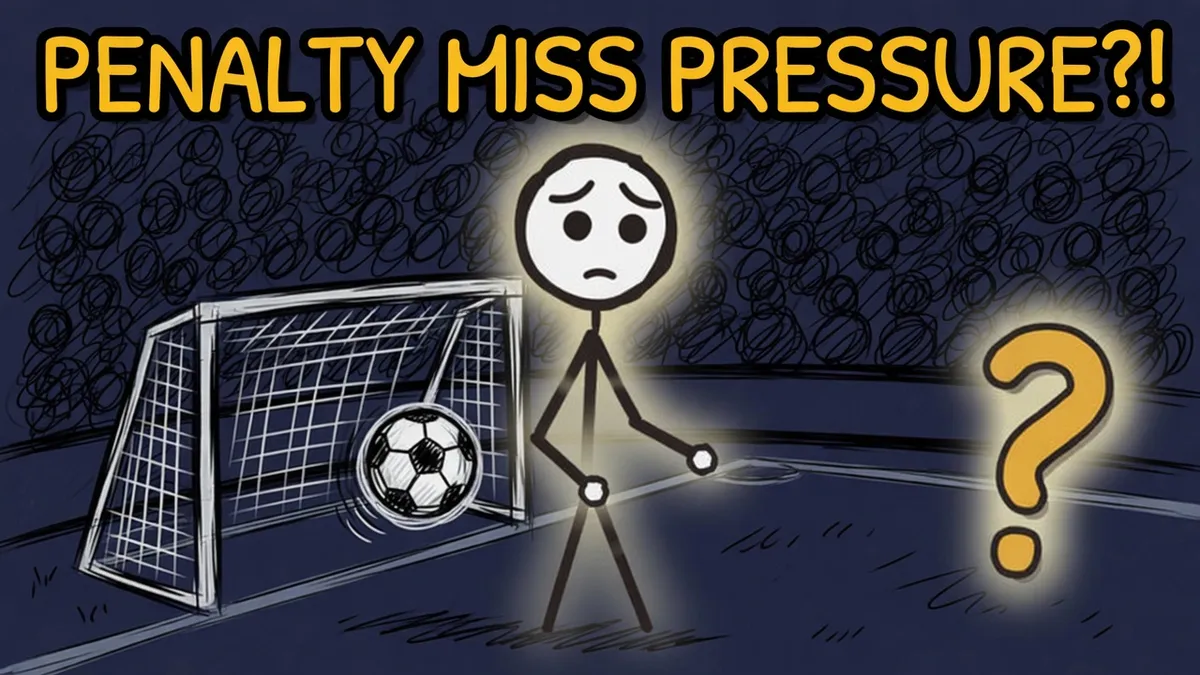
Here is the part that should bother you. The striker walking up to take the penalty has done this exact thing more times than he can count. In training, alone, with nothing riding on it, he buries it in the corner nine or ten times out of ten, half asleep. His body knows this movement the way yours knows a staircase. And yet, with a nation holding its breath, that same body sends the ball over the bar. Not because his skill vanished. Because, for one terrible second, he started paying attention to it.
01 · The wordChoking is not "bottling it"
Start by throwing out the word we usually reach for. When someone misses the big one, we say they “bottled it”, which is a tidy way of saying they lacked the nerve, and quietly blames them for it. It also explains nothing. The player who misses is not the one who cared least. He is very often the one who cared most, who wanted it so badly he tried to take charge of a movement that works best when nobody is driving.
That is the first thing sport psychologists will tell you: choking is a specific failure mode, not a character flaw. It is the sudden collapse of a well-drilled skill in exactly the moment it matters, and it has causes you can name, study, and to some extent train against. The interesting question is not “why was he weak.” It is “what, mechanically, went wrong in a body that had this move perfected.”
02 · The mechanismAttention is the thing that breaks it
The leading answer comes from work by Sian Beilock and Thomas Carr, and it is delightfully counterintuitive. A skill you have practised to death becomes proceduralised: it moves out of the slow, deliberate, step-by-step part of your mind and runs as one smooth automatic program, offline, without supervision. Walking. Typing. Taking a penalty you have taken ten thousand times. The whole point of expertise is that you no longer have to think about the parts.
Pressure ruins this by making you self-conscious. Suddenly you are aware of yourself performing, so you start doing the one thing an expert should never do: you begin monitoring and steering each piece of the movement consciously, planting foot here, hips like this, follow through just so. And attending to an automated skill at that step-by-step level jams it. You regress toward the clumsy, deliberate execution of a beginner. Beilock and Carr showed the flip side too: expert golfers actually putt better when a distraction pulls their attention off the mechanics, and experts can barely remember the details of individual putts, because those details were never running through conscious memory in the first place. The skill lives below thought, and thought is what wrecks it.
There is a rival account worth knowing, called distraction theory: pressure crowds your mind with worry and what-ifs, and those thoughts eat the mental bandwidth the task needs. That one fits working-memory tasks like mental arithmetic well. For a drilled physical action like a penalty, the evidence leans toward explicit monitoring, though honestly both can be running at once. The unifying culprit is the same: your conscious mind, uninvited, putting its hands on the controls.
03 · The cruel twistThink "don't miss left", miss left
Now it gets worse, because of a quirk the psychologist Daniel Wegner called the ironic process. When you try hard not to do something, part of your mind has to keep a lookout for the very thing you are avoiding, so it can flag it. That monitor is fine when you have spare attention. Under mental load, it backfires: the lookout for the mistake becomes a pointer toward the mistake.
Tell a golfer under pressure "don't overshoot the hole" and they overshoot. Have a player think "whatever you do, don't miss to the left" and, when the load is high, they miss to the left, sometimes more precisely than if they had never thought it. The mind's autopilot obligingly aims at the one target you told it to avoid.
This is why the internal monologue of a nervous penalty taker, “don’t scuff it, don’t go over, don’t let him read you”, is close to the worst possible soundtrack. Every “don’t” hands the automatic system a bullseye it was supposed to steer clear of.
04 · The evidenceThe scoreboard proves it
None of this would matter if it stayed in the lab, so here is the field data. The sport scientist Geir Jordet and colleagues went through the video of real shootouts, dozens of them, hundreds of kicks, from World Cups, European Championships and the Champions League, and split the penalties by what was at stake. Some kicks were positive: score and you instantly win the shootout. Some were negative: miss and you instantly lose it.
The gap is stark. Players convert the “score to win” kicks at a much higher rate than the “miss and you’re out” kicks, roughly nine in ten against closer to six in ten. Same elite takers, same twelve yards, same size of goal. The only thing that changed was the weight pressing on the moment, and the weight alone knocked a big chunk off their accuracy. (The precise percentages wobble a little between studies and datasets, but the direction never does.)
Jordet also caught how the pressure leaks out. On those dreaded negative kicks, players were more likely to turn their gaze away from the goalkeeper and to hurry their whole preparation, snatching at the shot to get it over with. He reads this as avoidance, an attempt to escape an unbearable situation as fast as possible, and it is associated with worse outcomes. The tragedy is that it feels like coping. Looking away and rushing is your nervous system trying to protect you, and it walks you straight into the miss.
05 · The keeper chokes tooWhy diving feels safer than standing still
The man in the gloves has his own glitch, and it is a beauty. When Michael Bar-Eli and colleagues studied 286 top-level penalties, they found something odd. Given where penalties actually go, a keeper who simply stayed in the centre would save more of them, roughly a third of the kicks aimed near the middle, than a keeper who dived. And yet keepers dived left or right about ninety-four percent of the time. They were leaving saves on the table, systematically, at the highest level of the game.
Why? Because of what the researchers call action bias. Diving the wrong way and conceding feels bad, but standing still and watching the ball roll into a corner you could have covered feels humiliating, like you didn’t even try. The pain of a goal conceded through doing nothing is sharper than the pain of a goal conceded through doing something. So keepers do something, almost every time, because inaction that fails is harder to live with than action that fails. It is not the optimal play. It is the play that hurts least to have chosen, which is a very human reason to keep making it.
06 · The fixesHow to get your own hands off the controls
Here is the useful part, and every fix does the same underlying job: it stops your conscious mind from grabbing a skill that runs better without it.
First, a pre-shot routine, the same small sequence every time, which gives your attention a rehearsed track to run on instead of freelancing into panic. Second, the “quiet eye”: a final, steady gaze locked onto the exact spot you are aiming for, rather than letting your eyes drift to the keeper. When Wood and Wilson trained footballers to do precisely this, fix on the target corner, not the goalkeeper, the trained group were more accurate and had about half as many shots saved. Keeping your eyes on the target keeps your attention pointed outward, where it belongs.
Third, an external focus of attention: think about the ball and the corner you want to hit, not about what your standing leg or your ankle is doing. Focusing on the intended effect keeps the movement automatic; focusing on your own body is an engraved invitation to start monitoring it. And fourth, the simplest of all: decide your target before you walk up, and commit. Reacting to the keeper mid-run-up forces last-second changes of direction, and last-second changes are exactly where accuracy falls apart. Pick your spot, ignore the keeper, and let the shot be one clean pre-planned thing rather than an anxious negotiation.
07 · The payoffSo why do they miss?
So, whole and honest: the penalty taker misses not because his skill deserted him and not because he lacked nerve, but because pressure made him take conscious charge of a movement that was only ever going to work on autopilot. He started watching himself kick, and the watching broke the kick. His inner voice handed the automatic system the one target it was meant to avoid. And his own nervous system, trying to help, told him to look away and hurry, which is the surest route to the miss. The keeper opposite him, meanwhile, dives when he should sometimes stand, because standing still and being beaten is the one outcome he cannot stand to choose. Two people, twelve yards apart, each undone by a perfectly human instinct to do something with a moment that mostly needed them to get out of their own way.
Quick questions
What is choking under pressure, exactly?
It is a sudden, involuntary drop in skilled performance in a situation where performing well matters most. The key word is skilled: choking is the failure of a well-practised ability precisely when the stakes rise, so it is different from simply being bad at something. Sport psychologists treat it as a specific, studyable phenomenon with identifiable causes, not as a moral failing or a lack of nerve.
Is choking the same as just 'bottling it'?
No, and the difference matters. 'Bottling it' frames a miss as a lack of courage, which blames the player and explains nothing. The research picture is almost the opposite: the athlete cares intensely and tries harder, and it is that extra conscious effort, aimed at a movement that runs best automatically, that breaks the skill. Choking is a control problem, not a courage problem.
What is explicit monitoring theory?
It is the leading explanation for choking on well-learned motor skills, developed by Sian Beilock and Thomas Carr. A skill you have drilled thousands of times becomes proceduralised: it runs smoothly without step-by-step conscious control. Pressure raises self-consciousness, so you start attending to and steering each part of the movement, and that conscious control disrupts the automatic execution. In effect you regress toward how you moved as a beginner.
What is the distraction theory of choking?
It is the main alternative. On this view, pressure fills your mind with worries and what-ifs, and those thoughts consume the limited attention and working memory the task needs, so performance drops. It fits tasks that lean heavily on working memory, like mental arithmetic. For automated physical skills the evidence leans more toward explicit monitoring, but the two mechanisms are not mutually exclusive and can both be at play.
What is Wegner's ironic process theory?
Daniel Wegner proposed that when you try to suppress a thought or action, part of your mind has to keep monitoring for the very thing you are avoiding, and under mental load that monitoring can tip you into doing it. In motor terms, a golfer told 'don't overshoot' tends to overshoot under pressure, and a player thinking 'don't miss to the left' can steer the miss precisely there. It is the mind's autopilot pointed at exactly the wrong target.
Do penalty takers really miss more when the stakes are higher?
Yes. Analysing international and club shootouts, Geir Jordet and colleagues found conversion is far higher on kicks where scoring immediately wins the shootout than on kicks where missing immediately loses it, roughly nine in ten versus closer to six in ten. Same players, same distance, the difference is the psychological weight of the moment. Exact figures vary between datasets, but the direction is consistent.
Why do stressed penalty takers look away from the goalkeeper?
Jordet calls it avoidance behaviour, and links it to escaping the stress of the moment. Facing a kick where a miss means defeat, players are more likely to turn away from the keeper and hurry their preparation, essentially trying to get the ordeal over with. The problem is that rushing and averting your gaze are linked to worse outcomes, so the coping response quietly makes the miss more likely.
Should a goalkeeper dive or stay in the centre for a penalty?
Statistically, staying centre is underused. In Bar-Eli and colleagues' analysis of 286 elite penalties, keepers stopped about a third of the kicks aimed near the middle when they held their ground, a higher save rate than diving either way, yet they dived roughly 94% of the time. Diving is not clearly the smart play so much as the expected one, which is a bias rather than an optimum.
What is action bias in goalkeepers?
It is the tendency to do something rather than nothing, even when doing nothing works better, because inaction that fails feels worse than action that fails. A keeper who dives and concedes feels they at least tried; a keeper who stands still and concedes feels foolish. So keepers dive almost every time, even though the numbers favour staying centre more often than they use it.
Does choking mean an athlete lacks mental toughness?
Not in any simple way. Choking strikes elite, highly skilled, highly motivated performers, often because they care so much and try to take conscious control. It is better understood as a mismatch between how a skill is best run (automatically) and what pressure makes you do (monitor it), than as a deficit of toughness. That is also why the fixes are technical routines, not just being told to 'be brave'.
What actually helps you not choke on a penalty?
The evidence points to a consistent pre-shot routine, a stable 'quiet eye' gaze fixed on your target rather than the keeper, an external focus of attention (on the ball and the corner you want, not your own legs), and deciding your target before you walk up and committing to it. All of these do the same job: they stop you from consciously micromanaging a movement your body already knows how to make.
What is the 'quiet eye' and does training it work?
The quiet eye is a final, steady fixation on your intended target just before you act. Wood and Wilson trained footballers to fix their gaze on the scoring zone rather than let it drift to the keeper, and the trained group were more accurate and had about half as many shots saved as a control group. Keeping the eyes on the target seems to keep attention external and the movement automatic.
Why does deciding where to shoot in advance help?
Because the alternative, waiting to react to the keeper mid-run-up, forces last-moment changes that reduce accuracy. Picking a target before you start and committing to it (a 'keeper-independent' strategy) keeps the movement one clean, pre-planned action rather than an anxious negotiation with the keeper. Late alterations of direction are exactly when precision falls apart.
Does choking happen outside sport?
Yes. The same mechanism shows up in music performance, public speaking, high-stakes exams and job interviews: an overtrained skill degrades because pressure makes you monitor and control it consciously, or floods your working memory with worry. Penalties are just an unusually clean, public laboratory for it, one kick, one keeper, a whole nation watching, and nowhere to hide.
Take the quiz on this
A quick 4-question check on what you just read. Get them right to earn XP: no points for just scrolling.
Our sources 11 checked
// every claim on this page was checked before it went up