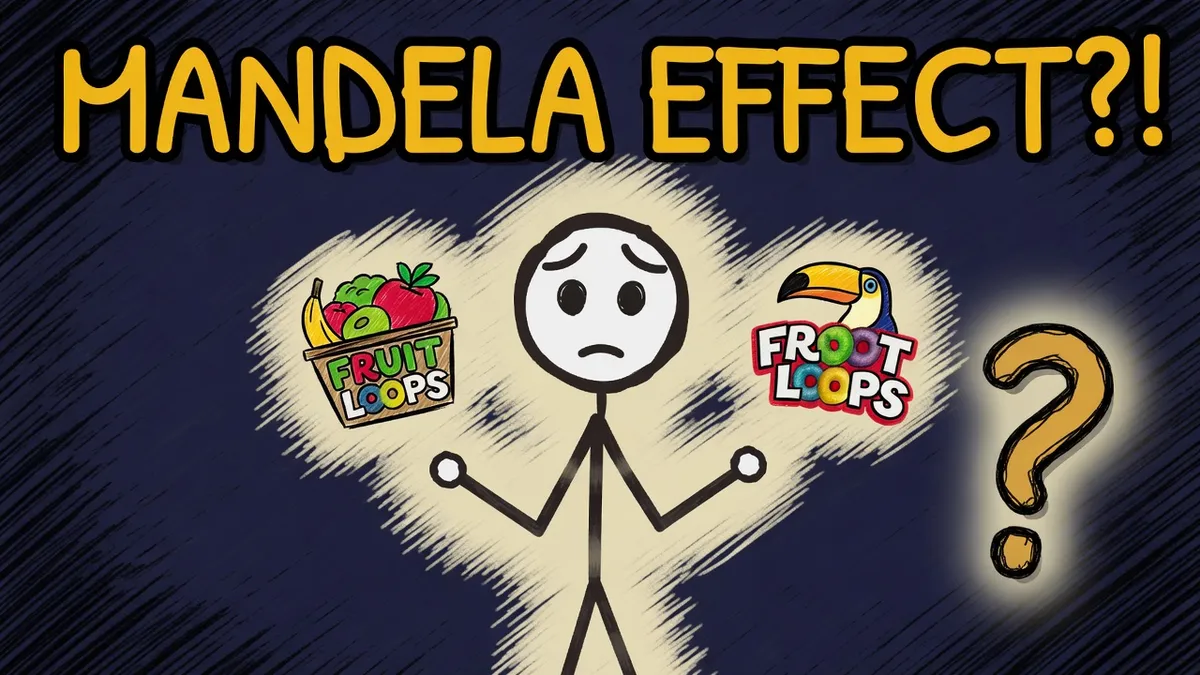
Here is something genuinely unsettling. Ask around, and a surprising number of people will tell you, with total confidence, that Nelson Mandela died in prison sometime in the 1980s. They remember the news coverage. Some remember his widow's speech. It is a clear, detailed memory. It is also completely wrong: Mandela walked free in 1990, became president, and died a very old man at home in 2013. The strange part is not that one person got it wrong. It is that so many people got it wrong in exactly the same way.
01 · The nameA death that never happened
The phenomenon got its name around 2009, when a researcher called Fiona Broome discovered she was not the only one carrying this false memory of Mandela’s death. Thousands of people shared it, down to similar details. Broome, who came at this from the paranormal side, floated a fun and dramatic explanation: maybe these people had slipped in from a parallel universe where Mandela really had died in prison. It is a great story. It is almost certainly not what is happening. But the name stuck, and “the Mandela effect” now covers any case where a crowd shares the same confident, false memory.
02 · The everyday examplesThe monocle that was never there
Once you know the pattern, you see it everywhere. The Monopoly man, Rich Uncle Pennybags, is remembered by huge numbers of people as wearing a monocle. He has never worn one. C-3PO from Star Wars is remembered as solid gold, when one of his lower legs is silver. Millions are certain the children’s books were the “Berenstein Bears”, when the spine has always read Berenstain. And nearly everyone can quote Darth Vader saying “Luke, I am your father”, a line that does not exist. What he actually says is “No, I am your father.” These are not obscure trivia slips. They are shared, specific, and stubborn.
03 · The boring, true explanationYour memory is not a recording
Here is the thing your brain would rather you did not know: memory is not a video file you play back. It is a reconstruction you rebuild from scratch every time, out of fragments, general knowledge, and expectation. You store the gist of a thing, not the pixels, and when you recall it, you regenerate the missing details on the fly. Usually that is a feature. It lets you remember the meaning of ten thousand experiences without a warehouse in your skull. But it means every memory is a fresh guess, and a guess can be wrong while feeling perfect. A cartoon tycoon “should” have a monocle, so your reconstruction quietly adds one.
04 · How to plant a memory on purposeThe word that was never on the list
We know memory works this way because we can break it in a lab, on demand. In the classic experiment, you read someone a list of related words: bed, rest, tired, night, dream, pillow. Then you ask what was on the list. Most people will confidently say “sleep” was there. It never was. Their brain stored the theme, and “sleep” fits the theme so well that it got filed as a real memory. Other studies have gone much further, convincing adults they were once lost in a shopping mall as a child, an event that never occurred, complete with invented details. The false memories are as vivid as the true ones. That is the whole problem.
In 2022, researchers showed people famous images and found that strangers do not just misremember, they misremember the identical wrong detail. We get it wrong the same way, as if our brains are running the same faulty autocorrect.
05 · Why we all break in the same placeThe visual Mandela effect
This is the part that makes the Mandela effect more than a pub-quiz curiosity. A 2022 study tested 40 well-known images on around 100 people and found 7 that produced a consistent, shared false memory: C-3PO, the Monopoly man, Pikachu, Curious George, the Fruit of the Loom logo, the Volkswagen badge, and Waldo. People did not just get these wrong, they got them wrong in the same specific way, and even drew the same errors from memory. The researchers checked whether it came down to where people looked, or how often they had seen the images. It did not. Something about these particular pictures nudges independent minds toward the identical reconstruction. Nobody yet fully knows why those images and not others.
06 · The internet as an amplifierA mistake, repeated until it is real
Now add the modern accelerant. False memories are contagious: hear someone else describe an event and their version can overwrite yours, and repeated misinformation steadily hardens into something that feels remembered. The internet is a machine for exactly this. One person posts “remember the Berenstein Bears?”, a thousand people nod, and the shared confidence makes the error feel like proof. The very act of naming and discussing a Mandela effect spreads it. The truth does not stand a chance against ten thousand people agreeing, warmly, on the wrong thing.
07 · The payoffSo why does it happen?
Not because reality is glitching. It happens because memory was never a recording in the first place: it is a story your brain rewrites every time you tell it, patched with what should be true and coloured by everyone else’s telling. When millions of similar brains patch the same gap the same way, and then compare notes online, a false memory can become a shared fact. The parallel-universe theory is the least likely explanation on the table. The real one is quietly more astonishing: the past you are so sure of is being reconstructed, right now, and you would never feel the seams.
The animated version
Same answer, told as a little animated story with the strange little stickman acting it out. Dry, quick, and, obviously, correct.
Quick questions
What is the Mandela effect in simple terms?
It is when a large group of people share the same false memory: they all confidently remember something one way, but the real record says otherwise. The name comes from many people 'remembering' Nelson Mandela dying in prison in the 1980s, when he actually died in 2013.
Who coined the term Mandela effect?
The paranormal researcher Fiona Broome, around 2009, after discovering that she and many others shared a vivid but false memory of Mandela's death in prison. She originally framed it as possible evidence of parallel realities.
Is the Mandela effect real?
The shared false memories are absolutely real and measurable. What is not supported is the supernatural explanation. Psychologists explain it with well-understood memory science, not alternate timelines.
What are the most famous Mandela effect examples?
Common ones include the Monopoly man's non-existent monocle, C-3PO being remembered as fully gold (one leg is silver), the Berenstain Bears misremembered as 'Berenstein', and the line 'Luke, I am your father', which is actually 'No, I am your father'.
Does the Star Wars line 'Luke, I am your father' really not exist?
Correct. Darth Vader's actual line is 'No, I am your father'. The misquote is so widely repeated that most people are certain they heard the wrong version in the film. It is a clean example of a memory rewritten by repetition.
What is a false memory?
A memory of something that did not happen, or a real memory distorted by later information. False memories usually feel exactly as vivid and certain as accurate ones, which is why you cannot spot them from the inside.
Can scientists create false memories on purpose?
Yes, routinely. The Deese-Roediger-McDermott task shows people a list of related words (bed, rest, tired, dream) and most will later swear the word 'sleep' was on it, even though it never appeared. Other studies have implanted whole fake childhood events.
Why do so many people misremember the same thing?
Because we share brains built the same way, and we share culture. When an image or phrase invites the same reconstruction error (a face 'should' have a monocle, a mascot 'should' have a tail), independent minds tend to make the identical mistake, then reinforce it online.
Is the Mandela effect evidence of parallel universes?
No. That was the original playful framing, but there is no evidence for it, and it is not needed. Everything the Mandela effect describes is explained by how normal memory reconstructs and how false beliefs spread. When a simple explanation and an extraordinary one both fit, the simple one wins.
Does the Mandela effect mean my memory is broken?
Not at all. It means your memory works like everyone else's: efficiently, by storing meaning and rebuilding detail. That system is brilliant for daily life and occasionally wrong in ways that feel completely convincing.
How can I tell if a memory is false?
You often cannot, from confidence alone. The only reliable check is external evidence: a photo, a recording, a contemporaneous document. Vividness and certainty are not proof, false memories come with both.
Is the Mandela effect the same as the placebo effect or déjà vu?
No. They are separate quirks. Déjà vu is a false sense of familiarity for a new moment, and the placebo effect is a real change from expectation. The Mandela effect is specifically a shared, confident memory of a false detail.
Take the quiz on this
A quick 4-question check on what you just read. Get them right to earn XP: no points for just scrolling.
Our sources 8 checked
// every claim on this page was checked before it went up