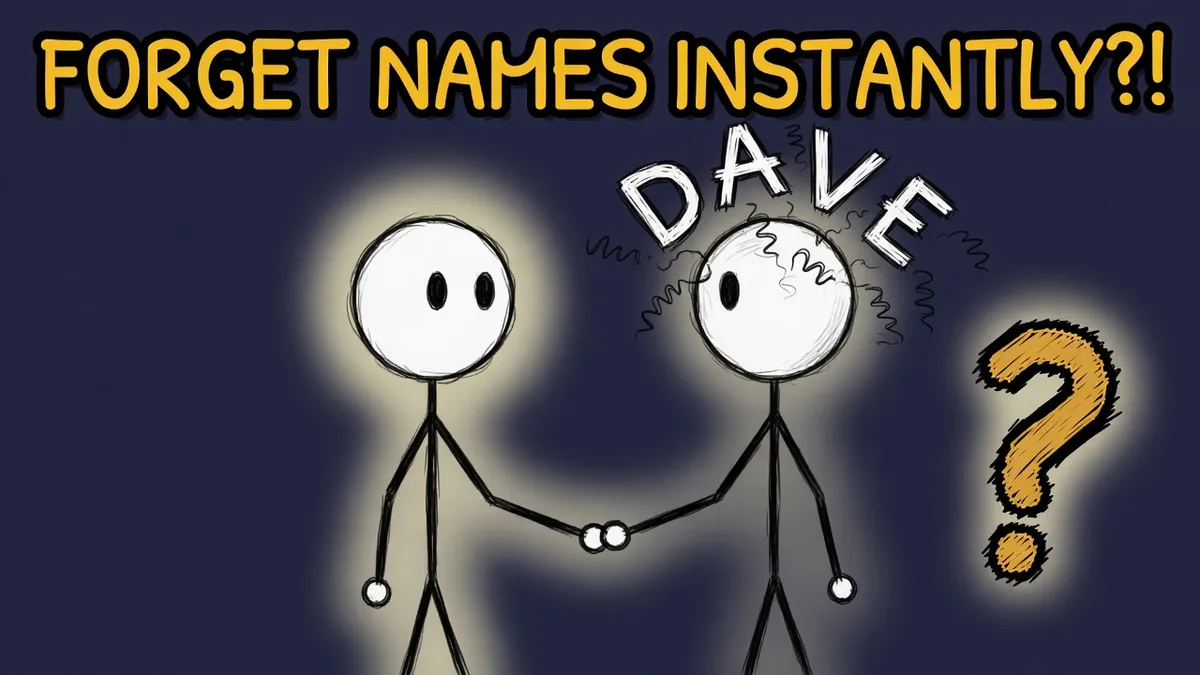
Here is a small daily humiliation you can set your watch by. Someone puts out a hand, says "hi, I'm David," and you say "great to meet you," and in the two seconds it takes to release the handshake, David is gone. Not the face. Not the firm grip or the nice jacket. Just the one thing you needed: the name. It feels like a personal failing, a flaw in your character even. It is neither. It is the predictable result of asking your memory to do the single hardest thing it is ever asked to do: hold onto something that means absolutely nothing.
01 · The paradoxBaker the job, Baker the name
The cleanest way into this is a demonstration so tidy it has its own name: the Baker/baker paradox. In a 1987 study, researchers taught people faces paired with information. Some were told a face’s occupation, “this man is a baker.” Others were told the same face’s surname, “this man is Mr Baker.” Identical word. Identical sound. Later, people were far better at recalling that the man was a baker than that his name was Baker.
Sit with how strange that is. The phonology is the same, the letters are the same, the effort to learn it was the same. The only thing that differs is what the word points to. “Baker” the occupation drops you into a whole warm network of things you already know: flour, ovens, early mornings, the smell of bread, a white apron. Any one of those can lead you back to the word. “Baker” the surname points to nothing. It is a bare label, an arbitrary sound bolted onto a stranger, with no web of meaning to catch it if it falls. And it falls.
02 · The reasonYour brain runs on meaning, and a name has none
That is the whole engine of the problem. Human memory is not a filing cabinet that stores things by how important they are. It is an associative network: things stick in proportion to how many other things they connect to. A fact about someone, that they have two kids, that they fixed your laptop, that they hate coriander, hooks instantly into knowledge you already own, and every hook is another route back to it later.
A name has almost no hooks. “David” does not tell you anything about David. It does not connect to his face, his job, his personality, or anything you know. It is a pointer with no meaning behind it, and meaning is the currency your memory actually trades in. So a name arrives with nothing to grab, and unless you deliberately build it some connections, there is simply nowhere for it to lodge. Forgetting it is not the memory system malfunctioning. It is the memory system working exactly as designed, on an input it was never built to favour.
03 · The chainThe name is the last, weakest link
There is a second reason, and it lives in the machinery of retrieval. In the leading model of how you name a familiar person, developed by Deborah Burke, Donald MacKay and colleagues, recognising someone runs along a chain: you see the face, which activates a “person identity node” (everything you know about them), which finally activates the name. The name sits right at the end of that line, and, crucially, it hangs off the rest by a single connection rather than the dense mesh of links that support meaningful words.
That structure explains the most maddening version of forgetting: the tip of the tongue. You can see the face perfectly, you know they own a spaniel and once lent you a stapler, you can feel the name is right there, and still it will not come. That is the last link failing to fire while everything before it works fine. The model calls this a transmission deficit, and it predicts exactly what surveys find: tip-of-the-tongue moments are overwhelmingly about proper names, because they alone depend on that solitary fragile hop. Everything else in your head has backup routes. A name has one.
04 · The introductionYou were not even listening
Now, a name has to be stored before it can be forgotten, and here is the uncomfortable truth: much of the time, you never stored it at all. The classic culprit has a name too: the next-in-line effect, first shown by Malcolm Brenner in 1973. He had people sit in a circle reading words aloud in turn, then tested their memory. People were reliably worst at remembering the words spoken in roughly the nine seconds before their own turn. Bracing to perform stole the attention needed to take anything in.
An introduction is that experiment, live. Just as the other person says their name, you are not listening: you are rehearsing your own name, deciding whether to shake or wave, worrying about your opening line. Your attention is pointed squarely at yourself at the precise instant theirs is spoken. So the name is not forgotten in the usual sense. It was never encoded, because you were somewhere else. Which is oddly freeing: the fix is not a better memory, it is simply to shut up internally for one second and actually hear the name.
Forgetting a name is not really a memory failure. It is a design consequence. Your brain is a magnificent meaning-finding machine, and a name is the one thing it meets that has been deliberately stripped of meaning. You are not bad at names. Names are bad for brains.
05 · The ageingWhy names go first
If you have watched an older relative reach for a name and land on “oh, you know, thingummy,” you have seen the model’s most reliable prediction. Ageing gradually weakens the connections that carry a word from concept to sound, and because proper names already depend on a single weak link, they are hit first and hardest. The general finding is that older adults report more tip-of-the-tongue states, and that those states are especially likely to be about someone’s name rather than an ordinary word.
It is worth being measured here, because it is a source of real anxiety. This is normal, everyday word-finding difficulty, not in itself a sign of dementia: healthy people of all ages blank on names, and the age-related increase is a shift in frequency, not a cliff. The mechanism is mundane and almost reassuring: the same solitary link that makes names fragile at twenty just gets a little more fragile each decade. The name is not lost. The last connection to it has simply thinned.
06 · The fixesWhat actually helps
The good news is that everything above tells you exactly how to fight back: you have to manufacture the meaning and the connections that a name does not come with. The simplest, best-supported move is to say it aloud immediately: “nice to meet you, Sarah.” That does two jobs at once, it forces you to actually encode the name, and hearing yourself say it is an instant rehearsal. Use it once or twice more in the conversation and you have spaced that rehearsal out, quietly recruiting the spacing effect that underlies most durable learning.
For names that really matter, the heavier tool is the face-name mnemonic: pick one distinctive feature of the face, turn the name into a vivid concrete image, and stitch them together in an absurd little scene (Sarah on a safari, a Mr Bell with a bell for a nose). Trials show this genuinely improves recall, even in people with mild cognitive impairment. The honest caveat is that it takes effort and practice, and no method is foolproof: you are working against the grain of a system built for meaning. But that is precisely the point. Every one of these tricks does the same thing, it smuggles hooks onto a word that arrived with none.
07 · The payoffSo why do names vanish?
Because a name is the hardest possible request you can make of a machine built for meaning. It connects to nothing, so it has no hooks. It sits at the end of a retrieval chain, dangling from a single weak link, which is why it lands on the tip of your tongue while everything else about the person comes freely. And you usually failed to store it in the first place, because you were too busy bracing to say your own name to hear theirs.
So the next time David evaporates before you have let go of his hand, extend yourself some grace. You did not fail. Your brain did exactly what it is extraordinary at, hunting for meaning, and found none, because there was none to find. Forgetting a name is not a bug in a memory built for meaning. It is the shadow that memory casts. The cure is not to try harder to remember. It is to give the poor, meaningless little word something to hold onto.
Quick questions
Why do I forget someone's name right after they tell me?
Usually because you never really encoded it. In the moment of an introduction you are often distracted, frequently by rehearsing your own name and what to say next, so the name is heard but not stored. It is not a failure of your memory so much as a failure of attention at the one second that mattered.
What is the Baker-baker paradox?
It is a classic demonstration that names are uniquely hard. If you are told a man's occupation is baker, you tend to remember it. If you are told his surname is Baker, the identical word, you often forget it. The job links to a rich web of knowledge (bread, ovens, aprons), while the name is an arbitrary label that links to nothing, so it has no hooks to hang on.
Does forgetting names mean I have a bad memory?
Almost certainly not. Proper names are the hardest thing memory is routinely asked to retrieve, even for people with otherwise excellent memories, because of how they are structured in the brain. Forgetting a name is closer to a design consequence than a personal defect.
Why are names harder to remember than faces or facts?
Because a name is a pure label with no meaning attached. Faces and facts connect to networks of related information, appearance, personality, context, that give many routes back to them. A name connects to almost nothing, so there is usually only one fragile path to it, and if that path is weak the name is simply gone.
Why is a name so often on the tip of my tongue?
Because in the leading model, the name node sits at the end of the retrieval chain and is joined to the rest by a single, easily weakened connection. You can reach the person (you know their face, their job, their dog) but the last hop to the name fails to fire, leaving you stranded one step short. That gap is the tip-of-the-tongue state, and names are its most common victims.
Why do names get harder to remember as you get older?
Ageing weakens the connections that carry a name from concept to sound, and this hits proper names disproportionately because they already rely on a single weak link. Older adults report more tip-of-the-tongue moments, and those moments are especially likely to be about someone's name.
What is the fastest way to remember a name?
Repeat it aloud immediately ("nice to meet you, Sarah") and use it once or twice during the conversation. Saying it forces you to encode it and gives you an instant, spaced rehearsal. It is the simplest evidence-supported step, though no trick is foolproof.
Do memory tricks for names actually work?
The best-studied one, the face-name mnemonic (pick a distinctive facial feature, turn the name into a vivid image, and link them in an absurd mental scene) does improve recall in trials, even in people with mild cognitive impairment. The honest caveat is that it takes real effort and practice, so it works but it is not free.
Why can I remember someone's face but not their name?
Because they are stored differently. Recognising a face is a matching task with many cues, and it lights up rich associated knowledge about the person. Producing their name is a single retrieval down one weak pathway. You can hold everything about a person and still lose the one arbitrary sound that labels them.
Does anxiety make you forget names?
It can, because it eats the attention you need to encode the name. If you are nervous about your own introduction, or self-conscious meeting someone, your focus is on yourself at the exact moment their name is spoken, so it never gets stored. Calm, present attention at the introduction is worth more than any trick.
Is being bad with names common?
Very. It is one of the most widely shared memory complaints, and it shows up across ages and cultures precisely because it stems from how names are built rather than from any individual weakness. If you struggle with names, you are in the overwhelming majority.
Why do I remember details about a person but forget their name?
Because details are meaningful and names are not. That they love hiking, have two kids, or fixed your laptop all connect to knowledge you already hold, so they encode easily and give you many ways back. The name has no such connections, so it is the first thing to slip and the last thing to return.
Take the quiz on this
A quick 4-question check on what you just read. Get them right to earn XP: no points for just scrolling.
Our sources 7 checked
// every claim on this page was checked before it went up