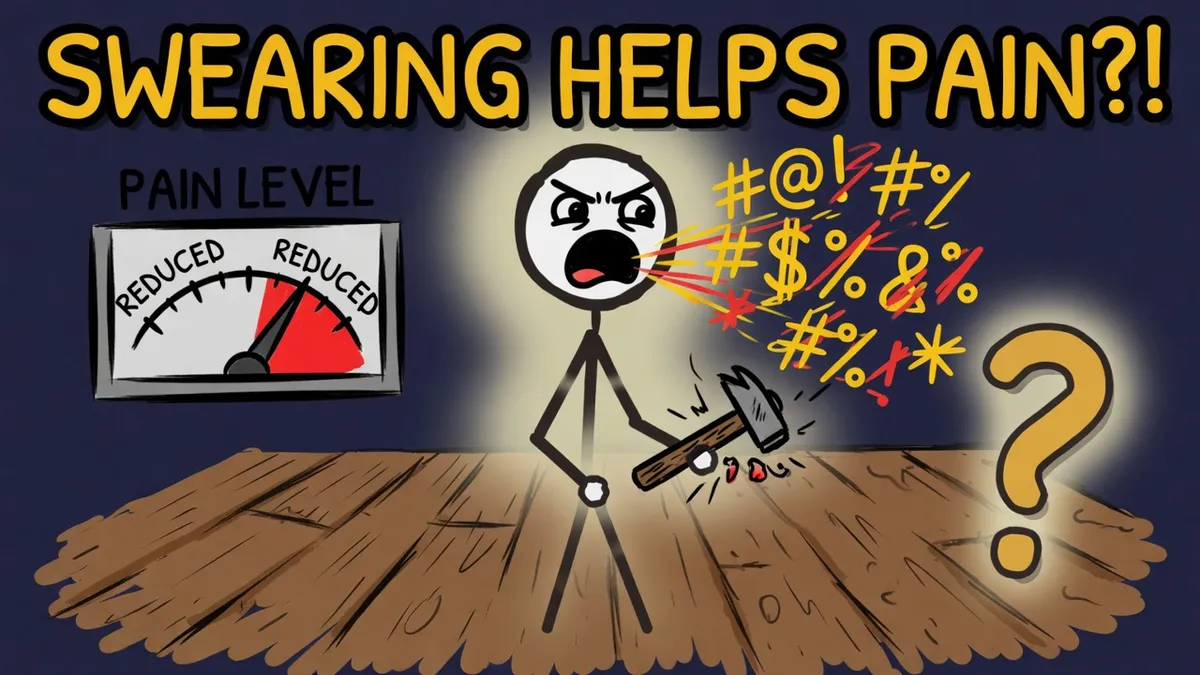
We all do it. You stub your toe on the corner of the bed, you slam a finger in a door, and before you've even had a conscious thought, out flies a word you would never dream of using in front of your grandmother. It's completely automatic. And it feels like it's helping, like the word itself is doing something. Here's the genuinely wonderful part: it is. A well-timed swear really does dull pain, and we can prove it in a lab.
01 · The testA hand, a bucket of ice, and one word
To pin the effect down, researchers ran a beautifully simple experiment. Volunteers plunged one hand into ice-cold water and held it there as long as they could bear, a classic, safe way to create real, steady pain in a controlled setting. While they did it, each person repeated a single word over and over: half the time a neutral word, half the time a swear word of their choice. Same hand, same water, same person: the only thing that changed was the word coming out of their mouth.
02 · The resultThe bad word acted like a painkiller
The results were startlingly clear. When people were swearing, they kept a hand in that freezing water noticeably longer and rated the pain as less intense. In a 2020 replication of the effect, swearing raised how long people could tolerate the cold by about a third, from roughly 56 seconds to 74, and pushed back the point where pain first kicked in by a similar margin. The bad word was, measurably, behaving like a mild painkiller. And in case this all sounds like a joke, it isn’t: it’s genuine, peer-reviewed research, first published in the journal NeuroReport.
03 · Not just a distractionIt changes your body, not only your mind
The easy assumption is that swearing simply distracts you, takes your mind off the pain. But it turns out to be more physical and more interesting than that. When people swore, it didn’t just occupy their thoughts; their heart rates went up. That’s the tell. Something was changing inside the body, not merely inside the attention. A distraction doesn’t raise your pulse. A threat response does.
Swearing seems to work like a tiny act of aggression, and your body answers it the way it answers danger, by quietly reaching for its own painkillers.
04 · The mechanismFlipping an ancient switch
Here’s the leading explanation. A good curse behaves like a small burst of aggression, and your body reacts to it as if it were a threat, a little jolt of the fight-or-flight response, which is exactly why the heart rate climbs. And that stress response comes with a very handy side effect. When your body thinks you might be in danger, it releases its own natural painkillers, so that pain doesn’t stop you fighting or fleeing. Swearing appears to flip that ancient switch. Researchers call it stress-induced analgesia, though it’s worth saying the precise mechanism is still being worked out, and this is the best current account rather than the final word.
05 · The taboo testWhy "twizpipe" does nothing
This is where it gets really clever. If swearing worked just by making a sharp, emotional sound, then any punchy word ought to do the job. It doesn’t. Researchers tested this directly by inventing brand-new, harmless nonsense words, twizpipe and fouch, words engineered to sound emotional or funny. People rated them as more emotional and more amusing than a neutral word. And for pain, they did absolutely nothing. Only genuine, taboo swear words produced relief. The forbidden charge of a real curse, the little transgression of saying it, turns out to be the active ingredient, not the sound.
06 · The catchSave your best swears
Which leads to one last, slightly tragic catch. The effect depends on that jolt, the small shock of a word you don’t normally allow yourself. So if you swear constantly, all day long, the words lose their charge. Studies found that heavy everyday swearers get far less pain relief when they curse: like any painkiller, overuse it and you build a tolerance. The magic is in the restraint.
07 · The payoffBasically medicine (sort of)
So a well-timed swear word isn’t just letting off steam. It’s a small, genuine, built-in painkiller, wired into your stress response and switched on by the sheer taboo of the word, real enough to have earned a share of a scientific prize. It’s modest, it’s temporary, and it only works if you keep it special. So don’t waste your best swears on the little stuff. Ration them. Because you’ll really want them working the next time you meet the corner of a coffee table in the dark.
The animated version
Same answer, told as a little animated story with the strange little stickman acting it out. Dry, quick, and, obviously, correct.
Quick questions
Does swearing really reduce pain?
Yes, it's been tested repeatedly. In cold-water pain experiments, people who repeated a swear word could tolerate the pain markedly longer and rated it as less intense than when they repeated a neutral word. The effect is modest but real and has replicated across studies.
Why does swearing help with pain?
The leading explanation is stress-induced analgesia. Swearing acts like a mild burst of aggression, nudging your body into fight-or-flight, heart rate rises, and that threat response comes bundled with the release of the body's own painkillers, which briefly dulls pain.
Do made-up swear words work for pain?
No. When researchers invented harmless nonsense "swear" words like twizpipe and fouch, they did nothing for pain, even though people found them emotional and funny. Only genuine, taboo swear words produced relief: the forbidden charge of the real word seems to be the active ingredient.
Does swearing work less if you swear a lot?
It seems to. Studies found that people who swear heavily in everyday life get far less pain relief from it. The effect depends on the jolt of transgression, so constant swearing dulls the shock, like building up a tolerance to a painkiller.
Did the swearing-and-pain study win a prize?
It did. The original 2009 research was awarded an Ig Nobel Prize in 2010, the award for science that first makes you laugh, then makes you think. It's genuine, peer-reviewed work published in the journal NeuroReport.
Why does swearing make you feel better?
Partly it's the same stress response that dulls pain: a well-timed curse is a small, sharp emotional release. Swearing lets you vent frustration or anger and briefly discharge the tension of a bad moment, and researchers increasingly treat it as a genuine, cheap coping tool. How much of the relief is body chemistry (the fight-or-flight response and its natural painkillers) versus simply feeling less inhibited for a second isn't fully pinned down, but the venting effect itself is real.
Does swearing make you physically stronger?
Surprisingly, a little. In experiments by the same research team, repeating a swear word boosted grip strength by roughly 8% and short-burst power on an exercise bike by about 4.5% compared with a neutral word. The leading explanation isn't an adrenaline surge but disinhibition: swearing seems to briefly lower your self-restraint so you commit more fully to the effort. The gains are modest, and as with pain, they may fade if you swear all the time.
Why do you automatically swear when you hurt yourself?
Because it's a reflex, not a decision. Sudden pain lights up the brain's emotional and threat circuitry, the limbic system, including the amygdala, faster than deliberate, considered speech, and swearing appears to tap into an ancient defensive reaction: the startled yelp an animal makes when it's suddenly hurt. That's why the word is out of your mouth before you've consciously chosen it.
Is swearing a sign of intelligence?
It's certainly not a sign of a limited vocabulary. Studies have found that people who can reel off more swear words also tend to score higher on general verbal-fluency tests, the reverse of the old idea that people swear because they can't think of better words. But that's a correlation, not proof that cursing makes you smart: fluent people are simply fluent across the board, taboo words included.
Is swearing actually good for you?
In moderation, it seems to carry real upsides: better pain tolerance, a small bump in physical strength, and a quick outlet for stress and frustration. Researchers frame it as a built-in, no-cost coping tool. The recurring catch is the same one that runs through all this work: the benefits depend on the words staying a bit special, so people who swear constantly get far less out of it.
How much does swearing actually increase pain tolerance?
In careful cold-pressor tests, a real swear word can raise pain tolerance and pain threshold by about a third compared with a neutral word. One 2020 replication put tolerance around 74 seconds versus 56 for the neutral word, with a similar lift in how long people waited before calling it painful.
Does swearing help when you are lifting or exercising hard?
Yes, in small controlled trials. Swearing while exerting yourself has been linked to roughly an 8% gain in grip strength and about a 4.5% gain in anaerobic power versus a neutral word. The proposed mechanism is disinhibition rather than a big adrenaline spike.
Take the quiz on this
A quick 4-question check on what you just read. Get them right to earn XP: no points for just scrolling.
Our sources 10 checked
// every claim on this page was checked before it went up