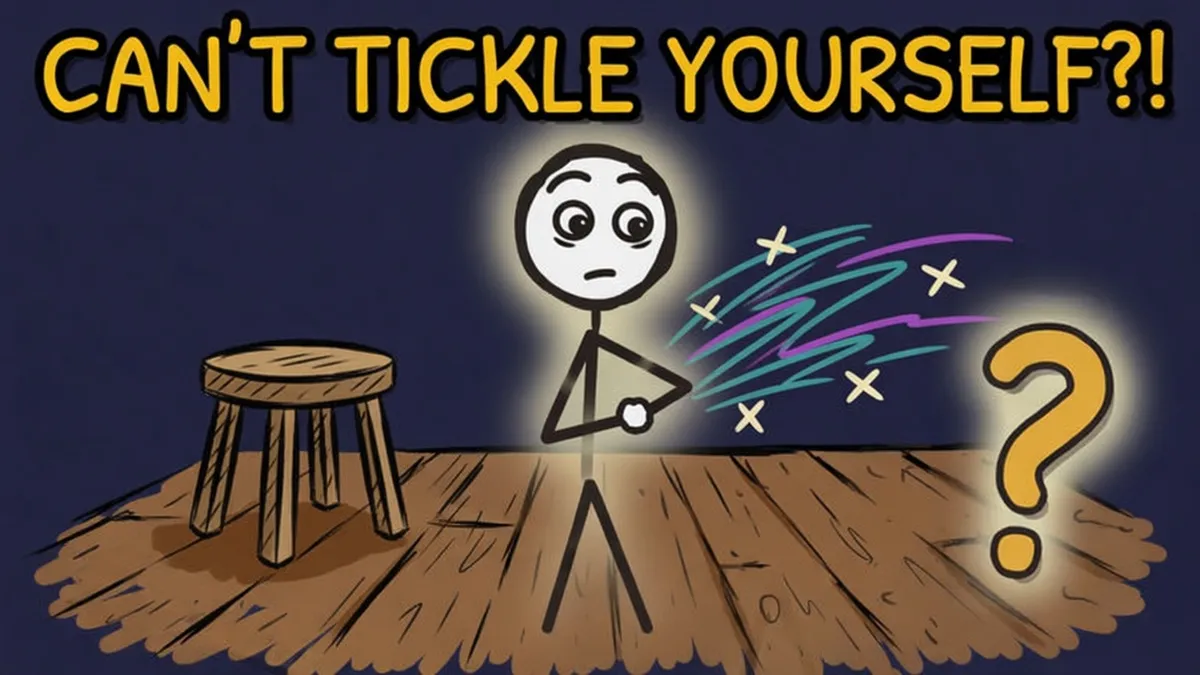
Try it right now. Run your own fingers up your own side. Nothing, a little silly, maybe, but nothing. Now picture someone else doing the exact same thing, and you're already flinching. Same fingers. Same ribs. Completely different result. That gap between the two is one of the most quietly astonishing things your brain does, and it's happening every second of your life without you ever noticing.
01 · The setupSame touch, opposite outcome
The puzzle isn’t really about tickling. It’s about the difference between you doing something and the world doing something to you. Physically, the two touches are identical: the same pressure, the same skin, the same nerves lighting up. Yet one is unbearable and the other is nothing. Whatever separates them isn’t in your fingers. It’s in your head. And it turns out to hinge on a single fact: one of those touches, your brain saw coming.
02 · The predictionYour brain lives half a second ahead
Here’s the strange part. Every time you move, your brain doesn’t just fire the command off to your muscles, it also keeps a private forecast of what that movement is about to feel like. In a real sense you live very slightly in the past, reacting to a model your brain has already made of right now. That forecasting is constant and invisible, and tickling is one of the rare moments it becomes something you can actually feel, or, rather, feel the absence of.
03 · The mechanismThe copy sent to the cerebellum
The trick works like this. When your brain sends a movement command to your muscles, it also sends a quiet duplicate of that command sideways, to the cerebellum, the dense little prediction engine tucked at the back of your skull. Scientists call that duplicate an efference copy. The cerebellum uses it to run a fast, private simulation of your own body, working out a fraction of a second ahead of time exactly what the movement is about to feel like: the where, the when, the how much.
04 · The cancellationTurned down before you feel it
So picture your hand creeping toward your ribs. Before it even lands, your cerebellum has already forecast the touch. When the real touch arrives, your brain compares its prediction against reality. They match perfectly, and it does something clever: it turns the sensation down. Relax, it says. It’s only us. The tickle is cancelled before it can begin. This is called sensory attenuation, and it isn’t unique to tickling. It’s the same reason your own voice sounds quieter to you than to everyone else, and the reason you can walk without the whole world juddering with every footstep. Your brain is constantly subtracting you, from you.
05 · The pointWhy muting yourself is survival
And this isn’t a party trick, it’s essential. You are touching things constantly: your clothes, your hair, your own skin, the chair beneath you. If every one of those sensations screamed for attention, you’d be overwhelmed in seconds. So your brain mutes the predictable, the self-made, the boring, precisely so that the things you didn’t predict can cut straight through. A spider on your neck. A hand on your shoulder. A tickle is simply what an un-muted touch feels like: a sensation that got flagged as a genuine surprise. It’s also, quietly, how you tell where you end and the world begins, every sensation tagged, instantly, as either me or not me.
If a tickle is just an un-muted touch, then you should be able to bring it back by breaking the prediction. Scientists did exactly that, with a robot.
06 · The proofThe robot that broke the trick
In a wonderfully strange experiment, people moved one hand on a lever while a robot arm stroked their other palm. Move it and get stroked at the same instant, and there was no tickle at all. You saw it coming. But then researchers added a tiny delay between the movement and the touch, and the tickle came creeping back. The longer the delay, the more it tickled. Push it out to around two-tenths of a second and people could tickle themselves nearly as much as a stranger could. Nothing about the physical stroke changed, only the timing. Your prediction no longer matched what actually happened, and the sensation slipped through. (Twisting the direction of the stroke seemed to do the same in the original work, though later studies are less sure that alone is enough. It’s the timing that’s rock-solid.)
07 · The exceptionThe people who can
The rule is almost perfect, but “almost” is the interesting word. When the brain’s prediction system runs a little imprecisely, some of that self-generated sensation stops getting cancelled. Research has found that certain people can, in fact, tickle themselves: some individuals with schizophrenia, and healthy people who score highly on schizophrenia-like personality traits. The leading explanation is that their internal forecast of their own actions is slightly off, so more of the touch leaks through un-muted. It’s a hedge worth keeping: the science here points strongly in one direction rather than being fully closed, but it’s telling that the exception traces back to the very same predict-and-cancel machinery.
08 · The two ticklesThe itch you can do, and the one you can't
There’s a wrinkle worth knowing, and psychologists spotted it as far back as 1897. There are actually two kinds of tickle. The first, knismesis, is the light, feathery, faintly maddening kind, a stray hair on your arm, a phantom insect, and you can absolutely do it to yourself; it’s closer to an itch than to laughter. The second, gargalesis, is the real event: the deep, writhing, gasping-for-air tickle that only ignites when someone else’s hands are involved. Everything in this piece, the prediction, the cancellation, the robot, is about that second kind. The gentle self-tickle survives precisely because it was never much of a surprise to begin with. It’s the helpless, laughing kind, the one that needs the shock of another person, that your own brain quietly refuses to hand you.
09 · The payoffSo why can't you tickle yourself?
Because a tickle is a prediction error, and you are the one thing in the universe you can never fail to predict. Every movement you make arrives with a forecast attached, and your brain quietly deletes everything that forecast got right, saving your attention for everything it didn’t. It’s the same reason you can’t feel your tongue resting in your mouth until, annoyingly, someone mentions it, or notice your own constant blinking. You are, in the most literal sense, completely un-prankable, by yourself, anyway. No matter how sneaky you are, the one person who already knows exactly what you’re about to do is standing right there behind your eyes.
The animated version
Same answer, told as a little animated story with the strange little stickman acting it out. Dry, quick, and, obviously, correct.
Quick questions
Why can't I tickle myself but someone else can?
Because your brain predicts your own movements and mutes the sensations they cause. When you reach for your own ribs, your cerebellum forecasts the exact touch and cancels it out. Someone else's hand is unpredictable, so nothing gets cancelled, and the full, un-muted sensation lands as a tickle.
What is an efference copy?
It's a duplicate of a motor command. Every time your brain tells your muscles to move, it also sends a copy of that instruction to the cerebellum. The cerebellum uses it to predict, a fraction of a second ahead, what the movement will feel like, which lets it filter out the expected, self-produced sensation before you consciously notice it.
Can you trick your brain into tickling yourself?
Yes, in the lab. In a well-known experiment, people moved one hand to control a robot arm that stroked their other palm. With no delay there was no tickle, but adding a tiny lag (up to about two-tenths of a second) brought it back, and the longer the delay, the more ticklish it felt. Breaking the timing breaks the prediction.
Why doesn't my own touch feel as strong as someone else's?
It's called sensory attenuation. Your brain predicts the consequences of your own actions and 'explains away' most of the resulting sensation, so self-generated touch, sound, and even your own voice feel weaker than the identical thing produced by someone else. Tickling is just the most dramatic example.
Can anyone tickle themselves?
Almost no one can, but the reflex isn't perfectly universal. Research has found that some people with schizophrenia, and healthy people who score highly on schizophrenia-like personality traits, are better able to tickle themselves. The leading idea is that their prediction-and-cancellation system is a little less precise, so more of the self-generated sensation slips through.
What are the two types of tickling?
Two, and psychologists named them all the way back in 1897: knismesis and gargalesis. Knismesis is the light, feathery, faintly itchy kind, a stray hair on your arm, a bug you can't see, and you can do it to yourself just fine. Gargalesis is the intense, squirming, can't-breathe kind that only fires when someone else does it. The tickle you can't reproduce on yourself is specifically the second one.
Why does being tickled make you laugh if it doesn't even feel good?
Oddly, the laugh isn't a verdict that it's funny. Tickle-laughter is acoustically different from laughing at a joke and involves far less vocal control, it behaves more like a reflex than an opinion. The leading idea is that it's a social, playful signal with deep evolutionary roots (chimps and other apes do a version of it too), which is exactly why you can be helpless with laughter and genuinely wish it would stop at the same time.
Why are feet so ticklish?
Feet are packed with nerve endings sitting very close to the surface, one often-quoted figure is around 8,000 in a single foot, plus touch-sensitive receptors called Meissner's corpuscles that fire for the faintest contact. The best guess is that a body part this exposed and this vital for standing and fleeing benefits from a hair-trigger alarm system. (The exact nerve count varies with how you count, so treat 8,000 as a ballpark, not gospel.)
Are animals ticklish?
Some clearly are. Great apes laugh when tickled, a breathy, panting version of ours. And in a famous line of experiments starting around 2000, Jaak Panksepp found that rats gently tickled on the nape and belly give off bursts of ultrasonic 50-kHz 'chirps' and come back begging for more. Researchers carefully call these ultrasonic vocalisations rather than 'laughter', but the resemblance to playful human giggling is hard to miss.
Why do some people hate being tickled?
Because being tickled can feel a lot like a loss of control, and a laughing face isn't the same as a happy one. Research links disliking tickling to anxiety and to the helplessness of being pinned and unable to make it stop, the laughter can be an involuntary reflex, even a kind of submission signal, rather than a sign anyone's enjoying themselves. If someone says stop, the decent move is to believe them.
When do babies become ticklish?
Later, and stranger, than you'd think. Babies react to touch from birth, but a 2015 Goldsmiths study found that under about six months they feel a tickle on their body without linking it to the outside world, cross their little feet over and they still wiggle the foot that was actually touched, not the one nearest your hand. The full social, squirmy, 'that came from you' tickle seems to switch on around six months, as they start mapping their own body onto the space around them.
Is being ticklish genetic?
Possibly a little, but the evidence is thin and mixed, one twin study hinted that identical twins match more closely on ticklishness than fraternal ones, while some researchers see no clear inherited component at all. What's clearer is that ticklishness varies with age (children tend to be more ticklish), with mood, and with how relaxed and playful you feel in the moment. Hold the genetic angle loosely.
Can you be tickled to death?
Not in any documented, reliable way, but tickling has genuinely been used as torture, from ancient China through to the 20th century, precisely because it's overwhelming and leaves no marks. Extreme, prolonged tickling can cause real distress and, in principle, dangerous strain, and the laughter never signals consent. A useful reminder that 'harmless' and 'pleasant' aren't the same word.
Take the quiz on this
A quick 4-question check on what you just read. Get them right to earn XP: no points for just scrolling.
Our sources 12 checked
// every claim on this page was checked before it went up