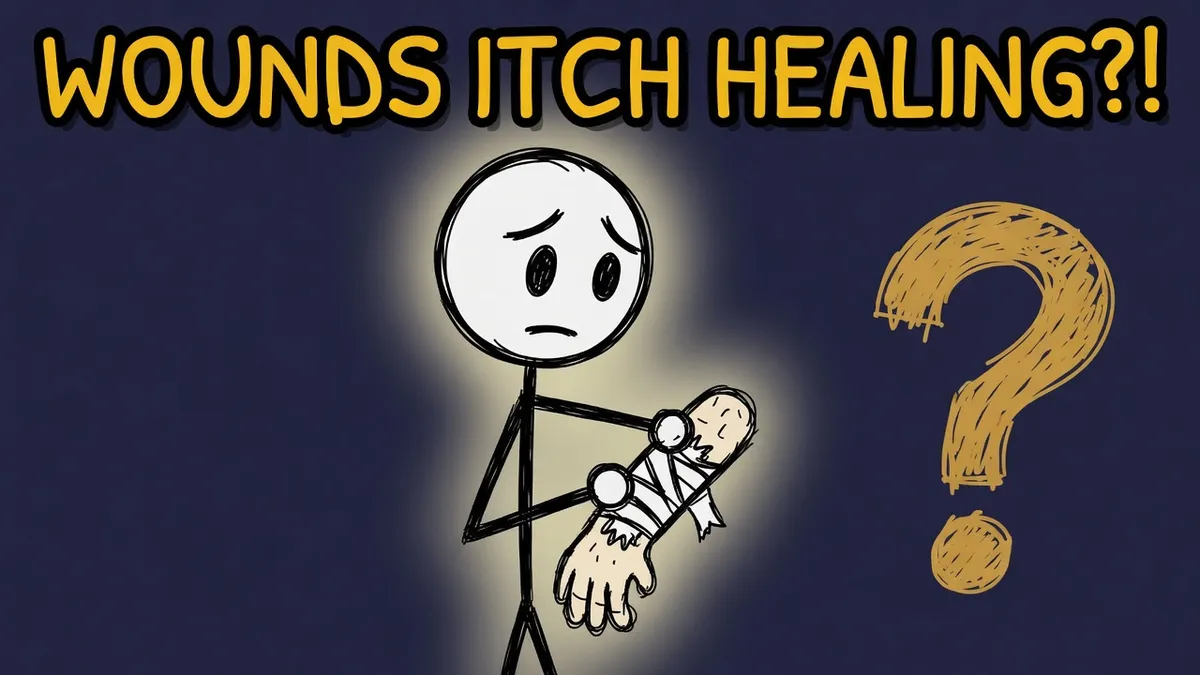
There is a strange turning point in every healing cut. For the first day or two it hurts, which makes sense: something tore, and pain is the appropriate complaint. Then, right around the time it is finally starting to close, the pain fades and is replaced by something almost worse, because you are not allowed to do anything about it. It itches. Maddeningly, insistently, in a spot you must not touch. And here is the reassuring part hidden inside the annoyance: that itch is not a sign something is wrong. It is the sound of the repair crew turning up.
01 · The timelineHealing has four phases, and the itch has a shift
A wound does not just “get better.” It runs through a set sequence, four overlapping phases, and knowing them tells you exactly when the itch will strike. First comes haemostasis, in the opening minutes: the bleeding stops and a clot forms a temporary plug. Then inflammation, over the next days, when immune cells pour in to clean out debris and bacteria (this is the red, swollen, sore stage). Then proliferation, where the real rebuilding happens: new tissue, new blood vessels, new collagen, and the wound starts to close. And finally remodelling, which can grind on for months as the fresh, messy repair is slowly reorganised into a proper scar.
The itch does not show up at random. It belongs mostly to those later phases, the proliferation and remodelling, which is exactly why a wound so often stops hurting and starts itching at the same time. The pain was the injury. The itch is the construction.
02 · The chemicalHistamine, and why it is only part of the story
Start with the usual suspect. Among the cells that flood a healing wound are mast cells, and when they activate they release histamine, the same chemical behind a mosquito bite’s welt or a hay-fever flare. Histamine is a classic itch trigger: it lands on receptors (chiefly H1) sitting on a special class of thin nerve fibres tuned to carry itch, and those fibres start firing. So part of the answer is genuinely that simple. Your wound is marinating in a chemical whose job is, in effect, to make you itch.
But here is where the tidy version breaks down, and it is worth being honest about it. If histamine were the whole story, an antihistamine would switch off the itch, and anyone who has taken one for a healing wound knows it often barely helps. That is because a great deal of wound itch is histamine-independent: it runs through other pathways entirely. Histamine is one loud voice in the room, not the only one. Which brings us to the two things it cannot explain.
03 · The pullNew skin literally tugging itself together
The second driver is mechanical, and it is oddly literal. During the proliferation phase, the wound does not just fill in, it contracts. Specialised cells and freshly laid collagen act like tiny cables, physically hauling the edges of the wound closer together to shrink the gap that needs covering. It is a genuinely clever bit of engineering. It is also, from your skin’s point of view, a constant tugging and stretching of the tissue.
And your skin has nerve fibres that respond to exactly that kind of mechanical pull. As the wound cinches itself tighter, that pulling plucks at stretch- and itch-sensitive fibres, and the brain reads the result as, once again, itch. This is a big reason antihistamines fall short: no drug that blocks histamine is going to stop new collagen from contracting. The tissue is tightening whether you like it or not, and it prickles the whole time.
The itch is not just chemicals and stretching. Your nerves themselves are regrowing into the wound, and fresh, half-built nerve endings do not sit quietly. They fire off on their own, sending itch signals about nothing at all.
04 · The rewiringNerves growing back, firing off nonsense
Here is the part that turns the itch from a nuisance into something almost eerie. When a wound cuts through skin, it cuts through the nerve endings in that skin too. Healing therefore means the nerves have to regrow, sprouting new fibres out into the fresh tissue to reconnect it to your brain. And newly regrowing nerve endings are not the calm, well-behaved fibres they will eventually become. They are immature, raw, and hypersensitive, and they have a habit of firing spontaneously, generating signals with no outside trigger whatsoever.
Some of those rogue signals travel on the itch fibres. So a chunk of that healing-wound prickle is, quite literally, your own nervous system rebuilding itself and misfiring as it goes: phantom itches from nerves that are still learning how to work again. It is the same broad idea behind why a regenerating or reorganising nervous system throws off strange sensations. The wiring is under construction, and construction is noisy.
05 · The wiringWhy itch is its own sense, not weak pain
It is tempting to assume itch is just a mild, low-grade version of pain, the same signal turned down. It is not. The evidence points to itch having its own dedicated wiring, at least in large part. In the skin, particular populations of thin C-fibres seem specialised to carry itch rather than pain. And deeper in, in the spinal cord, researchers found in 2007 that a set of neurons carrying a molecule called gastrin-releasing peptide, and its receptor (GRPR), relay itch specifically: block that receptor and animals stop scratching, but their sense of pain is untouched.
This idea of a private “labelled line” for itch is still being argued over and refined, and the itch and pain systems clearly cross-talk rather than running in perfect isolation. But the headline holds up: itch is a sense in its own right, with its own channels, not simply pain in a minor key. Which is exactly what makes the next part make sense.
06 · The scratchFighting itch with a little pain
If itch and pain run on separate but connected lines, you have the makings of a hack, and your body already knows it. When you scratch, you are not removing anything. You are creating a small dose of pain and mild damage right next to the itch. And that pain signal activates inhibitory circuits in the spinal cord that clamp down on the itch-carrying neurons, briefly muting the itch. That is why scratching feels so absurdly, disproportionately good: it is one sensation being used to switch off another, with a little squirt of reward chemistry thrown in.
The catch is in the word “briefly.” The relief is temporary, and the system tends to rebound. Worse, on a healing wound scratching is actively destructive: you can tear the delicate new tissue, drag in bacteria, and reopen a wound that was days from closing, and repeated scratching is a well-known way to make a scar thicker and worse. So you get trapped in the itch-scratch cycle: scratch, brief bliss, itchier than before, scratch again. The most useful thing you can do to a healing wound is exactly the thing every nerve is begging you not to: leave it alone.
07 · The long haulWhen the itch lasts for years
For most small wounds the itch fades as the skin finishes closing and the nerves settle down. But sometimes the repair overshoots. When the body lays down too much collagen in a raised, disorganised heap, you get a hypertrophic scar (staying within the original wound’s borders) or a keloid (spilling beyond them). These thick, dense scars come with a scrambled nerve supply and ongoing low-grade activity in the tissue, and they can itch, sting and feel tight for months or even years after the wound itself is long closed. It is one of the most common complaints people have about a bad scar, and it is a large part of why doctors try to manage a raised scar early, often with silicone sheets or gels, rather than waiting to see what it does.
08 · The payoffSo what is a healing itch, really, and when should you worry?
It is the feeling of your skin under repair: histamine simmering in the tissue, new collagen hauling the edges shut, and half-grown nerves firing off before they have learned to behave, all of it converging on the fibres that carry itch. It is annoying precisely because it is thorough. So the everyday rule is kind: an itchy healing wound is usually a wound that is healing, and the best response is to keep it clean, keep it moist, cool it if you must, and resist the scratch.
The one time itch is not reassuring is when it arrives with company. If a wound turns hot, the redness starts spreading outward, it swells or throbs more instead of less, it weeps pus or smells bad, or you run a fever, that is not the repair crew. That is infection, and it needs a doctor rather than patience. Healing itches. It should not fester. The difference between the two is the whole point of paying attention.
Quick questions
Is it good or bad when a wound itches?
Usually good. Itch tends to appear in the later, rebuilding phases of healing, when new tissue and nerves are forming, so it is often a sign the repair is underway. What is not reassuring is itch that arrives with spreading redness, warmth, swelling, pus or fever, which points to infection rather than healing.
Why do scabs itch so much?
Several things converge under a scab. Histamine and other inflammatory chemicals irritate itch fibres, new collagen contracts and pulls the skin, and freshly regrowing nerve endings fire off on their own. The dry, tight scab also mechanically tugs the surrounding skin, adding to the prickle.
Should I scratch an itchy healing wound?
No. Scratching can tear the fragile new tissue, reopen the wound, introduce bacteria, and make scarring worse. It also only helps for a moment: scratching relieves itch by triggering mild pain that briefly blocks the itch signal, but the relief fades and the itch usually returns stronger. Better to moisturise, cool it, or press gently instead.
Why does scratching feel so good but make it worse?
Because scratching works by fighting itch with a little pain. The mild pain from scratching activates spinal circuits that inhibit the itch signal, so you get a moment of relief plus a small hit of reward chemistry. But that same process nudges the system to rebound, and repeated scratching irritates the skin and nerves further, feeding an itch-scratch cycle that leaves you itchier than before.
How do I stop a healing wound from itching?
Keep it clean and moisturised (a healing wound left to dry out itches more), consider a cool compress, and cover it so you are not tempted to scratch. Gentle pressure or tapping around the area can help without damage. If itch is severe or persistent, ask a pharmacist or doctor, as some cases respond to specific treatments, though ordinary antihistamines often help less than people expect.
Do antihistamines help wound itch?
Sometimes, but often less than you would hope. Histamine is only one of several itch triggers in a healing wound, and a lot of the itch runs through histamine-independent pathways, including the mechanical tugging of new tissue and regrowing nerves. That is why an antihistamine can take the edge off some itching yet leave much of it untouched.
Why do old scars still itch months or years later?
Because a scar is not finished tissue, it is a long remodelling project. Raised hypertrophic and keloid scars in particular, with their dense, disorganised collagen and abnormal nerve supply, can itch, sting or feel tight for months or even years. It is one of the most common and frustrating complaints with these scars.
Why does a burn itch so much as it heals?
Burns damage a large area of skin and its nerves, so healing involves a lot of inflammation, a lot of new collagen contracting, and a lot of nerve regrowth, all major itch drivers. Burns also frequently form hypertrophic scars, which are notoriously itchy, so the itch can persist well after the surface has closed.
Is itching a sign of infection?
Itch alone is usually not. Infection tends to bring a cluster of other signs: redness that spreads outward, warmth, increasing pain or swelling, pus or cloudy discharge, a bad smell, or fever. If itch comes packaged with any of those, treat it as a possible infection and get it seen rather than assuming it is just healing.
Do itch and pain use the same nerves?
Largely no. The evidence points to itch having its own, partly dedicated wiring: specific populations of C-fibres in the skin and, in the spinal cord, neurons carrying gastrin-releasing peptide and its receptor (GRPR) that relay itch but not pain. The picture is still being refined, and the two systems clearly interact, but they are not simply the same signal at different intensities.
What is the fastest way a wound heals without itching?
You cannot fully switch off the itch, because it is tied to the healing itself, but you can dampen it: keep the wound moist and covered, avoid scratching or picking, protect it from sun, and manage a developing raised scar early with a doctor's advice (silicone sheets or gels are commonly used). Moist, protected wounds tend to itch less than dry, exposed ones.
Why does my skin itch more at night as it heals?
Itch often feels worse at night for the same reasons any sensation does: there are fewer distractions, skin temperature and blood flow shift in the evening, and levels of the body's own anti-inflammatory hormone dip overnight. None of it is unique to wounds, but it can make a healing itch harder to ignore once you are lying still in bed.
Can I put moisturiser on a healing wound to stop the itch?
Once a wound has closed over, keeping the new skin moisturised is one of the simplest ways to ease itch, because dry, tight skin itches more. On an open or weeping wound, follow whatever dressing advice you were given rather than applying random creams. If in doubt, ask a pharmacist which product suits the stage your wound is at.
Take the quiz on this
A quick 4-question check on what you just read. Get them right to earn XP: no points for just scrolling.
Our sources 9 checked
// every claim on this page was checked before it went up