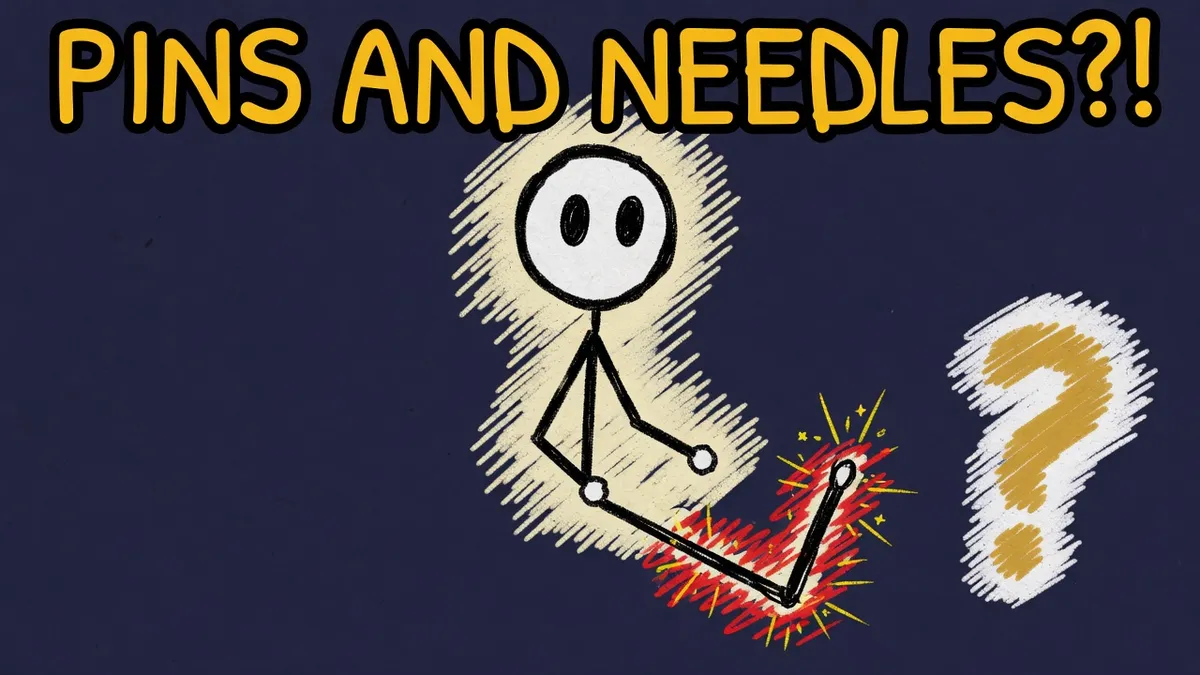
You cross your legs, sit on your foot for twenty minutes, and by the time you stand up the whole thing is dead. Not asleep in some cosy sense: numb, heavy, faintly alien, like it belongs to someone else. Then you take a step and it detonates. A fizzing, prickling, almost electric swarm crawls up from the sole, and for a few seconds you can only stand there wincing. It feels like the nerve rebooting. It is closer to the opposite: a starved nerve firing off nonsense as it scrambles back to normal.
01 · The setupYou did not cut off the blood to your foot. You strangled a nerve.
The popular version of this story is about circulation, about blood being cut off from the limb. That is only a sliver of it, and it points at the wrong organ. The thing you actually squashed is a nerve. When you fold a limb under your own body weight, the pressure lands on the nerve trunk running through that spot, and it does two unpleasant things to it at once.
First, it physically deforms the nerve: the pressure squeezes and stretches the delicate fibres and their fatty insulation, distorting the machinery that carries a signal. Second, and this is the part people miss, a nerve has its own tiny blood supply, a fine network of vessels called the vasa nervorum threaded through it to keep it fed with oxygen. Press hard enough and you pinch those vessels shut too. So the nerve is not just being crushed. It is being suffocated.
02 · The debateCrushed, or starved? Probably both.
Here is a genuine, honest wrinkle: scientists still argue about which of those two insults matters more. Is the numbness mostly the mechanical squashing of the fibres, or mostly the loss of their blood supply? The current answer is an unsatisfying but truthful “it depends.” For a brief, gentle press, ischaemia (the starvation) seems to do a lot of the early work. For a harder, longer crush, the mechanical deformation takes over and does the more serious damage.
What both mechanisms agree on is the outcome. Starve and squeeze a nerve and it stops conducting properly. The signals it is supposed to be relaying, “here is the texture of the sofa,” “here is where your foot is in space,” simply stop arriving. And crucially, they do not all stop at the same time.
03 · The dead phaseWhy touch dies first and pain hangs on
Your nerves are bundles of different fibres, and they are not equally tough. The fat, fast, heavily insulated fibres, the ones that carry fine touch, pressure and the sense of where your limb is, are surprisingly fragile under this kind of assault. They are the first to fail. The thin, slow, barely-insulated fibres that carry pain and temperature are far more resistant, and they keep working long after the others have gone quiet.
This is why a foot that has “gone to sleep” feels so strange, and why there is a party trick hidden inside it. The limb feels dead, numb, absent, because the touch channel has been cut. But if you were to pinch it hard, you would still feel that. The pain line is still open. It is a neat little demonstration that “feeling your foot” is not one sense but several, running on separate wires, that can be switched off one at a time.
The pins and needles are not the nerve waking up. They are the nerve panicking. A starved fibre, suddenly flooded with blood again, does not switch cleanly back on. It comes back overexcited and starts firing signals nobody asked for.
04 · The fizzA barrage of nonsense your brain has to read
Now the good part. You stand up, the pressure lifts, and blood rushes back into the starved nerve. You might expect the fibres to quietly resume normal service. They do the opposite. A nerve fibre keeps itself ready to fire by maintaining a careful electrical balance across its membrane, a difference in charge held in place by pumps shuffling ions in and out. Starve that fibre of oxygen and the pumps falter and the balance drifts. When the oxygen floods back, the recovering fibre is left in an unstable, hyperexcitable state, primed to fire at the slightest provocation, or at no provocation at all.
So it fires. Spontaneously, repeatedly, out of any sensible order: a phenomenon called ectopic discharge, meaning signals generated in the wrong place, from nowhere. Thousands of fibres do it at once, each pinging off its own random volley. Your brain, at the receiving end, has no way to know these are junk. It reads them the only way it can, as sensation, and the closest label it has for a chaotic scatter of firing across the skin is: prickling. Tingling. Pins and needles. The name is almost literal. It genuinely feels like tiny points because it is a fine spray of individual nerve fibres going off independently.
05 · The sequenceWhy it unfolds in that exact order
The whole episode has a choreography, and it maps neatly onto the biology. First the numbness, as the touch fibres drop out under pressure. Then, when you release, the flood of returning blood and the wave of ectopic firing, which is why the tingling arrives after you move, not before. The touch fibres, coming back online in their overexcited state, throw the classic fizz. And because some of that misfiring lands on the pain fibres too, the return can tip from a harmless prickle into something sharp and genuinely unpleasant for a few seconds. Then, as the pumps catch up and every fibre settles back to its proper resting balance, it fades, and the limb quietly becomes yours again. The order of the sensations is just the order in which your nerve fails and then recovers, played back at speed.
06 · The reassuranceYou cannot sit hard enough to do real harm
Given all that suffocating and misfiring, it is fair to worry you are damaging something. In a normal sitting or sleeping position, you almost certainly are not. To injure a nerve for real you need pressure that is both hard and unrelieved for a long stretch, and the ordinary human body has an elegant defence against exactly that: the discomfort. The tingling is unpleasant precisely so that you will shift, uncross your legs, roll over. That fidget lifts the pressure and restores the blood supply long before anything lasting happens. The pins and needles are, in effect, a safety alarm you are built to obey.
The exception proves the rule, and it has a name: Saturday night palsy. If someone drinks enough to pass out cold with an arm slung over the hard back of a chair, they can lie there for hours without the discomfort ever nagging them awake. The radial nerve, pinned against the arm bone all that time, takes a real hit, and they wake with a “wrist drop”: a hand they cannot lift. Even then the nerve is usually only blocked, not severed, and it typically recovers over weeks to a few months. It is the cautionary extreme of the everyday tingle: the same mechanism, minus the alarm that normally saves you.
07 · The warningWhen the tingle stops being harmless
So a leg that fizzes back to life in a minute is nothing to fear. It is when pins and needles stop following that script that they deserve attention. Tingling that is persistent, keeps returning for no obvious reason, or arrives with weakness or lasting numbness is a different animal, because now the nerve is not being briefly squashed by your own weight, it is being irritated or damaged by something that will not simply get up and walk away.
The list of possibilities is worth knowing without panicking over. A nerve trapped somewhere along its route, such as the median nerve at the wrist in carpal tunnel syndrome, causes recurrent tingling in a specific patch. High blood sugar over years damages the smallest nerves, and diabetic neuropathy classically shows up as tingling and numbness creeping in from the feet and hands. A vitamin B12 deficiency starves the nerves of what they need to maintain their insulation. Thyroid trouble and multiple sclerosis are on the list too. None of these announce themselves through a one-off dead foot. They show up as tingling that lingers, spreads, or brings friends. The rule of thumb is simple: if the pins and needles clear the moment you move, your body was just protecting a squashed nerve. If they do not, get them checked.
08 · The payoffSo what is a pins-and-needles, really?
It is the sound of a nerve losing its footing and finding it again. You crush and starve it, the touch fibres black out first while the pain line stubbornly stays lit, and for a while the limb is a stranger. Then you move, the blood surges back, and the recovering fibres, overexcited and out of order, spray your brain with a fine mist of signals that mean nothing at all. The tingle is your brain doing its honest best to interpret static. And the fact that it is annoying is not a bug: it is the whole reason you shifted your leg in time. A minor daily malfunction, built to fix itself, complete with a built-in alarm to make sure you let it.
Quick questions
What are pins and needles actually called?
The tingling itself is paraesthesia: an abnormal skin sensation with no outside cause. The specific version where a limb goes numb from pressure and then fizzes is sometimes called obdormition (the limb 'falling asleep') followed by paraesthesia on the way back.
Why does my foot go numb before it tingles?
Because the nerve fails in stages. Compression and the loss of blood supply knock out the large, fast touch fibres first, so the limb goes numb and dead-feeling. Only when you release the pressure and the fibres misfire on the way back do you get the tingling. Numb first, fizz second.
Why can I still feel a pinch when my foot is 'asleep'?
Because pain travels on different, thinner fibres than touch. The large myelinated fibres that carry light touch and pressure are the most vulnerable to compression and starvation, so they drop out first. The thin, slow pain fibres are more resistant, which is why a 'dead' foot can still feel a firm pinch.
Is it bad to make my arm or leg go to sleep?
A brief, normal one is not. In an ordinary sitting or lying position you cannot press hard enough, or long enough, to do lasting damage. The tingling is essentially a built-in alarm: it gets uncomfortable, so you shift, which lifts the pressure long before the nerve is genuinely harmed.
Why does it hurt when the feeling comes back?
As the nerve reperfuses, the recovering fibres are hyperexcitable and fire spontaneous, uncoordinated bursts. Some of that misfiring lands on pain fibres, so the return can range from a mild fizz to a sharp, almost electric ache. It settles as the fibres re-establish their normal resting state.
How long should pins and needles last?
A pressure-induced episode should clear within seconds to a few minutes once you move and blood flow returns. If tingling lingers for hours, keeps recurring in the same spot, spreads, or comes with weakness or numbness that does not resolve, that is no longer the harmless kind and is worth a doctor's look.
When are pins and needles a warning sign?
When they are persistent or recurrent without an obvious cause like a squashed limb, or when they come with weakness, muscle wasting, or loss of feeling. Chronic paraesthesia can point to a trapped nerve (like carpal tunnel), diabetes-related nerve damage, a vitamin B12 deficiency, thyroid problems, or multiple sclerosis, among others.
Can pins and needles be a sign of diabetes?
Yes. Persistent tingling, numbness or burning, especially starting in the feet and hands in a 'gloves and socks' pattern, is a classic sign of diabetic peripheral neuropathy from long-term high blood sugar damaging the nerves. Unlike a foot that has gone to sleep, it does not clear when you move, so it warrants testing.
Can a vitamin deficiency cause pins and needles?
It can. A vitamin B12 deficiency is a well known cause of paraesthesia, because B12 is needed to maintain the myelin insulation around nerves. Deficiencies in B6 and folate can contribute too. It is one reason doctors often check B12 when someone has unexplained, ongoing tingling.
What is Saturday night palsy?
It is the extreme version of a limb going to sleep. If someone (classically after drinking) passes out with an arm draped over a hard chair back, prolonged pressure on the radial nerve against the arm bone can cause a temporary conduction block, leaving a 'wrist drop' where they cannot lift the hand. It usually recovers on its own over weeks to months as the nerve repairs.
Why do my hands go numb when I sleep?
Often it is simple positional pressure: an arm tucked under you or a bent wrist squashing a nerve for a while, which clears on waking and moving. But hands that reliably go numb at night, especially the thumb side, can be early carpal tunnel syndrome, where the median nerve is compressed at the wrist. If it is regular, get it checked.
Does poor circulation cause pins and needles?
Circulation is part of the story but not the whole of it. The tingle from a squashed limb comes largely from cutting off the nerve's own tiny blood supply and deforming it, not from a heart or artery problem. That said, genuinely poor circulation from vascular disease can also starve nerves over time and cause tingling, which is another reason lasting symptoms deserve a check.
How do I make pins and needles go away faster?
Take the pressure off and get moving: stand up, walk, wiggle the toes or fingers, gently stretch and shake the limb. That restores blood flow and helps the misfiring nerve settle. The sensation is temporary, and there is no need to 'wait it out' motionless.
Take the quiz on this
A quick 4-question check on what you just read. Get them right to earn XP: no points for just scrolling.
Our sources 8 checked
// every claim on this page was checked before it went up