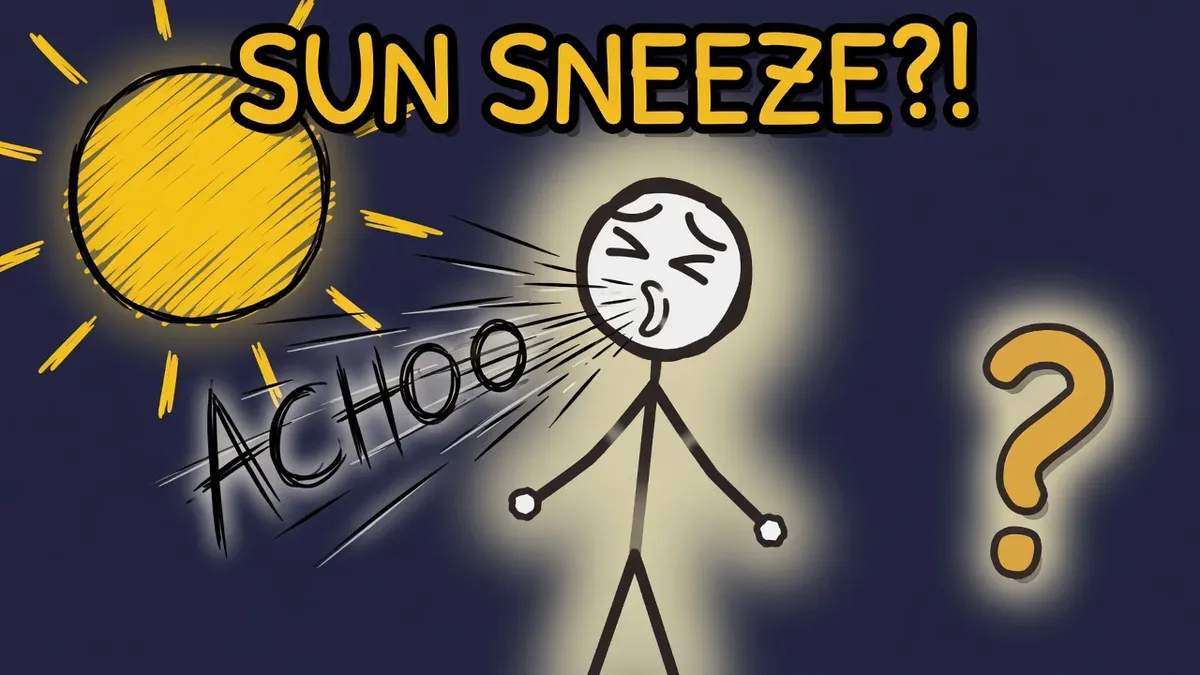
Here's a small, strange thing your body might do: step out of a dark building into bright sunshine, and before you've taken three steps, ah-choo. Not because of dust, or pepper, or the first sniffle of a cold. Because of the sun. And if this happens to you, you're in excellent company: roughly one in four people do exactly the same thing. The genuinely odd part is that, after more than two thousand years of people noticing it, nobody can tell you for certain why.
01 · The nameThe best acronym in medicine
The proper term is the photic sneeze reflex, and it has, without much competition, the greatest name in all of medicine. Doctors call it ACHOO syndrome, which officially stands for Autosomal-dominant Compelling Helio-Ophthalmic Outburst. Read that again: someone was paid, presumably at some length, to reverse-engineer a real medical term that spells “achoo.” It’s a reflex, it’s harmless, and its name is a joke that got past peer review. The rest of the story is a set of crossed wires inside your head.
02 · The old guessAristotle blamed the heat. He was wrong.
People have been baffled by this for a very long time. Aristotle wondered about it around 350 BCE, asking why the sun’s heat provokes a sneeze when the heat of a fire doesn’t, and concluded it must be the warmth, heating the nose. Clever, and completely wrong. Centuries later the philosopher Francis Bacon ran a beautifully simple experiment: he stepped into the sun with his eyes shut. The heat was still there. The sneeze was not. Which quietly demolishes the heat theory and points somewhere else entirely, to light getting into your eyes.
03 · The normal versionWhat a sneeze is actually for
To see what’s going wrong, first look at a sneeze doing its proper job. Normally it starts with something irritating the inside of your nose, dust, pepper, a stray hair. A large facial nerve called the trigeminal picks up that irritation and fires off the sneeze: a violent, involuntary blast of air to clear the intruder out. Sensible plumbing. The trigeminal is one of the big cranial nerves, and it handles sensation across your whole face. Which turns out to be exactly the problem.
04 · The crossed wireA light signal takes a wrong turn
That giant trigeminal cable runs right alongside the nerves that control your eyes and pupils. So picture what happens in bright light: your pupils slam shut, fast, sending a sudden surge of signal down that crowded bundle of wiring. In about a quarter of people, the leading idea goes, some of that signal leaks across into the sneeze circuit. Your brain gets a jolt that started in the eyes, misreads it as something is irritating the nose, and helpfully fires off a sneeze you never actually needed. This is the optical-trigeminal cross-talk hypothesis, and it’s worth being honest that it remains the best explanation rather than a proven one. What the reflex is triggered by is clearer: not heat, and not a particular colour of light, but a sudden change in brightness. Which is why calling it a “sun” reflex undersells it: a camera flash, or simply walking out of a dark room into a brightly lit one, can set it off in exactly the same way. The sun just happens to deliver the biggest, most abrupt jump you’ll meet in an ordinary day.
05 · The déjà vuIt's the same glitch as brain freeze
If this feels familiar, it should, because it’s the very same trick behind brain freeze. There, cold on the roof of your mouth travels up the trigeminal nerve and gets felt as a stab of pain in your forehead. Here, a light signal in your eyes travels the same nerve and comes out as a sneeze. In both cases one overloaded nerve simply mixes up where the signal came from and files it under the wrong department. Same cable, same wrong address. Your face, it turns out, is wired a little more like an old telephone exchange than you’d hope.
Whether you have this wiring at all isn't random, it's written into your genes, and it runs straight down family trees at roughly 50/50 per child. If the sun makes you sneeze, there's an excellent chance one of your parents does the exact same thing.
06 · The inheritanceIt's written into your genes
The photic sneeze reflex is what geneticists call autosomal dominant, which is the technical reason it clusters so neatly in families: each child of a sun-sneezer has about a 50% chance of inheriting the trait. Researchers have even started pinning down the specific markers. A large study run by the consumer-genetics company 23andMe flagged a spot on chromosome 2, a genetic variant known as rs10427255, and a later study in a Chinese population replicated it and found a second location besides. So the trait is real, heritable, and partly mapped. But here’s the caveat worth keeping: no single “sneeze gene” has been confirmed, and the precise chain of events from photon to sneeze is still unsettled.
07 · The payoffSo what is a sun-sneeze, really?
It’s not an allergy. It’s not a sign that anything is wrong. And it certainly isn’t you being strange, it’s a tiny, completely harmless crossover in the wiring of your face, an inherited quirk shared by a full quarter of humanity. Your pupils’ urgent little ow, too bright message takes a wrong turn and barges into the sneeze department, and out it comes. As far as anyone can tell, it serves no purpose whatsoever. It just happens. So the next time you step outside and the sunshine sets you off, take some comfort: a quarter of everyone alive is sneezing right there alongside you, and not one of them can tell you why either.
The animated version
Same answer, told as a little animated story with the strange little stickman acting it out. Dry, quick, and, obviously, correct.
Quick questions
What is it called when the sun makes you sneeze?
The photic sneeze reflex, nicknamed ACHOO syndrome, which stands for Autosomal-dominant Compelling Helio-Ophthalmic Outburst. Someone genuinely engineered a medical acronym that spells "achoo."
Why do only some people sneeze in sunlight?
Because it's a genetic trait. It's inherited as autosomal dominant, meaning if one of your parents is a sun-sneezer, you have roughly a 50% chance of being one too. If you sneeze in the sun, there's an excellent chance a parent does exactly the same.
Is sneezing in sunlight caused by heat?
No. Aristotle guessed it was the sun's heat around 350 BCE, but Francis Bacon disproved that by stepping into the sun with his eyes closed: the heat was still there, but the sneeze wasn't. It's about a sudden increase in light reaching your eyes, not warmth.
Is the photic sneeze reflex dangerous or a sign of illness?
No. It isn't an allergy and it isn't a symptom of anything wrong. It's a harmless quirk of nerve wiring with no known downside. The main practical caution is that it can be a nuisance for pilots or drivers emerging into bright light.
How common is sneezing in sunlight?
Estimates vary quite a bit: studies put it somewhere between about 11% and 35% of people, which is why it's often rounded to "1 in 4." A large study in a Chinese population found around 25.6%.
Can you stop yourself sneezing in sunlight?
There's no cure, but you can soften the trigger. Because it's the sudden jump in brightness that sets it off, easing the transition helps: putting on sunglasses (polarised or photochromic lenses especially) or a wide-brimmed hat before you step out can head it off. Some people find pressing on the philtrum, the little groove between nose and top lip, aborts a building sneeze. Antihistamines don't help, because it isn't an allergy.
Why do I sneeze when I look at a bright light, not just the sun?
Because the reflex responds to a sudden increase in light of any kind, not sunlight specifically. A camera flash, walking into a brightly lit room from a dark one, even surgical lighting can set it off in people who have it. The sun is just the most common everyday version, because the dark-to-bright jump outdoors is so large and so abrupt.
How many times do you sneeze when the sun sets you off?
Usually two or three, but it varies a lot person to person: some manage a single sneeze, others fire off ten or more in a burst. Curiously, the number tends to be fairly consistent for a given individual and even runs in families, which fits with the reflex being genetic.
Is it safe to look at the sun to make yourself sneeze?
The sneeze itself is harmless, but deliberately staring at the sun to trigger it is not. Staring into the sun can burn the retina (solar retinopathy), and there are documented cases of permanent vision loss in people who sun- or laser-stared specifically to force a photic sneeze. If you want the sneeze out, glance toward bright light; never fix your eyes on the sun.
Can the photic sneeze reflex be dangerous for drivers or pilots?
It can be a genuine nuisance at the wrong moment. Because a sneeze forces your eyes shut, a burst triggered by sudden glare, emerging from a tunnel, or a fighter pilot rolling toward the sun, has been flagged as a real safety concern in both driving and military aviation. For everyday life it's trivial; in split-second situations it's worth knowing about.
Can children have it, and does it ever go away?
It's congenital, present from birth and inherited, not something you catch. People who have it have usually had it as far back as they can remember, with onset in childhood, and it generally sticks around for life. So a sun-sneezing kid is very likely a sun-sneezing adult; it doesn't tend to fade away.
What is the photic sneeze reflex called?
It is often nicknamed ACHOO syndrome (autosomal dominant compelling helio-ophthalmic outburst). Roughly one in four people sneeze when they look at bright light, and it tends to run in families.
Is it safe to stare at the sun to make yourself sneeze?
No. Deliberately staring at the sun or a laser can cause photic retinopathy and permanent macular damage. Case reports describe vision loss in people who did exactly that to trigger the reflex. Use ordinary bright light, not the solar disc.
Take the quiz on this
A quick 4-question check on what you just read. Get them right to earn XP: no points for just scrolling.
Our sources 15 checked
// every claim on this page was checked before it went up