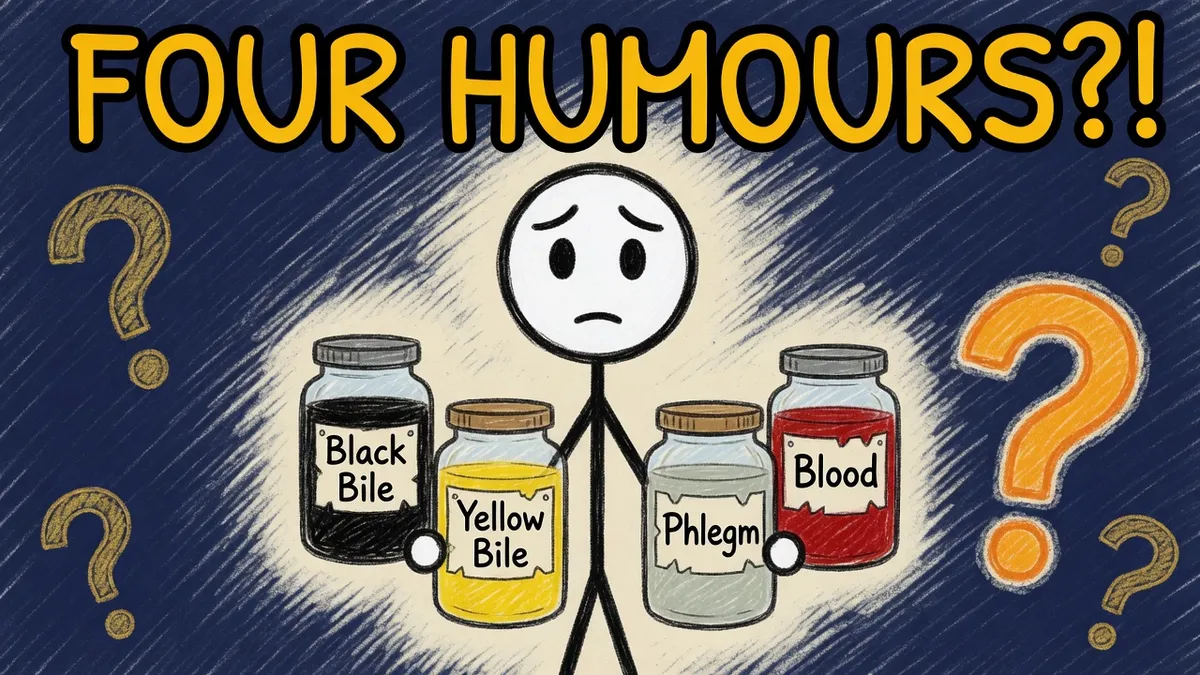
Here is an uncomfortable thought about being wrong. The four humours, the idea that your body and your very personality were governed by the balance of four fluids, was not a superstition scrawled in the margins of history. It was the best medical science available, taught in the finest universities, practised by the most respected physicians, for roughly two thousand years. It was coherent. It was teachable. It made predictions. And it was, from top to bottom, completely wrong. The unsettling part is not that people believed it. It is why they believed it for so long: because it explained absolutely everything.
01 · The systemFour fluids that ran the whole world
The theory was beautiful, in the way a wrong theory is allowed to be. Health, it held, was a balance of four bodily fluids: blood, phlegm, yellow bile and black bile. Too much or too little of any one, and you fell ill. That is the whole engine.
But the reason it captured minds for millennia is what got bolted on next. Each humour was paired with a pair of qualities, hot or cold, wet or dry. Blood was hot and wet, phlegm cold and wet, yellow bile hot and dry, black bile cold and dry. And those qualities let the humours slot neatly onto everything else the ancient world was already sorting into fours. The four elements: air, water, fire, earth. The four seasons: spring, winter, summer, autumn. The four ages of a human life. It all lined up. A single framework that connected your runny nose to the turning of the year to the fabric of the cosmos. Once you have a system that tidy, it is very hard to believe it could be false.
02 · The foundersFrom Hippocrates to Galen's word as law
The idea grew out of the Hippocratic writers in Greece around 400 BC, and their real contribution was quietly radical: they moved illness out of the hands of the gods. Disease was not a curse or a punishment, it was a natural imbalance of fluids, something in the body, with natural causes. That was a genuine step forward, even if the specifics were wrong.
Then, some six centuries later, came Galen. The Roman physician took the loose Hippocratic idea and built it into a total, closed system: a full account of anatomy, physiology, personality and treatment, all resting on the humours. And here is the thing that mattered most. Galen’s authority became near-absolute. For more than a thousand years, across Europe and the Islamic world, to study medicine was largely to study Galen. His writings were treated as something close to scripture. And a theory you are not allowed to question is a theory that cannot be corrected.
03 · The treatmentsThe logic that killed people
If illness is an excess of a humour, the cure writes itself: get the excess out. And that is exactly what physicians did, for centuries, with grim consistency. Too much blood? Open a vein and drain some. This was bloodletting, and it was the workhorse of Western medicine, applied to fevers, headaches, infections, almost anything. Where the vein was too crude, leeches did the job. For the other humours there was purging, drugs to force vomiting or empty the bowels, and cupping, heated glass cups on the skin to draw fluid to the surface.
The terrible elegance is that all of it followed logically from the theory. Nobody was being reckless. They were being rigorous, applying a coherent framework with care. The framework was simply wrong, and so the more faithfully you followed it, the more harm you could do. Draining blood from a sick, weak person is close to the last thing you want to do, and it was done, as a matter of best practice, to countless people for over a thousand years.
04 · The famous caseGeorge Washington, bled on his deathbed
The clearest illustration is also one of the most famous deaths in American history. In December 1799, George Washington woke with a severe throat infection, so swollen he was struggling to breathe. His physicians did what the best medicine of the day demanded: they bled him. Repeatedly. Over the course of roughly half a day, they drained a very large volume of his blood.
Exactly how much is genuinely uncertain, and the sources disagree, so it is worth hedging. A commonly cited figure is around 40% of his total blood volume, on the order of 80 ounces, with some accounts putting the total even higher. Whatever the precise number, it was an enormous amount to take from a man already dying. He was gone by that night. Historians still argue over how much the bleeding hastened the end versus the infection that would likely have killed him anyway. But the modern verdict is blunt: draining that much blood from a failing patient did not help, and very probably hurt.
05 · The illusionWhy it felt like it worked
Here is the real puzzle. If the treatments were useless or harmful, why did generations of intelligent, careful doctors keep believing they worked? Because almost any treatment looks effective, thanks to a handful of ordinary effects stacking up.
Start with the biggest: most illnesses get better on their own. Treat a self-limiting cold with bloodletting, and the recovery arrives on schedule, looking like a cure. Then add regression to the mean: people seek help when they feel their absolute worst, and “worst” is not where you stay, so you were likely to improve next no matter what was done to you. Layer on the placebo effect, a real, measurable improvement that comes simply from believing you are being treated. And finish with confirmation bias: a physician remembers the patients who recovered and credits the treatment, while the ones who died are explained away as too far gone. Put those four together and a completely inert remedy will feel reliably, obviously curative. The humours did not need to be right to feel right.
Notice what black bile actually is: nothing. There is no such fluid in the human body. It was invented to complete the pattern of four, and for two thousand years nobody could tell, because a theory that explains everything cannot be caught out by anything.
06 · The slow fallAnatomy, then circulation, then counting
The humours did not collapse in a single dramatic moment. They were chipped away. In 1543, Andreas Vesalius published his great anatomy and corrected around three hundred of Galen’s errors simply by dissecting actual human bodies instead of trusting the master. In 1628, William Harvey worked out how blood really moves, circulating in a loop pumped by the heart, which quietly demolished the Galenic picture of how the body worked.
But the decisive blow was the least glamorous, and it is the heart of this whole story. In the 1830s, a French physician named Pierre Charles Alexandre Louis did something almost nobody had thought to do: he counted. He gathered groups of pneumonia patients, some bled early, some bled later, and tallied who lived and who died. Bleeding did not help. The patients bled early fared no better, and if anything slightly worse. His “numerical method”, trusting the aggregate tally over any doctor’s personal impression, is one of the direct ancestors of the modern clinical trial. Germ theory later in the 1800s finished the job by giving disease real, testable causes. But it was the counting that first caught the theory in the act.
07 · The fossilsThe theory is still in your mouth
You use this dead theory every day without noticing. Call someone sanguine and you are saying they have plenty of blood, the cheerful humour. Phlegmatic? Ruled by phlegm, calm and slow. Choleric is too much yellow bile, quick to anger. Melancholic is, literally, “black bile”, the gloomy one. Even saying someone is in a “good humour” or a “bad humour” is a direct fossil of the belief that your mood was set by the balance of your fluids. The medicine is gone, but its vocabulary is welded permanently into how we describe each other.
08 · The payoffWe didn't get smarter. We started counting.
So here is the twist worth taking home. The four humours were not the product of stupid people. Given no microscopes, no germ theory and no statistics, they were a genuinely reasonable, internally consistent, teachable framework that made predictions and moved medicine away from the supernatural. Their fatal flaw was not that they were dumb. It was that they explained everything, which meant nothing could ever prove them wrong. A theory that can account for any outcome is a theory that can never be caught being false.
And that tells you exactly how we escaped, and it is humbling. We did not get cleverer than Galen. Louis was not smarter than the thousands of brilliant physicians who came before him. He just did the one thing the elegant, all-explaining system had made to feel unnecessary for two thousand years: he stopped trusting the story, and he started counting the bodies. That is the whole difference between medicine that kills you politely and medicine that works. Not genius. Arithmetic.
Quick questions
What were the four humours?
Four bodily fluids that were believed to govern health and character: blood, phlegm, yellow bile and black bile. Good health meant they were in balance; illness meant one was in excess or deficit. Each humour was also paired with two qualities (hot or cold, wet or dry), one of the four classical elements, a season, and a stage of life.
Who invented the theory of the four humours?
It grew out of the Hippocratic writers in Greece around 400 BC, who framed disease as an imbalance of bodily fluids rather than a punishment from the gods. Some centuries later the Roman physician Galen (around 129 to 216 AD) systematised it into a complete account of the body, personality and treatment, and it was mostly his version that Europe and the Islamic world inherited.
How did the humours map onto the elements and seasons?
Blood was hot and wet, tied to air and spring. Yellow bile was hot and dry, tied to fire and summer. Black bile was cold and dry, tied to earth and autumn. Phlegm was cold and wet, tied to water and winter. The neatness was part of the appeal: everything lined up in fours.
Does black bile actually exist?
No. There is no bodily fluid that corresponds to 'black bile'. It was a theoretical construct needed to complete the fourfold pattern. Practitioners may have been seeing real dark substances (clotted blood, or dark blood and stool from internal bleeding) and slotting them into the theory, but no such circulating humour exists in human physiology.
Why was bloodletting so common?
It followed logically from the theory. If illness was too much of a humour, especially too much blood, the obvious fix was to remove some. So doctors opened a vein, applied leeches or used cupping to draw fluid out. It was standard practice for a vast range of conditions for well over a thousand years, and for most of them it did nothing useful and often did harm.
Did bloodletting kill George Washington?
It very probably contributed. In December 1799 Washington developed a severe throat infection and his physicians drained a large volume of his blood over the course of a day. Estimates of the amount vary between sources, but many put it at roughly 40% of his blood volume. He died the same night. Historians debate how much the bleeding hastened his death versus the underlying infection, but draining that much blood from a dying man is now seen as, at best, no help.
Is bloodletting ever used in medicine today?
Yes, but rarely and for specific reasons, not to balance humours. Controlled blood removal (phlebotomy) genuinely treats a few conditions where the body has too much iron or too many red blood cells, such as haemochromatosis and polycythaemia vera. Medicinal leeches are still occasionally used in reconstructive surgery to relieve congested blood in reattached tissue. Those are narrow, evidence-based uses, not the cure-all of humoral medicine.
If the theory was wrong, why did it seem to work?
Several ordinary effects conspire to make almost any treatment look effective. Most illnesses get better on their own. People tend to seek treatment when they feel worst, so they were likely to improve afterwards no matter what (regression to the mean). Belief in the treatment produces a real placebo effect. And doctors remembered the recoveries and explained away the deaths (confirmation bias). Put together, a useless remedy can feel reliably curative.
What is regression to the mean?
It is the statistical tendency for an extreme measurement to be followed by a more average one. People usually go to the doctor at their worst, so they are likely to feel better next, simply because 'worst' is not a stable state. If a treatment is given at that low point, the natural rebound gets credited to the treatment. It is one of the biggest reasons ineffective remedies feel like they work.
Why did the theory survive for so long?
Because it was coherent, complete and backed by authority. It could explain any illness and any personality, which made it feel powerful but also meant almost nothing could ever prove it wrong. Galen's status turned his writings into near-scripture for over a thousand years, so questioning the humours meant questioning the entire foundation of educated medicine.
When did the four humours theory finally collapse?
It eroded gradually from the 1500s onward. Vesalius corrected Galen's anatomy in 1543, Harvey described the true circulation of the blood in 1628, and in the 1830s Pierre Louis used statistics to show bloodletting did not help pneumonia. Germ theory in the later 1800s finished it off by giving real, testable causes of disease. There was no single day it died, but by the late 19th century it was gone from serious medicine.
What did Pierre Louis actually prove?
The French physician Pierre Charles Alexandre Louis compared groups of pneumonia patients and counted outcomes. Bleeding them early in the illness did not improve survival, and if anything the early-bled patients fared worse. His 'numerical method', tallying results across matched patients instead of trusting individual impressions, is one of the ancestors of the modern clinical trial. Counting, not cleverness, is what exposed the error.
Why do we still say 'sanguine' and 'melancholic'?
They are fossils of the theory. Each temperament was named for the humour thought to dominate it: sanguine (blood, cheerful), phlegmatic (phlegm, calm), choleric (yellow bile, quick-tempered) and melancholic (black bile, gloomy). Even 'in a good humour' and 'bad humour' come straight from the idea that your mood was set by your fluid balance.
Were the four humours just stupid, then?
No, and that is the interesting part. Given what people could observe without microscopes, germ theory or statistics, humoral medicine was a reasonable, internally consistent framework. It shifted disease from the supernatural to the natural, it was teachable, and it made predictions. Its fatal flaw was not stupidity but that it could not be tested, and so it stayed wrong for a very long time.
Take the quiz on this
A quick 4-question check on what you just read. Get them right to earn XP: no points for just scrolling.
Our sources 10 checked
// every claim on this page was checked before it went up