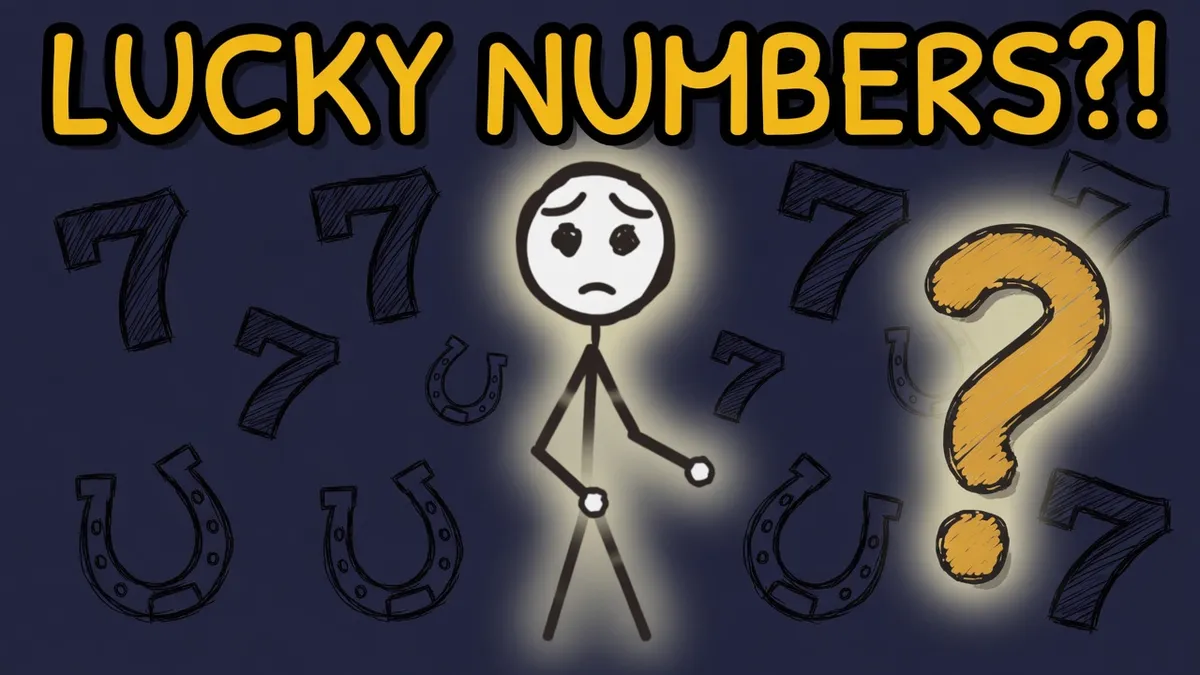
Here is the awkward thing about lucky numbers: almost nobody actually believes in them, and almost everybody uses them anyway. Ask someone straight out whether 7 is magic and they'll laugh. Then watch them pick 7 on the lottery slip, request a hotel room without a 4 in it, or refuse to change out of the shirt they were wearing when their team last won. The belief lives below the level you'd defend out loud. And the reason it's there at all turns out to be one of the more flattering things about the human brain, not one of the more embarrassing.
01 · The itchWhat a superstition is actually for
Start with the feeling underneath. A lucky number isn’t really about the number. It’s about control, or rather the lack of it. When an outcome matters to you and you genuinely can’t influence it (the dice, the exam result, the flight, the diagnosis), your brain does not enjoy sitting there empty-handed. So it reaches for the one thing it can do: perform a small ritual. Touch wood. Cross your fingers. Pick the number. The ritual does nothing to the world, but it does something to you, it hands back a sense of agency you’d just lost. Superstition, in other words, is not the opposite of rational control-seeking. It’s control-seeking with nowhere useful to point.
02 · The pigeonsHow coincidence builds a ritual
The cleanest demonstration of how this gets started involves no humans at all. In 1948, B. F. Skinner put hungry pigeons in boxes that dropped food at fixed intervals, completely regardless of what the bird did. There was no way to earn the food. And yet the pigeons developed elaborate private rituals anyway: one turned counter-clockwise between feedings, another repeatedly thrust its head into a corner, another swung its head like a pendulum. The logic was brutally simple. Whatever a bird happened to be doing when the food arrived got reinforced, so it did more of it, which made it more likely to be doing that when the next pellet dropped. Skinner called it “superstitious” behaviour: a ritual built entirely out of coincidence, from a reward that was never actually earned.
Now, honesty check: later researchers (Staddon and Simmelhag in 1971) argued Skinner somewhat oversold it, that a lot of what the pigeons did was generic restless behaviour the feeding schedule induced, not neatly personal rituals. So the textbook story is a little tidier than the data. But the core insight survives the correction, and it’s the load-bearing one: a brain that links “what I was doing” to “the good thing that followed” will manufacture superstitions out of pure noise, no magic required.
03 · Losing the wheelWhy control-loss makes you see patterns
Humans add a second ingredient the pigeons lack: we’re relentless pattern-finders, and that machinery seems to spin faster when we feel out of control. In a much-cited 2008 paper in Science, Jennifer Whitson and Adam Galinsky made people feel a loss of control, then showed they were more likely to see patterns in randomness: images in visual static, phantom correlations in noise, conspiracies in unrelated events, and, yes, superstitions. The proposed loop is neat. Feeling out of control makes you hunt harder for structure; finding “structure” (even fake structure) restores the feeling of control; so the superstition pays a psychological dividend even when it’s completely made up.
It’s a lovely idea, and I want to be straight with you about it: the specific effect has a mixed replication record. Some follow-up attempts reproduced it only weakly or partially. So treat this as a plausible, influential account rather than bedrock. The direction of travel, that uncertainty breeds pattern-seeking, is well supported. The exact, crisp lab effect is on shakier ground than its fame suggests.
04 · The charm that "works"Where believing changes the outcome
Here’s the finding that made headlines, and it’s worth telling carefully because it’s a case study in how science self-corrects. In 2010, Lysann Damisch and colleagues reported something startling: activating a superstition actually improved performance. Tell people the golf ball they were using was a “lucky” ball and their putting success jumped from around 48% to around 65%. Similar boosts showed up in dexterity, memory and word puzzles. The proposed mechanism wasn’t magic, it was confidence: the charm raised people’s belief that they could do it, so they set higher goals and persisted longer. The number does nothing; the believing does the work.
That beautiful result largely did not replicate. Independent, pre-registered, high-powered redos (including a big 2020 effort) found the effect close to zero. So the seductive headline, "lucky charms make you better," is now genuinely contested, and you should not bank on it.
So where does that leave us? Roughly here: the idea that confidence and a calm, familiar routine can steady performance is uncontroversial. That’s why athletes’ rituals persist. But the strong, clean “give someone a lucky charm and watch their skill jump” effect failed the replication test. A hedged-true statement beats a confident-wrong one, so the honest version is: believing may buy you a little poise, but the flashy original number was almost certainly too good to be true.
05 · Why everyone picks 7The most "random" number
If numbers were neutral, asking people to pick one from 1 to 10 would give you an even spread, about 10% each. It doesn’t. People swarm to 7. A YouGov survey found roughly a third of respondents chose it, and the reason is almost comically mechanical. Asked for a “random” number, people rule things out: 1 and 10 feel too obvious (they’re the ends), even numbers feel too neat, 5 sits too smugly in the middle, and 7 is the one left standing that feels the most arbitrary and least gameable. So it gets over-picked, which quietly feeds the myth that there’s something special about it. There isn’t. It’s just the number that best impersonates randomness, and we mistake that for magic.
06 · The unlucky and the priceless13, 4, and the price of a name
The dark side of lucky numbers is where the belief stops being cute and starts moving money and concrete. Take 13. Whatever its origin (13 at the Last Supper, or just the sense that it “spoils” the tidy dozen), the fear is real enough that buildings physically dodge it: the floor is there, but it gets relabelled, so you step from 12 to 14. By one industry estimate around 85% of a major elevator maker’s taller buildings have no floor called 13.
Then there’s the East Asian case, which is even more direct because it’s built on sound. In Mandarin, four (四, sì) is a near-homophone of death (死, sǐ), and the same eerie match holds in Japanese, Korean and Vietnamese. So 4 gets skipped in lifts, hospital floors and product packs, while 8 (八, bā), which sounds like prosperity (發, fā), gets prized. And this isn’t just talk. When economists studied around 117,000 Vancouver house sales, they found that in neighbourhoods with above-average ethnic-Chinese populations, homes with addresses ending in 8 sold at about a 2.5% premium and those ending in 4 at about a 2.2% discount. Same bricks, same street, different final digit, real difference in price. The number changes nothing physical. The belief prints a number on a cheque.
07 · Due or hotThe gambler's fallacy is the same machine
The lucky-number instinct and the roulette table run on identical wiring: a brain insisting that random streaks mean something. The gambler’s fallacy is the feeling that after a run of reds, black is somehow “due.” It isn’t. The wheel has no memory; each spin is its own coin flip. The most famous casualty is Monte Carlo in 1913, when the ball landed on black 26 times in a row and gamblers hurled fortunes onto red, certain the streak had to break. The odds never moved a millimetre.
Its twin is the “hot hand,” the belief that a streak will continue, that a player who’s hit five shots is on fire. For decades this was the textbook example of a cognitive illusion, after a famous 1985 study said the hot hand didn’t exist. Except here’s the honest twist: a 2018 reanalysis found that a subtle counting bias had been hiding a small, genuine effect all along, so a real hot hand may sometimes exist after all. Two beliefs, one machine: your brain reading a story into randomness, and only sometimes right by accident.
08 · The payoffThe number does nothing, the believing does
So why do we believe in lucky numbers? Because belief in them is what you get when you combine two genuinely useful brain habits, hunting for patterns and reaching for control, and point them at something you can’t actually influence. The ritual can’t touch the outcome. But it can touch you: it can calm your nerves, steady your hands, and hand back a feeling of agency in a moment that stole it. That small, real, internal effect is precisely why the belief refuses to die. Every time the ritual seems to “work,” your brain files the hit and quietly loses the misses. The number 7 will never once change a die, a wheel, a diagnosis or a putt. But believing it might, apparently, changes the only thing it ever could: the person holding it. And in a universe this indifferent, that turns out to be just enough of a payoff to keep the whole lovely, useless habit alive.
The animated version
Same answer, told as a little animated story with the strange little stickman acting it out. Dry, quick, and, obviously, correct.
Quick questions
Why is 7 considered lucky?
Partly culture (seven days, seven seas, seven wonders, it turns up everywhere in myth and religion), and partly maths. When people are asked to pick a 'random' number from 1 to 10, they avoid the ends (too obvious), the evens (too patterned) and 5 (too central), which leaves 7 feeling like the most arbitrary, least gameable choice. So it gets picked far more than its fair 10% share, which quietly reinforces the sense that it's special.
Why is 13 unlucky?
There's no single origin, and that's telling. The usual suspects are 13 guests at the Last Supper, and the sense that 13 'spoils' the tidy dozen (12 months, 12 hours, 12 zodiac signs). Whatever the root, the fear has a name, triskaidekaphobia, and real teeth: by one industry estimate around 85% of tall buildings with a certain elevator brand skip a floor labelled 13.
Do buildings really skip the 13th floor?
Often, yes. It's not that the floor is missing, it's that the 13 gets relabelled (you go from 12 straight to 14, or it becomes 12A). Otis, the elevator company, has estimated that a large majority of its taller buildings have no floor called 13. Hotels do it too. The floor is physically there. The number just isn't.
Why do Chinese and Japanese cultures avoid the number 4?
Because it sounds like death. In Mandarin the word for four (四, sì) is nearly a homophone for the word for death (死, sǐ), and the same near-match holds in Japanese, Korean and Vietnamese. The aversion even has a name, tetraphobia. Lifts and hospital floors skip 4, phone numbers and addresses with 4s are less wanted, and products sometimes aren't sold in packs of four.
Why is 8 lucky in China?
Because eight (八, bā) sounds like the word for prosperity or wealth (發, fā). The association is strong enough to move money: 'lucky' number plates and phone numbers loaded with 8s fetch large premiums at auction, and the Beijing Olympics opening ceremony began at 8:08 pm on 8/8/08. It is the flip side of the same sound-based logic that makes 4 unlucky.
Do lucky numbers actually affect house prices?
Measurably, yes. A study of roughly 117,000 Vancouver home sales found that in neighbourhoods with above-average ethnic-Chinese populations, homes with addresses ending in 8 sold at about a 2.5% premium and those ending in 4 sold at about a 2.2% discount, versus other numbers. The belief does nothing to the bricks. It does plenty to the price.
Does a lucky charm actually improve your performance?
This is genuinely contested. A well-known 2010 study reported that activating a lucky charm improved golf putting and dexterity, apparently by boosting confidence. But a large, pre-registered 2020 replication of the same idea found effects close to zero. So the honest answer is: maybe a small confidence effect exists in some settings, but the strong original result did not hold up, and you shouldn't count on it.
Is being superstitious a sign of low intelligence?
No. Superstition isn't a failure of reasoning so much as a side effect of two things every healthy brain does well: hunting for patterns, and craving a sense of control. Highly rational people hold lucky rituals too, often while knowing full well they 'shouldn't work'. The belief runs on a faster, older track than deliberate logic.
What is the gambler's fallacy?
It's the false feeling that a run of one outcome makes the opposite 'due'. After five reds on a roulette wheel, black feels overdue, but the wheel has no memory: each spin is still roughly 50/50. In 1913 at Monte Carlo the ball landed on black 26 times in a row, and gamblers lost fortunes piling onto red, certain it had to break. The odds never budged.
Is the 'hot hand' the same thing as the gambler's fallacy?
They're close cousins: both are your brain reading a streak in randomness. The gambler's fallacy expects a streak to reverse; the hot-hand belief expects it to continue. Interestingly, the hot hand isn't purely a myth: after a famous 1985 paper called it an illusion, a 2018 reanalysis showed a subtle counting bias had hidden a small real effect in sports. So the machinery is the same, but the hot hand may sometimes track something real.
Why do we get superstitious specifically when we feel out of control?
Because rituals are a way to buy back a feeling of control you've lost. When an outcome matters and you can't influence it, doing something, touching wood, wearing the shirt, picking the number, restores a sense of agency. Research suggests losing control also nudges people to see patterns and meaning in noise, which is fertile ground for a superstition to take root.
Do athletes really have pre-game rituals for a reason?
Their rituals are extremely common, and they may genuinely help, but probably not the way the athlete thinks. The likely mechanism is psychological: a familiar routine lowers anxiety and boosts confidence going into a high-pressure moment, which can steady performance. The specific charm or sequence is arbitrary. The calm and focus it produces are not.
Can believing in luck ever be harmful?
It can. Mostly it's harmless or even mildly useful (a confidence prop), but the same machinery drives the gambler's fallacy that empties bank accounts, and lottery play built on a 'lucky' number. And a belief that outcomes hinge on rituals rather than actions can, taken far enough, shade into anxiety. The trick is enjoying the ritual without outsourcing your decisions to it.
Why do superstitions survive if they don't work?
Because they don't need to work on the world to survive: they only need to occasionally seem to. Your brain remembers the hits and quietly forgets the misses, so the ritual keeps 'earning' credit it didn't deserve. And because it can genuinely calm you, it delivers a small real benefit that keeps you doing it. The number is useless. The believing isn't, and that's enough.
Take the quiz on this
A quick 4-question check on what you just read. Get them right to earn XP: no points for just scrolling.
Our sources 13 checked
// every claim on this page was checked before it went up